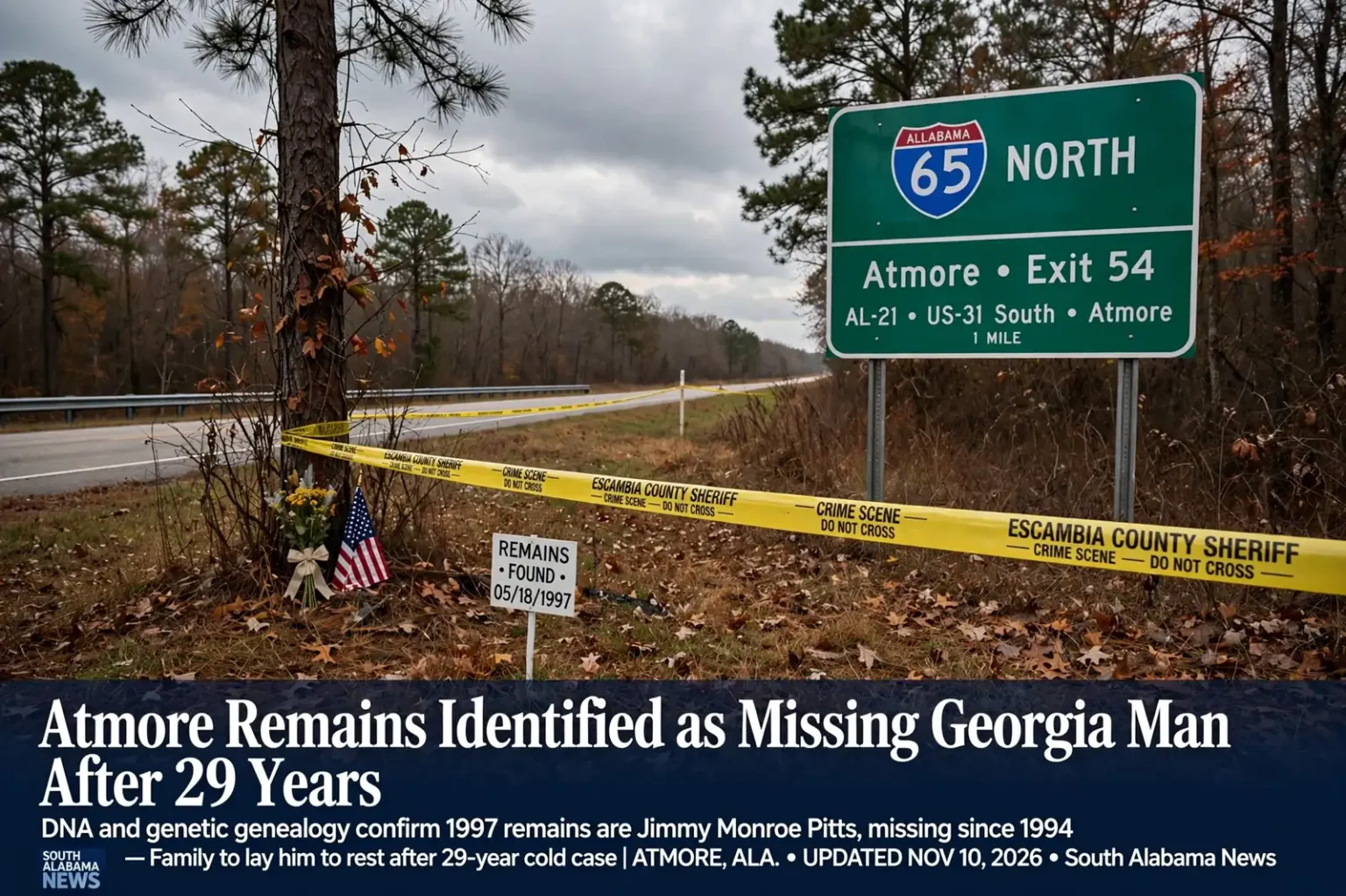
ATMORE, Ala. — A man whose skeletal remains lay unidentified for nearly three decades after they were discovered beside Interstate 65 now has his name back. The Escambia County Sheriff’s Office announced on Tuesday, Nov. 10, that the Atmore remains identified through modern DNA work belong to Jimmy Monroe Pitts, a Georgia man born Feb. 21, 1953, who had been reported missing from his home state.
The identification closes one of the county’s longest-running unanswered questions and gives Pitts’ surviving siblings the chance to bring him home. The sheriff’s office said its investigation has concluded and that there is no evidence of foul play.
Who Jimmy Monroe Pitts Was
Pitts disappeared in October 1994 after setting out for the lake at West Point, Georgia, a community on the Chattahoochee River near the Alabama state line. How he came to be in south Alabama is still not fully understood. The last known sighting placed him near his car along I-65, where a state trooper saw him.
Roughly two and a half years later, on May 18, 1997, skeletal remains were found near the interstate in Atmore. Pitts would have been 44 years old at the time. Had he lived, he would be 73 today.
His parents never learned what happened to him. His mother died in 2007, and his father died in 2009. A sister and a brother are still living, and his remains are expected to be returned to the family so he can be buried alongside his parents.
Why the Case Stalled for So Long
When the remains were recovered in 1997, investigators had little to work with. The sheriff’s office said the condition of the remains, combined with the limits of forensic science at the time, made identification impossible despite repeated efforts over the years.
In the late 1990s, DNA testing typically required a relatively well-preserved sample and a known person to compare it against. Skeletal remains that have been exposed to the elements often yield only small or degraded amounts of genetic material, and without a likely name, investigators had no family members to test. Cases like this frequently end up classified as unidentified, with the file kept open in hopes that science will catch up.
Atmore Remains Identified Through Genetic Genealogy
The turning point came in 2020, when a crime scene investigator with the Escambia County Sheriff’s Office took a fresh look at the case. That renewed effort brought in several outside forensic organizations to attempt more advanced DNA testing.
Success did not come quickly. After multiple laboratory extractions failed, DNA Labs International managed in 2025 to obtain and sequence usable DNA from the remains. That genetic profile opened the door to forensic genetic genealogy, a technique that has reshaped cold case work over the past decade.
Moxxy Forensic Investigations, a nonprofit organization that uses public DNA databases to help solve cold cases, took on the genealogical research. Its researchers compared the profile with people who had voluntarily shared their DNA in public genealogy databases, then built out family trees for the relatives who matched. Within 12 days, the work narrowed down where the unknown man fit within a family.
The family tree research led researchers to an old newspaper notice in which Pitts’ sister had pleaded for help finding her missing brother. In August 2026, Moxxy Forensic Investigations identified Pitts as a potential match.
Confirming the Match
A genealogical lead is not the same as a confirmed identification. To be certain, investigators from the Escambia County Sheriff’s Office traveled to Georgia and collected a DNA reference sample from Pitts’ sister. DNA Labs International then compared that sample with the profile from the remains, and the results provided the scientific evidence needed to establish his identity.
The sheriff’s office noted that investigative work does not always deliver quick answers, and it credited the persistence of its personnel for staying with the case. Officials said the most meaningful result is that, after nearly 30 years, Pitts’ family finally has answers.
A researcher who worked on the genealogy said the effort had been a long one and that being able to restore his name carried deep personal significance.
A Team Effort Behind the Identification
The sheriff’s office thanked a number of partners whose contributions made the identification possible:
- DNA Labs International, for extracting and sequencing the DNA and performing the final family comparison.
- Moxxy Forensic Investigations, for its genetic genealogy research.
- The Cold Case Coalition, which provided financial support for the work.
- A Brewton dentist, who helped obtain critical dental evidence.
- A genealogy researcher whose assistance helped advance the investigation.
Advanced DNA testing and genealogy research can be expensive, and outside funding often determines whether smaller agencies can pursue it. Nonprofit support has become a common way for rural sheriff’s offices to move long-dormant cases forward.
Genetic Genealogy and Cold Cases
Forensic genetic genealogy combines traditional DNA analysis with family history research. Instead of searching only law enforcement databases, which contain profiles of people previously arrested or convicted, the method looks for distant relatives in consumer genealogy databases where users have agreed to allow law enforcement matching. Genealogists then use public records such as birth, marriage and death records, obituaries and archived newspapers to build family trees until a likely candidate emerges.
The technique has been used across the country to identify both crime suspects and unidentified remains. In cases like this one, it is often the only realistic path to a name, because the person was never in any criminal database and no one locally knew to look for him.
The U.S. Department of Justice’s National Missing and Unidentified Persons System, known as NamUs, serves as a national clearinghouse for missing and unidentified person cases and is a resource for families still searching for loved ones.
Closure for a Family After Nearly 30 Years
For the Escambia County Sheriff’s Office, the case is now closed. For Pitts’ brother and sister, it marks the start of a long-awaited chance to lay him to rest with their parents.
Atmore sits along I-65 in Escambia County near the Florida line, and the interstate corridor carries travelers from across the Southeast. The case is a reminder that people reported missing in one state may be found far from home, and that modern forensic tools can reconnect them with their families years later.
Follow more Escambia County news and crime coverage from across South Alabama on South Alabama News.