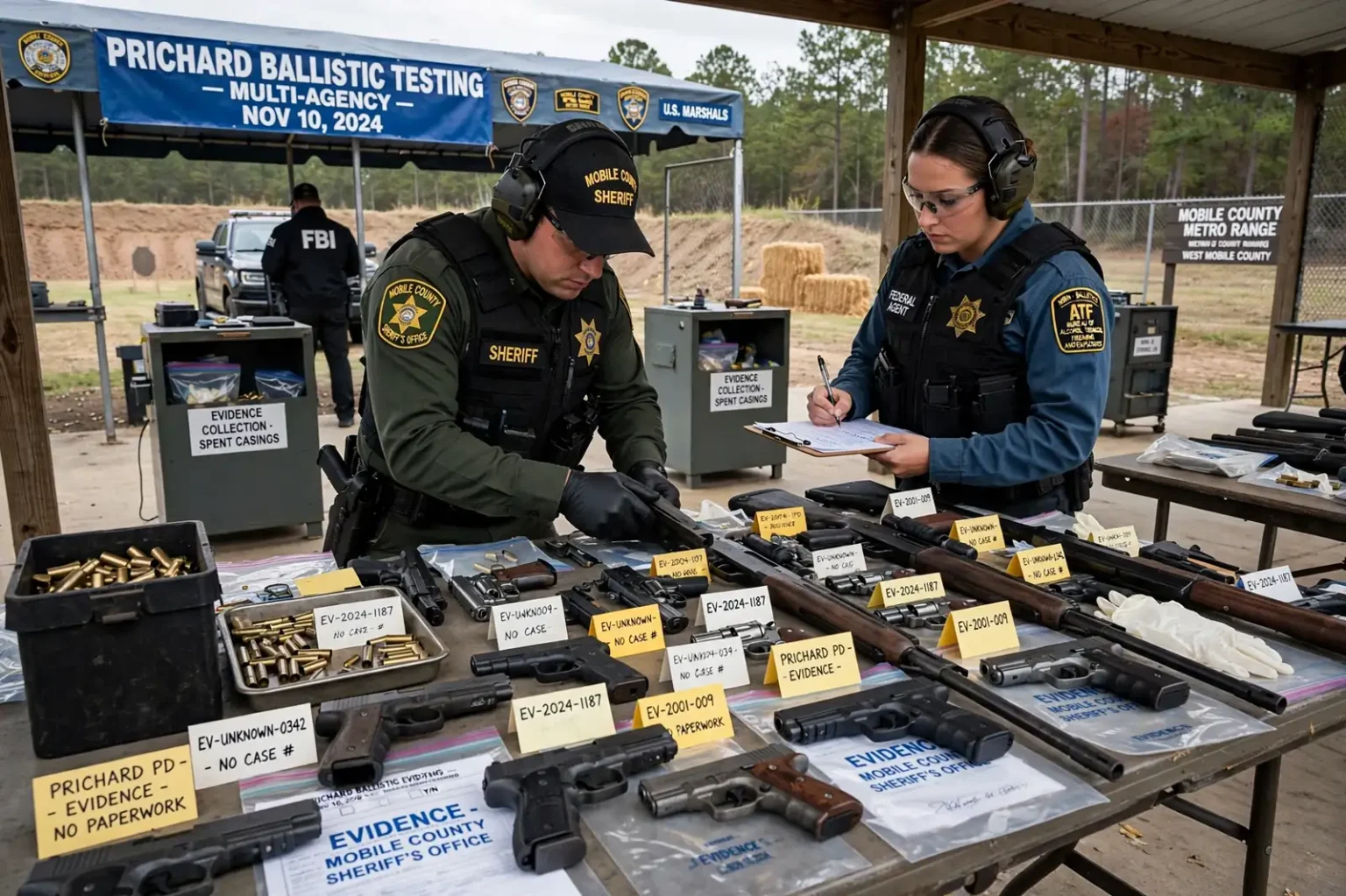
MOBILE COUNTY, Ala. — Investigators spent Tuesday, Nov. 10, firing round after round at a county range as Prichard ballistic testing got underway on roughly 1,800 firearms that had been sitting in the Prichard Police Department’s evidence room, in some cases for decades and in many cases with no paperwork explaining why they were there.
By the close of the workday, about 1,200 of those guns had already been test-fired. The Mobile County Sheriff’s Office, which has run day-to-day policing in Prichard since June, organized the effort with help from a long list of local and federal partners. The goal is straightforward: find out whether any of these weapons can be tied to shootings or other crimes that remain unsolved, whether inside Mobile County or beyond it.
What the Prichard Ballistic Testing Is Meant to Answer
Every gun that leaves marks on a fired cartridge case leaves a kind of mechanical signature. When a firearm discharges, its firing pin, breech face and ejector press distinctive impressions into the brass. Investigators can compare those impressions against casings collected at crime scenes to see whether the same weapon was involved.
That is the heart of the work now being done. After each firearm is inspected, those judged safe to shoot are test-fired, the spent casings are collected and the eligible ballistic evidence is entered into the National Integrated Ballistic Information Network, commonly known as NIBIN. The network allows agencies across the country to search for potential links between a particular gun and evidence recovered at shooting scenes.
The sheriff’s office said it will not know whether any of the Prichard firearms connect to other cases until the entire process is finished and the results have been reviewed. A match in the system is a lead, not a conclusion; trained examiners typically confirm potential hits before investigators act on them.
NIBIN is managed by the Bureau of Alcohol, Tobacco, Firearms and Explosives, which describes the system as a tool for generating investigative leads in shooting cases. More information about how the network works is available on the ATF’s NIBIN page.
A Stockpile Without a Paper Trail
The sheer volume of the stockpile is only part of the story. The sheriff’s office said many of the guns recovered from the Prichard evidence room carry no case number at all. Without that basic record, investigators cannot say why a given weapon was seized in the first place or how long it has been in storage.
The oldest firearm that does have documentation is tied to a case number from 2001. The sheriff’s office described the discovery of so many undocumented weapons simply sitting in a room as astonishing.
Estimates of the total have varied slightly. The sheriff’s office counted about 1,800 firearms in its formal inventory, while leaders also described the collection more loosely as well over 1,500 guns. Either way, the number is far beyond what a typical seizure or evidence review involves.
Proper documentation matters in an evidence room because it is the chain that connects a physical item to a case, a court record and, ultimately, a lawful outcome. When that chain is missing, items can languish indefinitely, and potential evidence in other investigations may never be examined.
How the Sheriff’s Office Came to Control Prichard’s Evidence
The firearms came under the sheriff’s office’s control after a federal investigation into the Prichard Police Department. In June, federal agents searched the department’s headquarters, and a Prichard officer was arrested on a criminal complaint alleging civil rights violations, bribery, evidence tampering and extortion. Those allegations have not been proven in court, and the officer is presumed innocent unless and until a court finds otherwise.
In the wake of that investigation, the Mobile County Sheriff’s Office assumed day-to-day law enforcement responsibilities in Prichard, a city of roughly 19,000 people just north of Mobile. Deputies also began the painstaking job of cataloging everything stored in the police department’s evidence facilities.
The firearms were not the only concern to surface. During that review, officials identified 247 sexual assault kits. Of those, 148 had never been processed, and they were transferred to the FBI for testing. Untested kits can contain DNA evidence that helps identify offenders or link separate cases, which is why their discovery drew particular attention.
Months of Preparation Before a Single Shot
Tuesday’s range day was the visible part of a much longer project. The sheriff’s office said it spent months inventorying, labeling and securing the guns after taking over in Prichard. Getting them ready to move to the Mobile County Metro Range in West Mobile County and setting them up for testing took several more days.
Safety governed each step. Every firearm was inspected before anyone pulled a trigger, and the sheriff’s office said any gun that appeared unsafe would not be test-fired. Older weapons, or those stored for long periods without care, can develop mechanical problems that make firing them hazardous.
Once the testing wraps up, the guns must be transported back to the sheriff’s office, adding another logistical step to an already large operation.
Test-firing seized guns is itself routine. The sheriff’s office said firearms taken in a case are regularly brought to the range for this kind of testing, usually within days of being seized. What set this effort apart was the scale: even with personnel from multiple agencies pitching in, the work was expected to fill an entire day.
A Multi-Agency Effort
The sheriff’s office did not take on the job alone. Agencies taking part in the operation include:
- The Bureau of Alcohol, Tobacco, Firearms and Explosives
- The U.S. Marshals Service
- The Mobile Police Department
- The Drug Enforcement Administration
- Homeland Security Investigations
- The FBI
- The U.S. Attorney’s Office
- The Mobile County District Attorney’s Office
Bringing prosecutors into the operation alongside investigators reflects the fact that any leads produced by the testing may eventually need to hold up in court, where the handling of evidence is closely scrutinized.
What Happens to the Guns Next
Beyond searching for links to crimes, the testing serves a practical purpose. The sheriff’s office said its own evidence room is not built to hold this many firearms on an ongoing basis, so clearing the backlog is a priority.
The results will help sort the weapons into categories. Investigators want to learn whether any of the guns were reported stolen; those may be returned to their rightful owners, provided the owners are legally allowed to possess firearms. Guns found to be connected to other crimes would remain evidence in those cases.
Firearms that are not tied to any other crime may be destroyed or otherwise disposed of, but the sheriff’s office said that will happen only after it obtains a court order authorizing the disposal. Court approval is a standard safeguard in evidence handling, ensuring that items are not discarded while they might still be needed in a pending matter.
Why It Matters for Prichard and Mobile County
For residents of Prichard, the review is part of a broader effort to account for what was held by a police department now under federal scrutiny. For families waiting for answers in unsolved shootings, the database comparisons offer at least the possibility of new leads, even in cases that have been cold for years.
The work also highlights how evidence management, often an unseen part of policing, can have lasting consequences. A firearm that sits untested for years is a missed opportunity to connect it to a crime, and items without records create uncertainty for owners, investigators and the courts.
The sheriff’s office has not announced a date for releasing results from the testing, and it cautioned that conclusions will not be available until the full process is complete. Readers can follow continuing coverage of Prichard news and crime and public safety in South Alabama on South Alabama News.