Atmore Thrift Store Asks Public’s Help Identifying Man Seen Taking Items From Donation Bin
Managers at Atmore's We Care Thrift Store are asking for help identifying a man seen on video taking items from a donation bin behind the store.
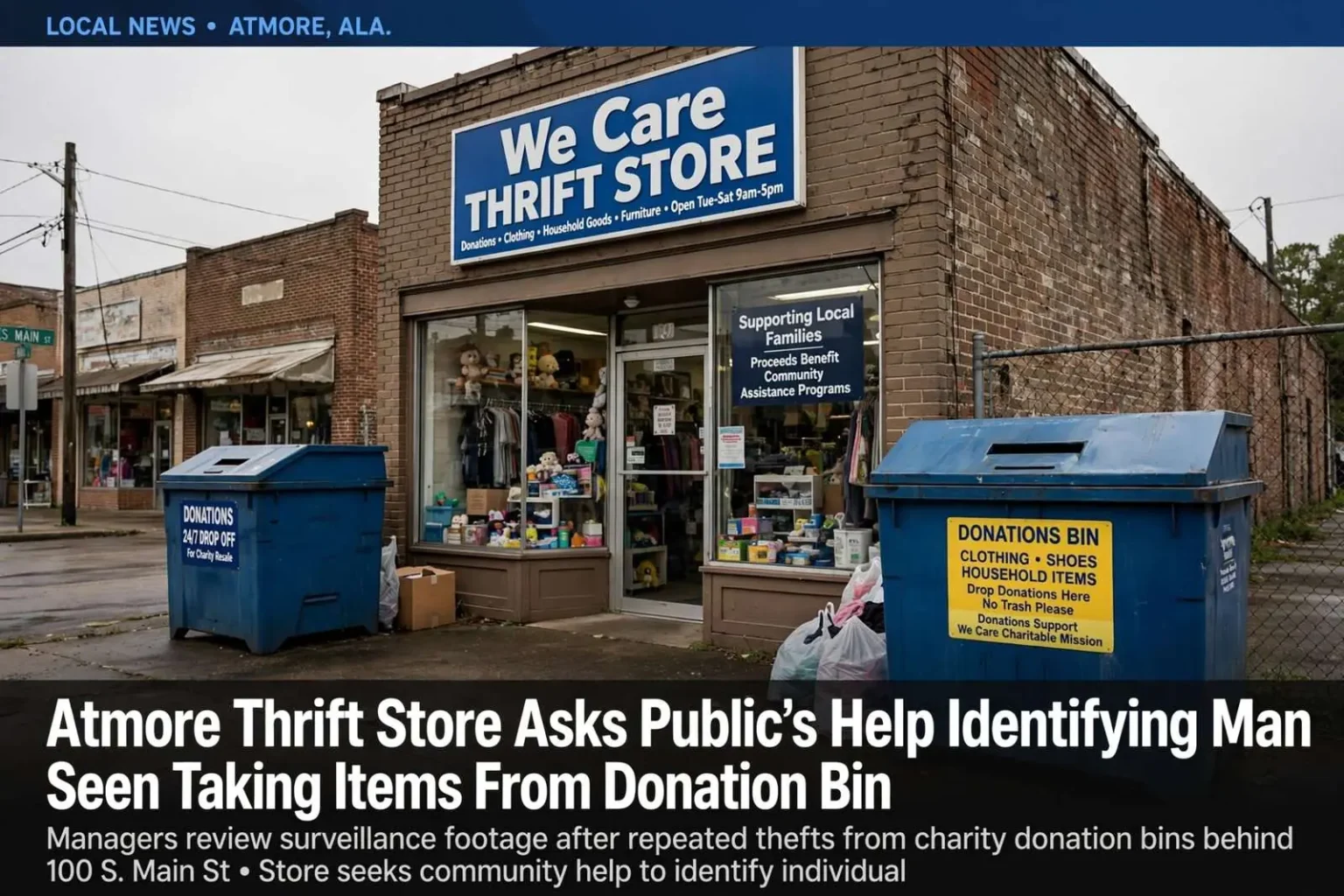
ATMORE, Ala. — Managers of the We Care Thrift Store in Atmore are asking the public to help identify a man seen on surveillance video appearing to take items from one of the store’s donation bins. The request, issued after store staff reviewed footage from their security system, turns a familiar small-town frustration into a public appeal: someone is taking from a charity operation that depends entirely on what the community gives.
Store officials said the incident was captured on camera Monday behind the shop, which sits at 100 S. Main St. in downtown Atmore. The bins behind the building are the store’s lifeline — the collection point where residents drop off clothing, household goods and other items the store resells to fund its charitable work. Downtown Atmore’s Main Street corridor is the commercial heart of the Escambia County town, and the thrift store’s location there puts its donation bins in one of the busiest foot-traffic areas in the city.
According to managers, items have been taken from the bins behind the store more than once, and they hope someone will recognize the person seen in the video. The repeat nature of the losses is what pushed managers to go public, they said. A single incident might be written off, but a pattern of removals from donation bins cuts directly into the inventory the store needs to keep its racks stocked and its mission funded.
Anyone who recognizes the individual is asked to call the We Care Thrift Store. Managers have not said whether the matter has been referred to Atmore police, but a public identification request of this kind typically accompanies a case where the value of the items is modest but the harm to the operation is real — and where store officials believe someone in the community will know exactly who is on the tape.
How the thrift store’s mission works
The bins collect donated goods that the store resells to support its charitable mission, so losses cut into the proceeds the shop depends on. Thrift operations like We Care run on a simple cycle: community donations in, modest-priced sales out, and the proceeds directed back into charitable service. Unlike national chains with regional distribution centers, a single-store operation in a town of Atmore’s size has no cushion — the inventory on the floor is what the bins produced that week.
Atmore, a city of roughly 8,000 people near the Florida line in Escambia County, Alabama, has a long tradition of community-supported charity work, with churches and civic organizations filling gaps for families in need across the area. Thrift stores play a central role in that network, providing affordable clothing and household goods to families on tight budgets while generating funds that flow back into local assistance programs. When donations disappear before they reach the sales floor, both sides of that equation suffer.
Donation bins are particularly vulnerable because they sit outdoors, unsupervised, around the clock. Retailers and charities that operate them typically position them behind buildings or in parking lot corners where donors can find them, but the same accessibility that makes them convenient also makes them targets. Organizations that run bins routinely remind donors to give during business hours when possible, so that items go directly to staff rather than sitting in an unattended container overnight.
A wider problem for charity operations
Theft from donation bins and collection boxes is a problem charity operators across Alabama and the Gulf Coast have wrestled with for years. In larger cities, metal collection boxes for clothing donation have been emptied by scavengers who resell the goods, forcing some organizations to install locking bins, surveillance cameras and signage warning that removal of donated items is theft. Smaller-town operations like the We Care Thrift Store often lack the resources for anything beyond basic camera coverage, which is why managers there turned to the public.
Legal consequences for taking donated goods can be significant. In Alabama, property placed in a charity’s donation bin belongs to the charity, and taking it can support theft of property charges, with the degree of the offense depending on the value involved. Police departments in towns across the state have prosecuted bin thefts, particularly when, as here, the conduct is captured on video and repeated over time.
The surveillance angle gives managers hope that the community can finish what the camera started. Downtown Atmore is a close-knit commercial district where shop owners and regulars know one another’s routines, and footage from a camera behind a Main Street business is often enough for someone to recognize a face, a vehicle or a pattern of behavior. That is the bet managers are making in asking for the public’s help rather than letting the matter pass quietly.
What donors in Atmore can do
For residents who support the store, managers’ appeal comes with practical lessons. Donations can be delivered inside the store during business hours instead of dropped into the bins after hours, ensuring goods reach staff directly. Donors who do use the bins are encouraged to do so when the store is open and, if they notice anything unusual around the bins — someone loitering, a vehicle backed up to the area, or bins that look disturbed — to report it promptly.
The store’s managers have not announced any changes to how the bins are operated or secured, but the repeat losses suggest the conversation about additional protection — from camera placement to bin design to more frequent pickups — is likely happening behind the scenes. Charity operators across the region who faced similar problems have found that a combination of lighting, cameras and community awareness does more than any single measure alone.
The We Care Thrift Store has long been part of the network of assistance organizations serving Atmore and the surrounding communities in northern Escambia County, alongside church pantries and civic groups that help families with clothing, furniture and household needs. Every item that makes it from a donation bin to the sales floor becomes part of that safety net — which is why managers say they are determined to find out who has been taking from it, and why they are counting on someone in Atmore to recognize the man on the video and pick up the phone.
The timing of the appeal — days after the Monday incident was captured on tape — reflects how charity store managers typically handle these situations. The first step is always an internal review: pulling the footage, confirming what it shows, and checking whether prior losses match the same pattern. Only after that do managers go public, because an identification request carries weight only when it comes with a specific, recent description of what happened.
Atmore’s location along the U.S. Highway 31 corridor between Mobile and Pensacola means its downtown businesses see a mix of local shoppers and pass-through traffic, and the Main Street storefronts that anchor the district have been the focus of steady revitalization efforts in recent years. The We Care Thrift Store is part of that fabric, and its donation bins serve donors who come not just from the city itself but from the surrounding communities of northern Escambia County and the nearby Poarch Creek Indian reservation area.
The economics of a small-town thrift store make the math of bin theft particularly stark. A garbage bag of donated clothing might yield only a modest amount in sales, but multiplied across a year’s worth of donations, those sales fund real charitable work — assistance for families, clothing for people starting jobs, household goods for those recovering from fires or other setbacks. Each bag that never makes it inside is a small loss individually and a meaningful one in aggregate, especially when, as managers here say, the taking has happened more than once.
Surveillance systems like the one behind the Main Street store have become standard equipment for small charities across Alabama, driven down in price by consumer camera technology. What the cameras cannot do, on their own, is identify anyone — that requires either a police investigation or the kind of community recognition managers are now requesting. In towns the size of Atmore, the latter often works faster: a still image circulated among neighbors, church groups and local social media pages frequently produces a name within days.
Managers say their goal remains protecting the mission rather than making an example of anyone. The store exists because the community gives, and the community gives because it trusts where those goods end up. Every appeal to identify the man on the video is, at bottom, an appeal to that trust — a reminder that the bins behind 100 S. Main Street are not a public discard pile or an unclaimed cache, but the front end of a charitable operation that serves Atmore’s families.
Anyone with information about the individual seen in the surveillance video is asked to call the We Care Thrift Store directly. Managers have indicated they will pass along credible identifications to the appropriate authorities if needed, and they continue to welcome donations during business hours, when goods can be handed to staff and put straight to work for the community the store serves.