
Austal USA plans to hire hundreds of workers in Mobile this year
Austal USA, a major Mobile shipbuilder, plans to hire hundreds of new workers in 2019 with competitive pay and training available.
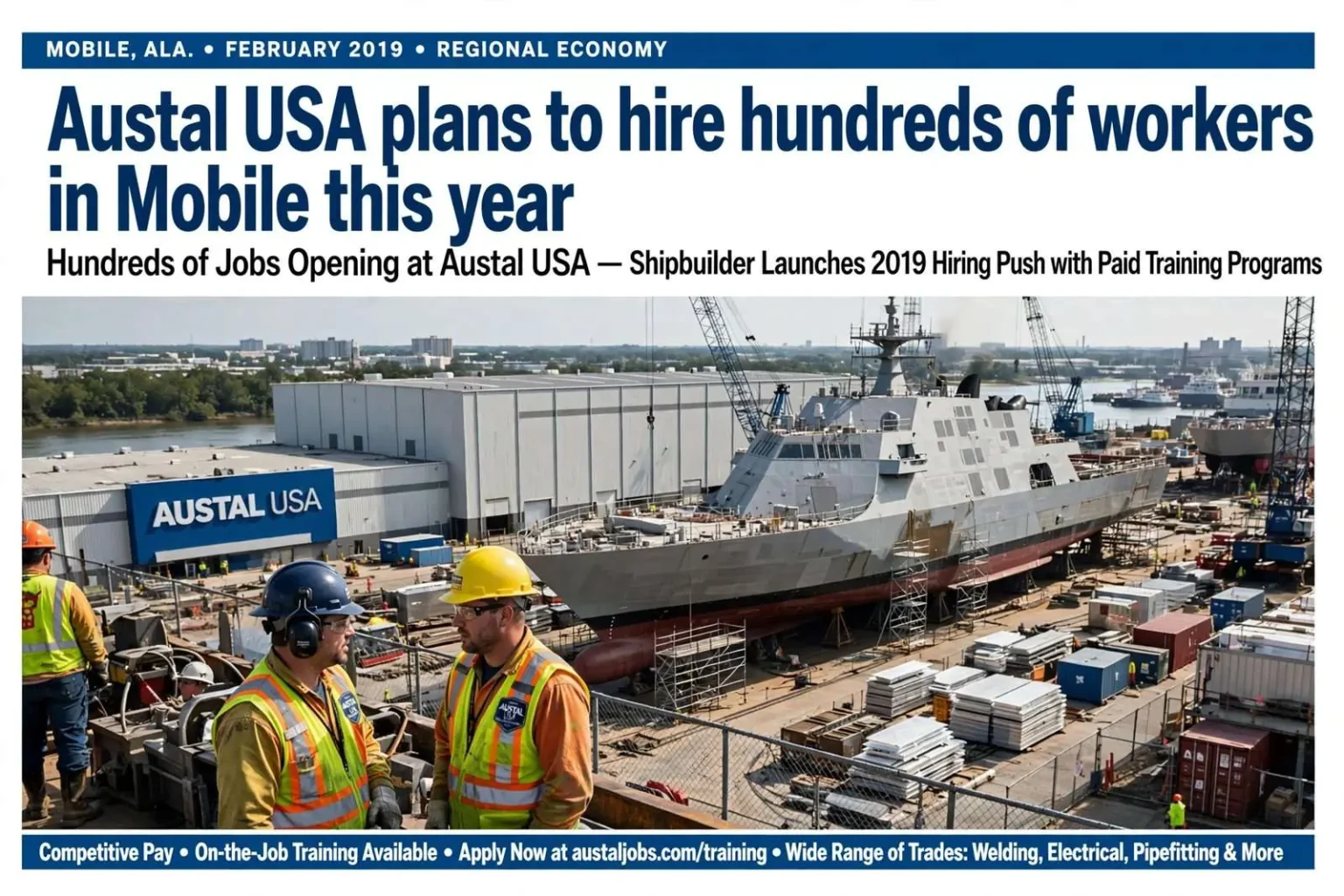
Hundreds of Jobs Opening at Austal USA
MOBILE, Ala. — Austal USA, one of the largest employers in the Mobile area, plans to hire hundreds of new workers in 2019. The shipbuilder says it has a wide range of open positions with competitive pay and training available for those looking to start a career in the shipbuilding industry. Applications are being accepted now. Interested candidates can apply at austaljobs.com/training.
The hiring push comes at a moment of sustained growth for the shipyard on the Mobile River, where production lines have run continuously through back-to-back Navy contracts. For job seekers across the Gulf Coast, the announcement means hundreds of openings in trades that pay well and, increasingly, in a workplace that is willing to teach the skills from the ground up. The company’s message is aimed at two audiences at once: experienced tradespeople looking for a step up, and workers with no shipbuilding background who want one.
Austal USA operates one of the most modern shipyards in the United States on the Mobile River, just south of downtown. The company made its name in Mobile building aluminum-hulled ships for the United States Navy — the Independence-variant littoral combat ships and the Spearhead-class expeditionary fast transports — and its production pace has made it a cornerstone of the region’s manufacturing economy. Each hull that moves down the ways represents thousands of hours of work by welders, pipefitters, electricians, painters and the skilled support trades that keep a shipyard running.
The wide range of open positions reflects how a shipyard actually works. Building a ship is not one job but an assembly line of them: structural welders fit and join aluminum panels; shipfitters read drawings and lay out the steel and aluminum that become a hull; electricians pull and terminate miles of cable; pipefitters install the systems that give a warship its lungs; and painters, insulation workers and outfitters finish the spaces where sailors will live and work. Behind them stand the planners, buyers, quality inspectors and safety specialists who hold the whole operation together.
Training That Starts From Zero
The training Austal offers is the answer to the question every prospective shipyard worker asks: what if I have never done this before? The company has invested in training programs that take new hires through the fundamentals of their trade in a controlled environment before they ever set foot on a production ship. Welding schools, in particular, have become a pipeline into the industry, teaching the aluminum welding skills that naval construction demands — skills that are in short supply across the country and command a premium in the job market.
The availability of paid training changes the calculus for career-changers. A worker coming out of retail, food service or construction can enter the shipyard’s training track, learn a trade on the clock, and emerge into a job with competitive pay and a path upward. Shipbuilding is also one of the few manufacturing sectors where the work cannot be offshored: Navy ships must be built in American yards by American workers, by law, which gives the trade a stability that few industries can match.
For Mobile, the hiring wave is another chapter in the city’s long relationship with shipbuilding. The riverfront has built ships for more than a century, through world wars and the rise and fall of other industries, and the modern yards that line the Mobile River today carry that history forward. Austal’s growth since it established its USA operations in Mobile has made the company one of the largest industrial employers in the region, and its payroll ripples through the local economy — supporting the restaurants, housing markets and service businesses that grow around a major employer.
The jobs also anchor families in ways that go beyond a single paycheck. Shipyard work is career work: apprentices become journeymen, journeymen become leads and supervisors, and the skills travel with workers across the industry. Mobile’s shipbuilding community is a multigenerational one, where parents who welded hulls now watch children enter the same trades, and the industry’s demand for workers shows no sign of easing as Navy shipbuilding budgets sustain the production lines.
The timing of the hiring also lines up with broader currents in the Gulf Coast economy. The region’s workers are mobile by habit — following refinery turnarounds, construction booms and offshore projects across state lines — and a shipyard offering steady, year-round indoor work with a single employer holds obvious appeal against that churning. Local educators have responded in kind: area community colleges and technical programs have built curricula around the industrial trades the yards need, and graduates of those programs feed directly into the same hiring pipelines the company is now widening. The result is an ecosystem in which a student can move from a high school shop class to a training program to a production job without ever leaving the region, and in which the yards themselves have a stake in keeping that pathway open.
What Applicants Should Know
The application process runs through the company’s careers site, and interested candidates can apply at austaljobs.com/training, where the training-focused openings are listed alongside the company’s broader positions. Applicants are generally asked to provide work history and, for the trades, any certifications they already hold — though the training programs exist precisely for those who do not. Shipyard work does carry real physical requirements: the ability to work in confined spaces, at heights and in the Gulf Coast heat, and candidates should expect standard screenings as part of the hiring process.
Prospective workers often ask what the schedule and conditions are like. Shipyards run production shifts, and the work is genuine industrial manufacturing — indoors in modern facilities for much of the process, with the rhythm of production deadlines shaping the calendar. Pay is described by the company as competitive for the region, and the benefits package that comes with large-scale industrial employment — health coverage, retirement plans and steady hours — is part of what draws workers from other industries into the trades.
The range of openings means the hiring touches more than the production floor. Shipyards employ logistics coordinators, administrative staff, security personnel, maintenance technicians and safety professionals, and each of those roles scales up as the workforce grows. A hiring wave of hundreds of workers multiplies through the yard’s support functions, which is why a single shipbuilding expansion can be felt across dozens of job categories.
Why the Navy’s Demand Drives Mobile’s Growth
The story behind the hiring is the demand curve of the United States Navy. The littoral combat ship program and the expeditionary fast transport fleet have kept Austal USA’s production lines running at a pace that requires a constantly renewing workforce — each delivery matched by a new hull under construction. Naval contracts run for years and are funded through national budgets that treat shipbuilding as a long-term commitment, giving the yard’s workforce a visibility into the future that workers in other manufacturing sectors rarely enjoy.
That demand has also driven the yard’s expansion over the years, with new production facilities added on the Mobile River campus as the company’s portfolio has grown. Each expansion deepens the company’s roots in Mobile and raises the ceiling on the region’s industrial workforce. Suppliers across south Alabama — machine shops, fabricators, service companies — ride the same wave, and the skills concentrated at the shipyard spill over into the wider regional economy.
The workforce itself has become part of the region’s story. Hundreds of workers joining the payroll in a single year changes the market for everything from apartments to lunch counters near the yard, and the shipyard’s shifts shape traffic patterns on the riverside roads each morning. Civic leaders track the company’s hiring the way farming communities track rainfall, because a healthy production line at the shipyard is one of the clearest indicators of the region’s economic health. When the company announces hundreds of openings with training attached, it is not only filling jobs — it is signaling another year of growth on a riverfront that has staked much of its future on building ships for the Navy.
For the candidates weighing an application in 2019, the essential facts are simple: Austal USA plans to hire hundreds of workers this year, positions span a wide range of trades and skills, training is available for those starting from scratch, and applications are being accepted now at austaljobs.com/training. For Mobile, the announcement is a reaffirmation of the city’s place as one of the Gulf Coast’s great shipbuilding centers — a place where a worker with ambition and steady hands can turn a hiring notice into a career.
The advice from those already in the trades is consistent: apply, and apply soon. Production hiring moves in waves aligned with contract schedules, and the best positions in any wave go to the earliest qualified applicants. Workers unsure of which trade fits them best are encouraged to look first at the training listings, where the company’s educators help match aptitude and interest to a discipline — welding, fitting, electrical or one of the many support roles. A shipyard, like a ship, needs every station filled to sail, and the hundreds being hired this year will each find the station that suits them.


