
Austal workers and guest speaker push Blount High girls toward nontraditional careers
Austal employees and speaker K.L. Moore talked with Blount High School girls in Mobile about nontraditional careers during a Women's History Month event.
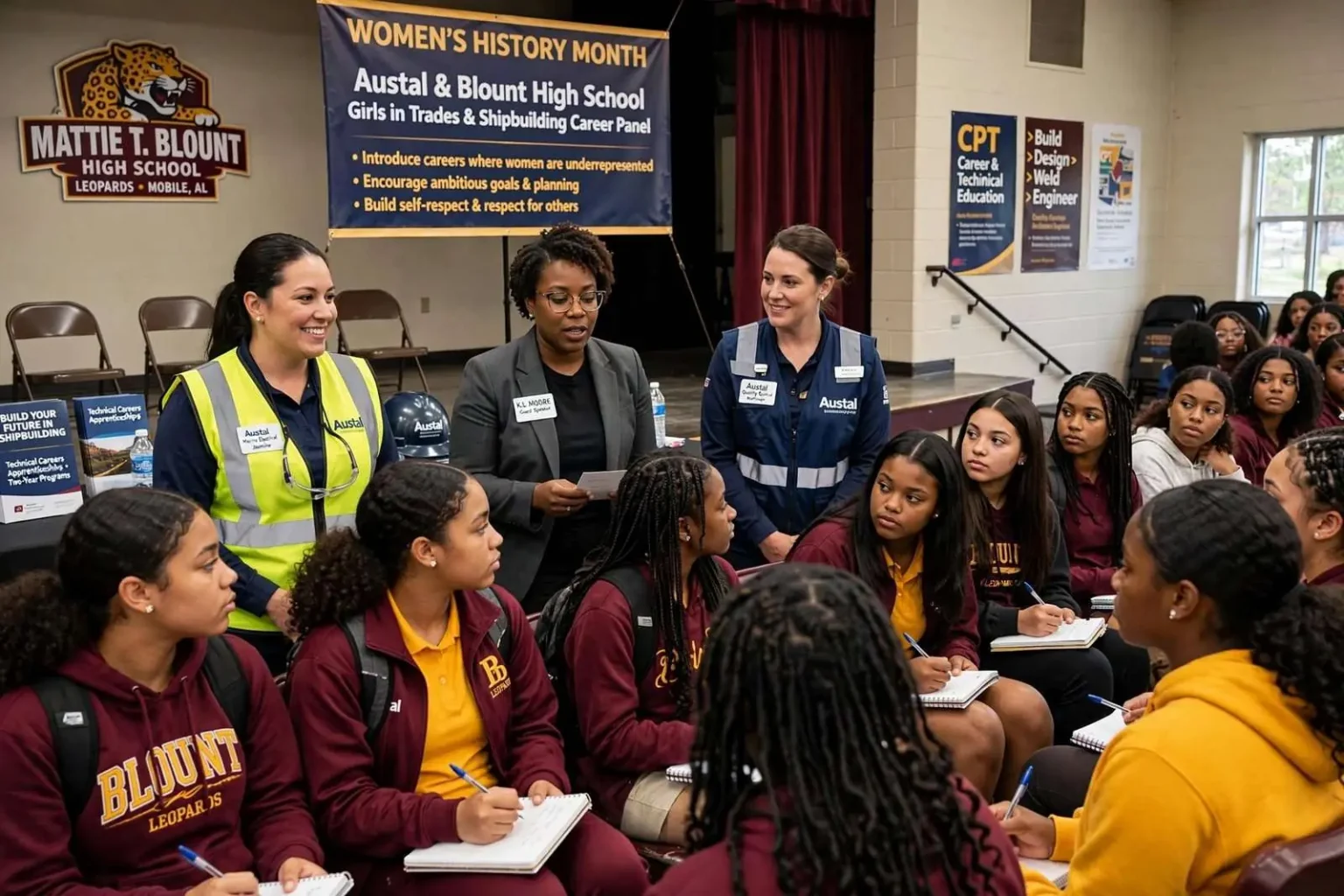
MOBILE, Alabama — Junior and senior girls at Mattie T. Blount High School in Mobile spent part of their Thursday hearing from working professionals about career paths that few of them had likely considered, during an event held to mark Women’s History Month.
Employees from Austal, the Mobile shipbuilder that produces vessels for the U.S. Navy, joined guest speaker K.L. Moore for the session. Organizers said the goal was to put women who already work in technical and industrial fields directly in front of students who are close to making decisions about work and college.
Three goals for the session
According to information released about the event, organizers built the program around three aims: introducing high school girls to careers where women are underrepresented, encouraging them to set goals and plan ambitiously regardless of their present circumstances, and raising awareness about self-respect and respect for the people around them.
The third aim — respect — framed the others. Organizers have said that conversations about ambition and career planning only stick when students first believe they belong in the rooms where those careers happen, and that self-respect is the foundation on which everything else is built.
Moore said Blount struck her as the right place to start those conversations. “Here at Blount there’s a lot of opportunities for girls to get this information and to make a larger impact,” Moore said. “I feel like this might be an area where some of these topics are sort of shoved underneath the carpet and not really come to the surface. So I felt Blount would be a great start for that.”
Austal’s presence in the room
The Austal employees who came to Blount work in a shipyard that has become one of Mobile’s largest industrial employers. The company’s Mobile operations build the Independence-class littoral combat ships and other vessels for the U.S. Navy, employing thousands of workers across trades that range from welding and electrical work to design engineering and program management.
Shipbuilding has historically been one of the most male-dominated industries in the country, and the Gulf Coast yards are no exception. Women make up a minority of the production workforce nationally, which is precisely why the company’s participation in events like this one matters: students met women who hold the jobs, not recruiters describing them in the abstract.
The trades represented at a modern shipyard — welding, pipefitting, electrical systems, quality control, marine design — pay wages that can support a family, and many of them are reached through two-year technical programs rather than four-year degrees. That message, delivered by someone a few years older than the audience and doing the work today, lands differently than it does in a brochure.
Widening what students think is possible
Blount Principal Jordan Woods said the point of bringing outside professionals into the building is to expand what students believe is available to them after graduation. “I hope they walked away with some nuggets to give them the opportunities to walk into places with confidence, to be able to go after jobs that girls wouldn’t normally go after and think about careers they could be in as well,” Woods said.
Events pairing local employers with Mobile County students have become a recurring feature of the spring semester, particularly in trades and manufacturing fields where regional companies face steady demand for skilled workers and schools face the challenge of showing students what those careers actually look like.
Blount High School, which serves the Prichard area of Mobile County, has built its career programming around exactly that challenge. The school’s academies and technical pathways are designed to connect classroom work to the industries hiring along the Gulf Coast, from shipbuilding and aviation to health care and logistics.
The timing of the session — Women’s History Month — gave organizers a natural occasion, but the subject matter is year-round. Women remain underrepresented across the industrial and technical workforce in Alabama, and the gap begins early, in the assumptions students form about which jobs are “for them” long before they ever fill out an application.
The wider workforce picture
The event also reflects the realities of Mobile County’s economy. The region’s industrial base — shipbuilding on the Mobile River, aerospace along the Brookley corridor, chemical and manufacturing plants north of the city — generates a persistent need for welders, electricians, mechanics and technicians, and employers have increasingly gone straight to the high schools to build their future pipelines.
Those employers talk about a coming wave of retirements among skilled tradespeople, which makes today’s juniors and seniors the workforce of the next decade. For companies like Austal, an afternoon in a high school auditorium is a long-term investment: a student who hears about shipyard careers as a junior may be an applicant — or an apprentice — within a couple of years.
For the students, the arithmetic is compelling even if they never set foot in a shipyard. Technical and industrial careers that welcome women are among the few paths that offer strong wages without years of student debt, and the women who spoke to the Blount students could point to their own careers as evidence.
What the students heard
Sessions like the one at Blount tend to follow a recognizable shape: speakers describing their own paths — including the detours and the doubts — followed by questions from students about pay, training, and what a first day on the job looks like. The candid questions are usually the point, since the practical details are what turn an abstract career into a plan.
The message organizers wanted students to carry out of the room was simple: the jobs exist in Mobile, the training paths exist, and nothing about them requires being someone other than who the students already are. Confidence, in the framing of the event, is a skill that can be practiced — starting with walking into an interview believing the job is available to you.
Blount’s administration has treated events like this as part of the school’s core mission rather than an add-on. Principal Woods has emphasized that a high school’s job is not just to graduate students but to send them out the door knowing what doors exist, and partnerships with employers are how that knowledge gets delivered.
For the junior and senior girls who spent their Thursday with shipbuilders and guest speakers, the session offered one more data point in the decisions they will make in the coming year. Whether any of them eventually welds a Navy vessel on the Mobile River cannot be known — but the industry, the opportunity, and the people doing the work are all twenty minutes from their campus.
Women’s History Month as a teaching moment
Women’s History Month, observed each March, began as a weeklong celebration in California schools in the late 1970s and became a national month-long observance in 1987. In schools, the month is an occasion for exactly the kind of programming Blount hosted: events that connect historical firsts to the choices students in the room are making now.
For high school juniors and seniors, the timing is practical. These are the months when college applications, technical program enrollment and post-graduation job plans get settled, which means March is when a conversation about careers can still change a decision rather than just inform one that has already been made.
The Blount session leaned on the present tense rather than the past: instead of a history of women’s firsts, students heard from women whose careers are underway right now, in workplaces students can drive past on the way home. Organizers have found that immediacy does more to change perceptions than any timeline of achievements.
Building the pipeline in Mobile County
The Mobile County Public School System, the largest district in Alabama, has spent years building career and technical education programs meant to line up with the region’s employers. Signature academies at high schools across the county focus students toward industries — maritime trades, aviation, health sciences, engineering — where local hiring is real and measurable.
The district’s approach depends on partners like Austal showing up in person. Employer participation is what turns a career academy from a label into a program: guest instruction, plant tours, internships and, eventually, interviews. Each visit by working professionals is a thread in that fabric.
Blount’s career-focused programming has made it one of the district’s active sites for employer engagement, and its location near Prichard puts it close to the industrial corridor along the Mobile River where shipbuilding and related trades concentrate. The school’s students live, in many cases, within sight of the industry the speakers described.
The gap those programs are trying to close is measurable: nationally, women remain a small share of workers in welding, machining, marine trades and construction management, and the percentages barely move year to year. Changing them requires exactly the mechanism the Blount session used — introducing young women to the work early enough that they can choose it deliberately.
The afternoon ended the way these sessions usually do, with a line of students staying behind to ask the speakers questions one on one. Organizers count that as the real measure of the event’s success: not the applause at the end, but the students who wanted to keep the conversation going.


