
Azalea Film Festival 2016 Launches Inaugural Year at Wynnsong 16
A new film festival for Mobile was nearing the end of its open-submission period, with the inaugural Azalea Film Festival set for September 24 at the.
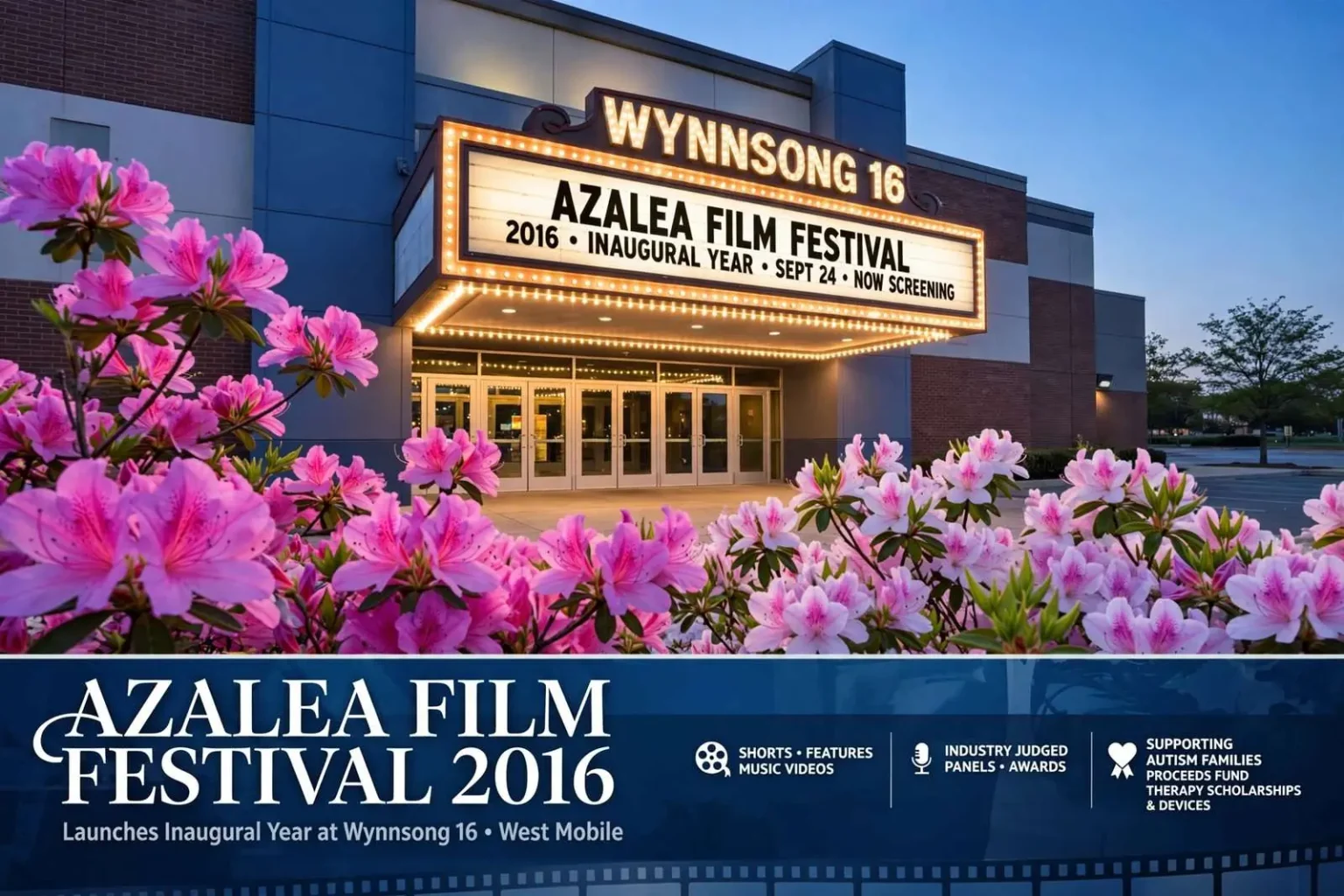
A new film festival for Mobile was nearing the end of its open-submission period, with the inaugural Azalea Film Festival set for September 24 at the Wynnsong 16 theater in West Mobile. The first-year event promised to give Gulf Coast filmmakers something the region has long lacked: a dedicated hometown festival where their work can be seen on a true cinema screen, judged by working industry professionals and celebrated alongside entries from around the world.
The fest accepted shorts, features, and music videos of any genre. That breadth is a deliberate choice for a debut festival — rather than narrowing the field to one style or format, organizers opened the door to everything from five-minute experiments to full-length narratives, from documentaries to horror to animation. For a first outing, the wide net maximizes the chances of building a program with genuine variety for audiences and genuine opportunity for the filmmakers behind the camera.
An emphasis on the little guy
Organizer Joel Knain said the festival was born after he and collaborators submitted a film to another event and came away wanting to do things differently — giving filmmakers a true big-screen experience judged by industry veterans. The frustration is a common one among independent filmmakers: entries fees paid, films mailed off, and then a screening experience that can feel like an afterthought — a laptop projector in a hotel conference room, a half-empty matinee, or no screening at all beyond an online listing.
Azalea’s answer is to build the festival around the screening itself. Putting every selected film on a proper theater screen, with an audience and a sound system built for cinema, restores the experience that independent work rarely gets. Judging by industry veterans rather than a lottery of anonymous online ballots adds a second layer of value: feedback and recognition from people who make films for a living, whose names mean something on a poster or a resume.
The model also speaks to where filmmaking has moved geographically. Digital cameras and affordable editing software have turned cities like Mobile into places where serious films can actually be made, without a studio or a coast-side postcode. What regional filmmaking lacks is infrastructure for exhibition and recognition — and that gap is precisely what a hometown festival can fill, one September weekend at a time.
A worldwide submission pool
Entries arrived from as far as India, Spain, the UK, and Canada, alongside local submissions, and panel discussions were planned. The international spread, achieved in the festival’s very first year, is a testament to how open online submission platforms have made the festival circuit: a filmmaker in Barcelona or Mumbai can enter a Mobile festival as easily as one across town, and strong first-year branding can travel far through filmmaker networks and social media.
For local audiences, that global pool is part of the draw. Festival-goers in Mobile will have the chance to see work they would not find just anywhere else — short films and features that may never receive distribution, presented the way they were meant to be seen. For local filmmakers, entries from abroad raise the bar and the profile simultaneously: winning a category against an international field means more than winning it in a sparsely attended local contest, and programmers get a stronger slate to screen.
The planned panel discussions round out the educational side of the event. Festivals that pair screenings with panels give attendees access to working professionals — conversations about craft, funding, distribution and the practical realities of getting a film made and seen. For students and aspiring filmmakers along the Gulf Coast, those conversations can be as valuable as the screenings themselves, offering the kind of networking and advice that usually requires travel to distant industry events.
Awards and judges
Awards were slated for Best Short, Best Feature, Best Music Video, and Best Overall, with judges Drew Hall, Sam Medina, and Jack Teague. The category structure keeps the focus on the two dominant formats of independent work — shorts and features — while the separate music video award recognizes a form that has become a genuine filmmaking discipline of its own, often serving as the proving ground for directors who go on to narrative work.
The Best Overall prize gives the festival a signature honor, the one entry that rises above its category regardless of length or genre. On a first-year festival’s resume, that award becomes the flagship, the name future submitters will compete for. The judging panel’s professional credentials give all of the awards their weight: when working film industry veterans attach their judgment to a winner, the laurels carry meaning on a filmmaker’s next grant application or festival poster.
Judged awards also shape the tone of the event itself. Festivals with real stakes attract more serious submissions in year two, and audiences respond to the competitive energy — the sense that what they are watching has been winnowed and that the screenings culminate in something. First-year festivals live or die on that perception, and Azalea’s organizers built it into the structure from the start.
A mission beyond movies
Knain noted the festival’s ultimate goal: supporting families affected by autism spectrum disorder. Net proceeds were to fund therapy scholarships, communication devices such as iPads for non-verbal children, sensory-sensitive opportunities, and education for caregivers. The mission gives the event a purpose that reaches well past a weekend of screenings, directing ticket revenue toward some of the most concrete needs that autism families along the Gulf Coast face.
Therapy scholarships address one of the hardest practical realities for affected families: intensive therapies that can measurably improve outcomes are expensive, and insurance coverage varies widely. A scholarship fund can stand in the gap for families who cannot otherwise access services. Communication devices fill another critical need — for non-verbal children, tablet-based communication tools can be transformative, opening a channel for expression that changes daily life at home and at school.
Sensory-sensitive opportunities respond to a different barrier altogether. Many children on the autism spectrum find standard movie theaters — loud, bright, crowded — genuinely distressing, which locks them out of shared cultural experiences most families take for granted. A festival that commits to sensory-friendly options extends its hospitality to an audience that is routinely excluded, and it models the practice for other venues and events across the region. Education for caregivers rounds out the mission, recognizing that parents and grandparents caring for children with autism need training, respite and community as much as the children need services.
A big screen in West Mobile
The event promised Gulf Coast film-goers a chance to see work they would not find just anywhere else, all on a 40-foot screen at Wynnsong 16, 785 Schillinger Rd. S. The venue choice puts the festival in the heart of West Mobile, convenient to neighborhoods stretching toward the Mississippi line and an easy drive from downtown and the Eastern Shore. A multiplex setting also means professional projection and sound — the technical backbone of the “true big-screen experience” the organizers set out to provide.
For an inaugural festival, the combination is ambitious: international submissions, industry judges, educational panels, a charitable mission, and a real cinema as the venue. If the September 24 event delivers on that promise, Azalea Film Festival will have planted something Mobile’s filmmaking community has needed for years — and given autism families along the Gulf Coast a new source of support in the process.
What a festival means for Mobile
Cities that host film festivals tend to collect benefits that compound over the years. Filmmakers who attend become visitors who fill hotels and restaurants; a festival’s growing reputation attracts premieres and regional premieres that would otherwise skip the market; and a local creative economy gains a calendar anchor that gives young filmmakers a deadline to aim at. Mobile’s cultural calendar already runs deep, from Mardi Gras to its museum and music events, and a film festival slots naturally into that lineup.
The charitable mission gives the event a community stake that pure entertainment festivals often lack. When proceeds fund therapy scholarships and communication devices, every ticket sold translates into measurable support for families in the area, and the festival becomes a fundraising engine that runs on the community’s love of movies. Organizers hoping to build a lasting annual tradition rarely find a better foundation than a mission that local families can see at work.
For now, the countdown was on: the submission window closing, selections taking shape, and a September date approaching at the Wynnsong 16 in West Mobile. Gulf Coast audiences and filmmakers alike had reason to circle the date — the first chance to see what the Azalea Film Festival could become.
First-year festivals only get one inaugural edition, and the one that establishes credibility early is the one still handing out awards a decade later.


