The Azalea Trail Maids appear set to be part of Senior Bowl week in Mobile after all, following days of questions about why Mobile’s longtime ambassadors were absent from this year’s plans. The resolution ended a brief but very public standoff between one of the city’s most recognizable civic institutions and one of its most prominent annual sporting events, and it unfolded in the unusual setting of a Mobile County Commission work session, where elected officials pressed event organizers for answers on behalf of constituents.
The Senior Bowl said the group of young women, who have served as official ambassadors of Mobile since 1929, accepted an invitation to attend the game’s welcome reception. Organizers also extended invitations for the Trail Maids to march in the annual parade and greet fans as they enter the stadium on game day. With those invitations extended and accepted, the immediate dispute was resolved — but the episode exposed the kind of tension that can build around long-standing traditions in a changing city.
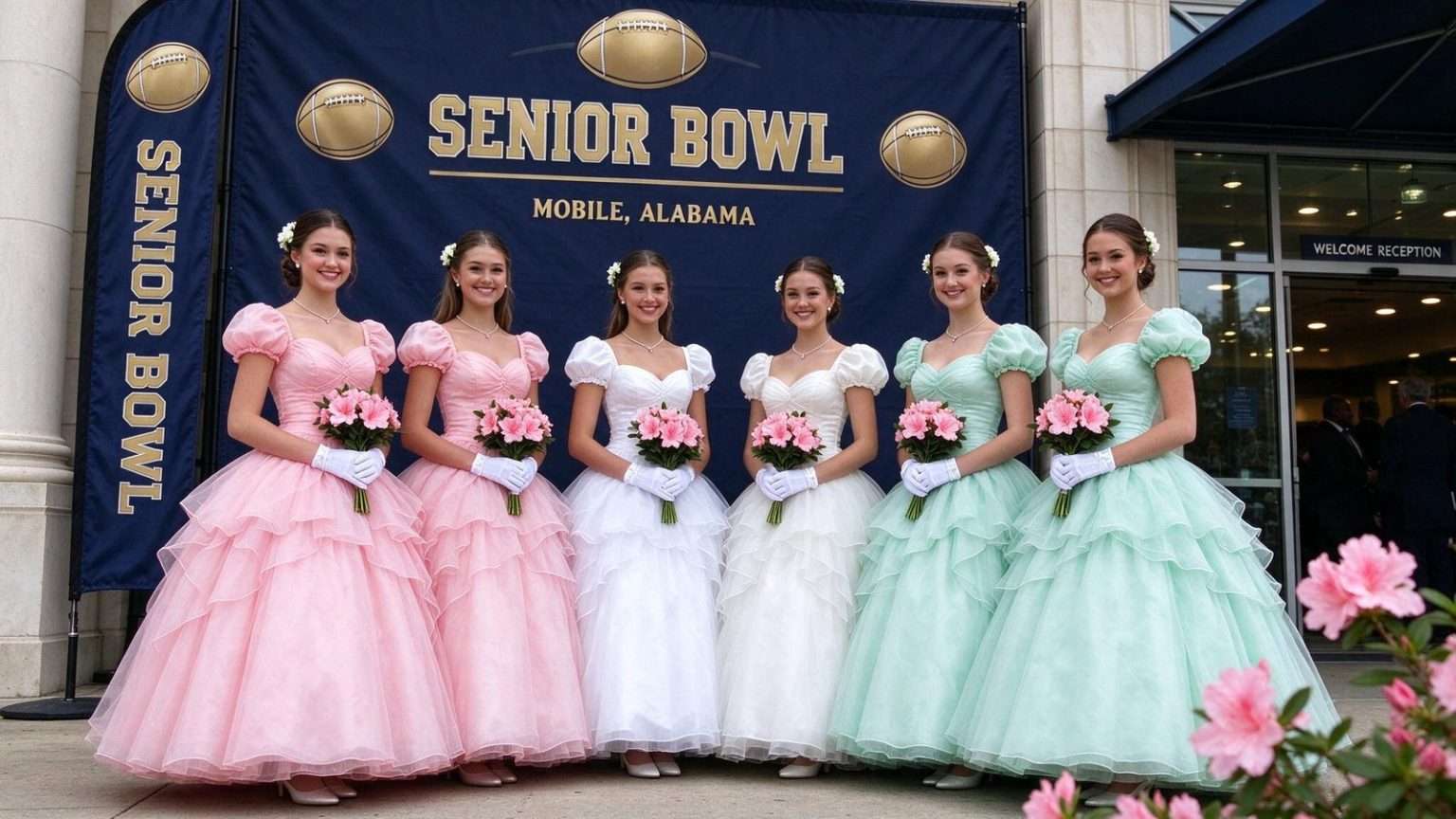
“For decades, Azalea Trail Maids … have welcomed fans to the Senior Bowl,” Senior Bowl leadership said in a statement, describing the group as “an important part of our Senior Bowl traditions.” The statement acknowledged what generations of Mobile football fans already knew: the pastel-gowned young women, chosen each year from area high schools, have been a fixture of the game week pageantry for most of the event’s history, posing for photographs, greeting dignitaries and lending the week a distinctly Mobile flourish.
The Senior Bowl itself has been a Mobile institution since 1951, when the college all-star game settled permanently in the city and began its long run as the premier pre-draft showcase in professional football. Each January, hundreds of NFL coaches, scouts and executives descend on Mobile to evaluate the nation’s top senior prospects, filling hotels and restaurants during the otherwise slow weeks after the college season ends. For a city of Mobile’s size, the game’s economic and promotional footprint is considerable, which is why questions about who participates in its events carry real civic weight.
Commissioners Raised the Issue
The dispute surfaced at a Mobile County Commission planning meeting, where Commissioner Randall Dueitt said he had been trying without success to reach Senior Bowl Executive Director Jim Nagy for comment on why the Trail Maids were not participating this year. Raising the matter in a public meeting — rather than through private calls or staff contacts — signaled how strongly constituents felt and put the event’s leadership on notice that county government, which has supported the Senior Bowl, was paying attention.
Commissioner Connie Hudson noted she had taken calls from residents wondering why the group appeared to be left out, and Commissioner Merceria Ludgood observed that controversy around the Trail Maids was not new, calling it “just a new iteration” of a long-running debate. The three commissioners, each of whom represents a different corner of the county, thus captured the full range of public sentiment: frustration at the perceived snub, curiosity about what had happened, and a longer historical view that the Trail Maids have courted controversy for generations.
Ludgood’s point was well taken historically. The Azalea Trail Maids, with their antebellum-inspired dresses modeled on the azaleas that bloom across Mobile each spring, have been debated periodically for decades — celebrated by supporters as a cherished tradition that awards college scholarships and public-speaking experience to outstanding high school seniors, and questioned by critics who see the imagery as a relic of another era. Each generation, it seems, has re-litigated the program, and each time the institution has survived with adjustments.
Dueitt later spoke with Nagy but remained at odds with organizers over the decision. He pointed to the group’s history of inclusion since the early 1970s and its appearances at national events such as the Macy’s Thanksgiving Day Parade, parades at Walt Disney World, and President Barack Obama’s inauguration, where the Trail Maids represented Alabama. The national résumé is a point of pride in Mobile: few civic organizations of any kind from the city have appeared at events of that prominence, and the Trail Maids’ selections at those venues reflected decades of building a reputation beyond the Gulf Coast.
The inclusion history Dueitt cited traces to the program’s modernization. For its first decades, the Trail Maids were drawn from Mobile’s white high schools; since the early 1970s, the program has selected young women from across the city and county regardless of background, and its classes have reflected the diversity of the area’s public and private schools. Supporters of the program describe that evolution as proof that the institution can change with the city around it while preserving what makes it distinctive.
What Comes Next
Dueitt initially suggested he would oppose funding for the Senior Bowl if the Trail Maids were not included in its activities, though he stopped short of repeating that threat publicly once talks began. County support for the game is not an abstraction — Mobile County, like the city, has invested public money in the event over the years, and commissioners weigh those allocations each budget cycle. The commissioner’s willingness to link the two made clear that the Trail Maids’ absence was viewed not as a private scheduling matter but as a question with public consequences.
The resolution came as welcome news for an event that has been a Mobile fixture for decades. For organizers, the episode was a reminder that even routine decisions about game-week pageantry are watched closely in a city where the Senior Bowl is woven into the winter calendar alongside Mardi Gras, which follows soon after. For the Trail Maids, the invitation restored a role their predecessors have held for generations: greeting fans, marching in the parade and putting Mobile’s best-known ambassadors in front of a national television audience.
The previous year, the Senior Bowl retired its North/South team naming in a move away from Civil War imagery. That decision, made quietly and announced as part of a broader rebranding, drew far less attention than the Trail Maids episode but signaled the same institutional instinct — that the event’s traditions should be examined as the game’s audience and its host city change. Together, the two episodes illustrate how a 1950s-era sporting event navigates the expectations of the 2020s.
The Trail Maids program itself continues to function much as it has for decades. Each year, high school juniors and seniors compete through interviews, essays and public appearances for a limited number of places on the court. Winners receive scholarship assistance and spend a year representing Mobile at festivals, conventions and civic functions across the country. Alumni of the program include business leaders, elected officials and broadcast journalists who credit the experience with teaching poise and public engagement.
For Mobile residents, the episode was a compact demonstration of how the city’s identity debates tend to run: a tradition questioned, elected officials weigh in, organizers respond, and a compromise is reached that preserves the tradition while acknowledging the concerns. Whether the pattern holds as the city continues to change will depend on institutions like the Senior Bowl and the Trail Maids remaining willing to have those conversations — ideally, as this episode showed, before the commissioners have to ask about it in public.
The game’s January timing makes the Trail Maids’ role especially visible. The Senior Bowl occupies the stretch between New Year’s and Mardi Gras, when Mobile’s tourism calendar is otherwise quiet, and its week of practices, banquets and community events draws visitors into downtown restaurants and hotels. The Trail Maids, in their full antebellum-style gowns of pink, white and mint green, photograph well against the backdrop of the city’s historic districts, and their appearances at welcome receptions give out-of-town guests an immediate introduction to one of Mobile’s signature traditions.
Scholarship money is another dimension that often goes unmentioned in the controversies. Participation in the program carries substantial college scholarship support funded through the Mobile Azalea Trail Festival organization and its partners, and the selection process is competitive, drawing applicants from high schools across Mobile County. For many families, the program functions as a leadership pipeline — one of the few civic institutions that puts teenagers from different schools and neighborhoods into the same year-long cohort of public service.
How the dispute resolves into routine will be watched by both camps in the long-running debate. Supporters of the Trail Maids took the outcome as affirmation that the city still embraces its ambassadors; critics noted that the controversy itself demonstrated how much scrutiny the program now attracts. The Senior Bowl, for its part, gained a week of unwanted attention but emerged with its traditions intact and its relationship with county government — and with the Trail Maids — restored in time for kickoff.
The episode also illustrated the changing role of county commissions in cultural disputes that once played out privately. Commissioners said openly what residents were posting on social media, and their questions forced a public accounting from a private event. Whether that dynamic becomes the norm for other Mobile institutions with contested histories is an open question, but the Trail Maids episode suggested that silence is no longer the default answer for anyone planning a Mobile tradition around an institution as visible as the Senior Bowl.