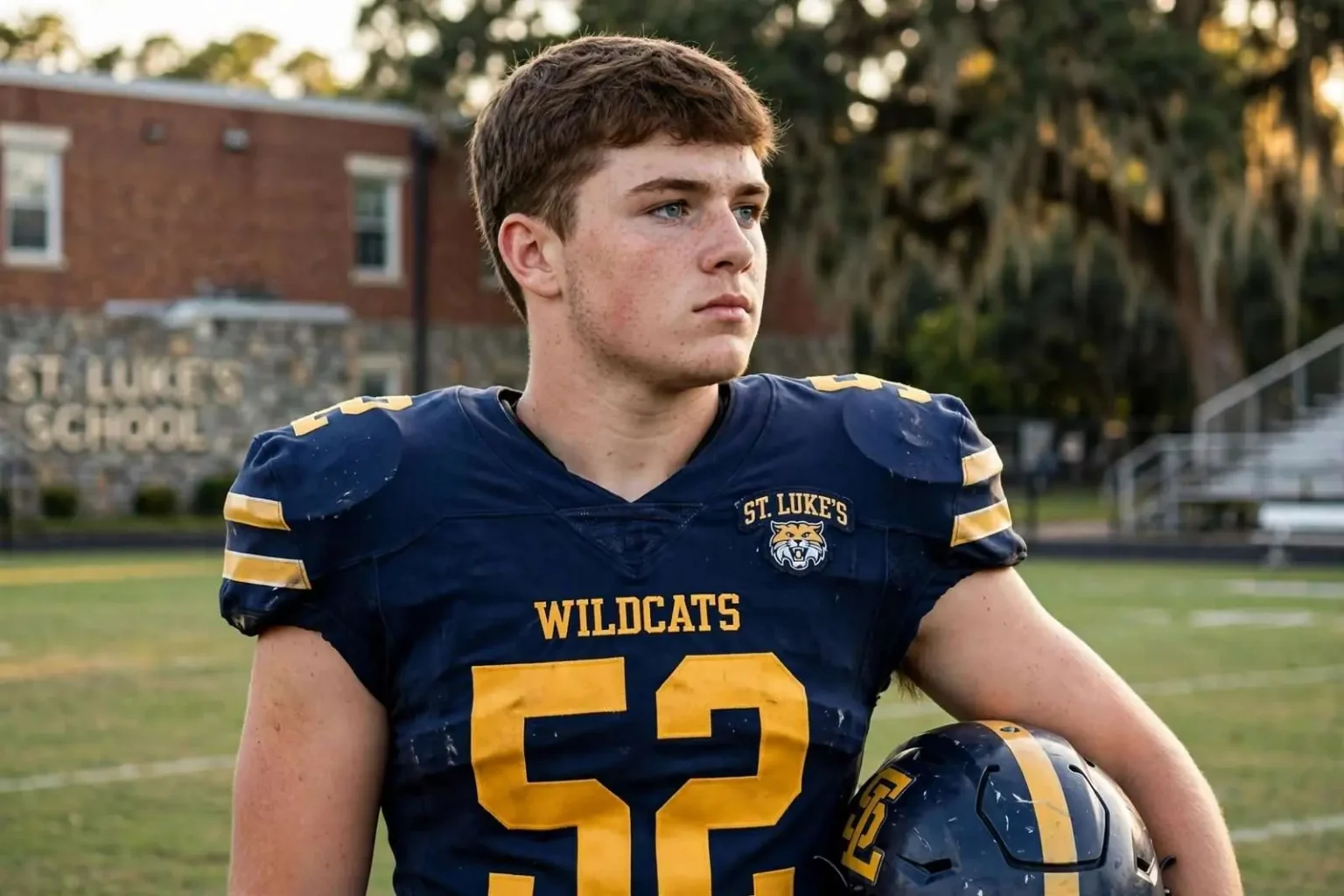
MOBILE, Ala. — Baker Farnell did not always love football. When he joined the St. Luke’s program as a kindergartner, the sport was simply something to do, a way to spend an autumn afternoon around other kids. That indifference faded in middle school, and by the time he reached high school the game had become the organizing force of his life at school. Now a senior lineman at 5-foot-10 and 165 pounds, Farnell enters the upcoming season as one of the most visible players on a small roster, expected to line up on offense and defense and, at times, at linebacker as well.
“I feel like football has helped me develop as a leader,” Farnell said. “Now it’s my favorite part of being in school there, getting to play and getting to help those younger teammates.”
That progression — from a reluctant kindergartner to a senior leader — is one of the quiet stories that plays out inside every small-school program in Alabama, where the distance between the youngest player on the sideline and the senior captain can be measured in a single hallway. At St. Luke’s, a private school in west Mobile, the football program draws from a compact student body, which means the varsity roster and the youth pipeline share the same campus, the same weight room and, in many cases, the same families. Farnell’s journey through that pipeline is the norm there rather than the exception, and it is precisely why his voice carries weight with the players coming up behind him.
The turning point, he said, came in middle school, when he first understood that effort in practice translated directly to results on Friday nights.
“In middle school we had a really good team, and it was because of hard work, and I was realizing that really, if you work hard enough in something you will get results,” he said.
One player, three positions
Farnell’s assignment this season is as demanding as any on the roster. At 5-foot-10 and 165 pounds, he will play offensive and defensive line for the Wildcats, and sometimes linebacker, often facing opponents who carry a significant size advantage across the line of scrimmage. In larger classifications, a player of those dimensions would almost certainly be funneled into a skill position; at St. Luke’s, need dictates the depth chart, and the coaches count on seniors like Farnell to fill the most physically punishing jobs regardless of the matchup.
Playing both sides of the line is an endurance test as much as a skill test. An interior offensive lineman spends a drive driving his shoulders into a heavier defender; forty minutes later, the same player is doing the pressing from the other side. There is no shorthand for that kind of workload — it is built through summer conditioning, film study and a tolerance for contact that only repetition can produce. Farnell has been accumulating all three since he first put on a helmet as a five-year-old, which is one reason the coaching staff trusts him with assignments that would stagger a less experienced player.
A first-year coach’s endorsement
First-year head coach Rick Cauley, who served as an assistant on last season’s staff before taking over the program, praised Farnell’s work ethic and the example he sets for the rest of the roster.
“You can tell he loves it. Loves the way he trains and loves being around the guys,” Cauley said. “It seems like a lifelong thing.”
That endorsement matters at a school where every senior’s habits are on display. With a small roster, there is no place for a player to hide in practice — every rep is watched by teammates who will be blocking or tackling the same opponent an hour later. Coaches at small private schools in the Mobile area routinely describe their best players as extensions of the staff, the ones who set the pace in conditioning drills and pull younger teammates through the parts of practice that are no fun. Cauley’s description of Farnell places him squarely in that category, and it is the category a two-way lineman has to occupy to survive a full season.
Two-way football as a way of life
With a small roster, most St. Luke’s players — including some of the youngest on the team — are expected to play both offense and defense, a reality that Cauley said the group embraces rather than resists.
“They get upset when they come out of the game,” he said.
That attitude says a great deal about the culture Cauley inherited and now shapes. In classifications where 40 or 50 players wear the same jersey, two-way duty is a burden to be spread around; on rosters that count barely two dozen, it is a point of pride. Alabama’s small private and rural schools have long produced teams built this way, and the players who thrive in them tend to be the ones who treat every snap as an opportunity rather than an obligation. A starter who complains about coming out of a game is, in that environment, the healthiest sign a coaching staff can see.
The demands of two-way football are substantial. Conditioning has to support four quarters of sustained effort, because a player who is gassed in the fourth quarter is a liability on both sides of the ball. Practice time is split between two playbooks, two sets of techniques and two film sessions, which forces players to be efficient learners. Injuries take a heavier toll as well, since a starter lost to injury leaves a hole in two position groups at once. Programs like St. Luke’s manage those pressures through careful snap counts, rotation in practice and an emphasis on fundamentals that hold up under fatigue.
Farnell, who has never before played both sides of the ball in every game, said he is bracing for exactly that kind of season — and looking forward to it.
“I’m excited for that,” he said. “It’s fun when you get going and you just don’t stop.”
A three-sport athlete
Farnell is also a member of the school’s track and tennis teams, a profile that has become less common as specialization narrows the athletic year for many high school athletes. Multi-sport participation is widely valued among Alabama coaches, particularly at smaller schools where roster depth in every sport is thin. The conditioning that track demands carries over directly to a lineman’s fourth-quarter stamina, and the footwork and hand-eye coordination developed on a tennis court show up in a defensive lineman’s first step and use of hands.
There is a leadership dimension to it as well. A senior who competes across three sports moves through the school’s athletic community in a way a single-sport athlete does not, encountering teammates and coaches from different programs and carrying the same standards into each one. At a compact school like St. Luke’s, that visibility compounds: the same students who see him on the football field watch him run in the spring and swing a racket between seasons, and the consistency of his effort in all three becomes the standard the younger athletes measure themselves against.
The small-school landscape around Mobile
St. Luke’s competes in the Alabama High School Athletic Association’s smallest classification, where the Wildcats’ schedule brings them against private and public programs of similar size from across southwest Alabama. Those matchups share a common feature: thin rosters on both sidelines, and games that often turn on which team’s best players can hold up longest over four quarters. Depth charts in that environment are written in pencil, and a player who can competently fill two or three roles is worth more to a staff than a specialist at a single position.
First-year coaches inherit that arithmetic along with everything else. Cauley’s promotion from assistant to head coach means he is implementing his program with a group of players he already knows, several of whom he has watched grow from youth football into varsity starters. Continuity of that kind is an asset in a first season, especially with a roster that includes players as young as freshmen pressed into varsity duty. The staff’s task is to build habits — in the weight room, in conditioning, in film study — that let a small team play bigger than its numbers.
A summer of preparation
Cauley said the Wildcats have had a good summer of preparation as the team works toward the opening of the season.
“We really just focus on the day and having a good time and learning and playing ball,” he said. “And it’s just been a lot of fun.”
Summer work along the Gulf Coast is its own test. Strength and conditioning sessions unfold in heat and humidity that would flatten a less committed roster, and programs across Mobile and Baldwin counties structure their summers around early-morning lifting, evening conditioning and the walkthroughs and 7-on-7 sessions that fill the weeks between the end of school and the start of fall practice. For a two-way player like Farnell, those months are when the aerobic base for a full season of line play is built — the conditioning that lets a 165-pound defensive end chase a play to the sideline in the fourth quarter the way he did in the first.
The tone Cauley describes — days focused on learning and playing, with an emphasis on enjoyment — reflects a philosophy common among coaches taking over a program for the first time: establish the daily habits before installing the scheme. At a school where players grow up together, the summer months are also when the peer leadership that will carry the team through a long season takes shape, usually without anyone announcing it. Seniors set the attendance patterns, the practice tempo and the way younger players are treated, and those patterns are largely set by August.
What a senior season means
For Farnell, the upcoming season is the endpoint of a pipeline that began in kindergarten, and it carries the responsibilities that come with being the oldest player in a program that spans a dozen grades. The seniors on a small roster are its institutional memory: they know what previous teams did well, they know the standards the coaches expect and they know, better than anyone, what it takes to hold up physically when the roster offers no relief. Passing that knowledge to the sophomores and freshmen who will inherit the two-way burden next year is a core part of the job.
His own words make the point. The game, he said, has helped him develop as a leader, and helping younger teammates is now his favorite part of being at the school. That outlook is the practical payoff of a small-school structure in which a senior lineman practices beside the same kids he once lined up with as a kindergartner, or their younger brothers. The continuity is not sentimental decoration — it is the mechanism by which programs with thin rosters stay competitive year after year, with each class graduating into mentorship before it graduates into the alumni column.
The season ahead will test him in ways no previous one has: two-way duty in every game, a linebacking assignment at times, and opponents whose rosters can field more size in the trenches than the Wildcats can counter. Farnell’s answer to that test, by every account from the program, is the same answer he has given since middle school — work hard enough and the results follow. It carried him from a kindergartner’s after-school activity to a senior captain’s role, and it is the standard he intends to leave behind when he does.
For a program rebuilding under a first-year head coach, having a senior like that at the center of the line — on both sides of the ball — is the kind of foundation that summer practices are designed to build on. The Wildcats’ season will be measured in wins and losses like any other, but the habits being installed now, with Farnell as their most visible example, are the part that outlasts any single autumn on the Gulf Coast.