Baker High School student arrested after allegedly trying to stab coach with pen
A 19-year-old Baker High School student in Mobile was arrested on assault and resisting arrest charges after allegedly trying to stab a coach with a pen.
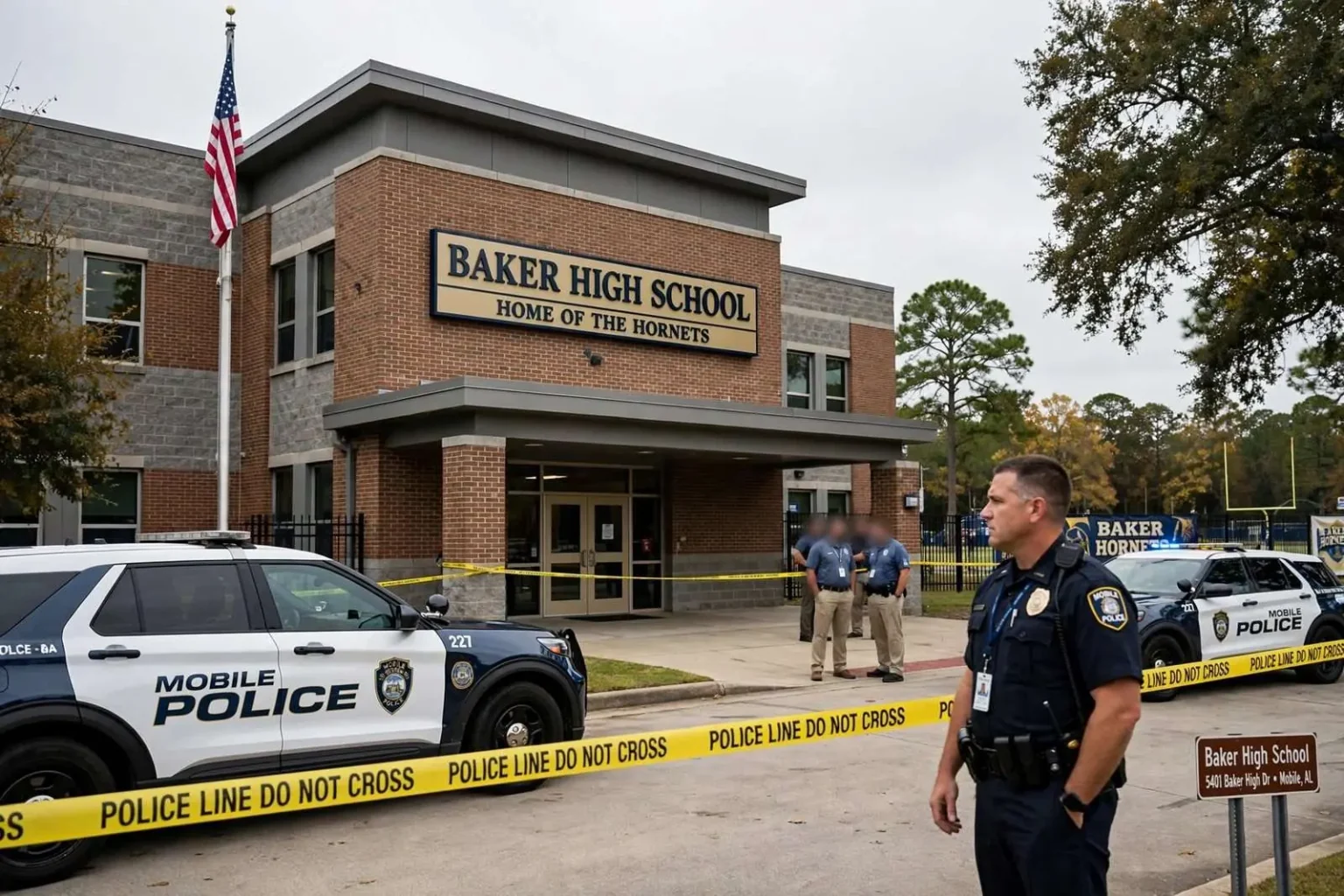
MOBILE, Ala. — A 19-year-old Baker High School student was arrested and charged with assault and resisting arrest after an incident at the school on Thursday, according to the Mobile Police Department. Officers were called to the high school after a student became violent toward staff, and the confrontation that followed left several school employees dealing with the student before police took him into custody. Investigators said the student, identified by police as Kodie Nelson, tried to bite and spit on school employees while struggling with them and also allegedly tried repeatedly to stab a coach with a pen. Nelson also allegedly head-butted an officer while being escorted to a patrol car. The Mobile County Public School System and police have not released further details, and the investigation is ongoing. The charges — assault and resisting arrest — are the standard counts filed when a suspect is accused of injuring or attempting to injure others and then physically resisting being taken into custody.
The incident occurred at Baker High School, one of the largest public high schools in Mobile County, located in the city’s western suburbs. The school serves thousands of students drawn from west Mobile neighborhoods, and its campus includes extensive athletic facilities. Like all public high schools in Mobile County, Baker has school resource officers and administrative staff who handle campus discipline, with Mobile police called in when an incident rises to the level of criminal conduct. The response to a violent incident on campus typically follows a defined sequence: school staff secure the area and intervene first, resource officers and police respond, medical attention is arranged for anyone injured, and parents of students involved are notified. In this case, the initial intervention fell to staff members before officers arrived, which is why school employees — including the coach allegedly attacked — were the ones struggling with the student.
An arrest of this kind is handled differently from the campus discipline that follows most student incidents. Because the student was 19, he was processed as an adult rather than through the juvenile system, which means the charges and his identity became part of the public record. Alabama law allows students to remain enrolled in public high school past the age of 18, and older students on campuses built for minors present a recurring management consideration for large school systems. When an older student is accused of a violent offense on campus, school systems generally move on two parallel tracks: the criminal case handled by police and prosecutors, and the disciplinary track handled by the school system, which can include suspension or a recommendation for expulsion pending a hearing.
What the Charges Cover
Assault charges in Alabama cover the intentional or reckless causing of physical injury to another person, and the degree of the charge depends on the conduct alleged and any injuries involved. Attempting to injure someone — such as the alleged repeated attempts to stab a coach with a pen — can support an assault charge even when no significant wound results. Resisting arrest covers the conduct described in the report: physically struggling against officers, which in this account included the alleged head-butting of an officer during the escort to a patrol car. Additional charges can be added or adjusted as investigators review the incident, and any charges that began as allegations are subject to the court process that follows an arrest.
The alleged use of biting and spitting against school employees is treated seriously in law enforcement practice, both because of the injuries it can cause and because of the health risks it carries. Officers and school staff who are bitten or spat upon during a struggle are routinely evaluated afterward, and such conduct is charged as part of the assault count when it occurs. The fact that several employees were involved in the struggle before officers took over reflects the reality of school incidents: staff members are the first responders on any campus, and their decisions in the first moments of an incident shape how the rest of it unfolds.
Mobile police investigators documented the scene, interviewed the staff members involved and any student witnesses, and collected accounts of the sequence of events before the formal charges were announced. Because the report states that the school system and police have not released further details, questions that typically follow such incidents — what started the confrontation, whether the student had a prior disciplinary history at the school, whether anyone required hospital treatment, and where the incident occurred on the campus — remain unanswered in the public record. That gap is common in the early stages of a school-related case, where agencies coordinate before releasing information and where student privacy rules limit what a school system can say about any individual student’s records.
School Safety in a Large District
The Mobile County Public School System is the largest school district in Alabama, operating dozens of schools across the county from the city of Mobile to its suburbs and outlying communities. With an enrollment measured in the tens of thousands, the district maintains its own security staff, places resource officers in its schools, and follows state requirements for reporting incidents that involve law enforcement. Violent incidents on campus are handled under both state law and district discipline policy, and serious cases such as this one generally prompt a review of the circumstances by school administrators alongside the criminal investigation. The district’s practice in cases involving individual students is to limit public comment, citing student privacy, which is why the school system’s account of Thursday’s incident added nothing to the police report.
For parents of Baker High students, incidents of this kind raise the questions families ask after any campus disturbance: whether their children were ever in danger, how quickly staff and police responded, and what measures will change afterward. Schools typically communicate with parents directly after significant incidents, and the district’s notification practices — automated messages, letters home, or briefings at parent meetings — are separate from the public statements police make about charges. When the incident involves staff members being attacked, teachers and school employees are also part of the affected group, and district practice generally includes support for the employees involved while the case moves forward.
The Legal Process Ahead
Because the charge file now moves into the court system, the next steps belong to the process rather than the school. An adult defendant charged with assault and resisting arrest in Mobile County is booked, makes an initial appearance before a judge, and has bond set on the charges. From there the case proceeds through the district court system, where prosecutors review the evidence gathered by police and decide how to proceed. The allegations — an attack on a coach with a pen, biting and spitting at school employees, and a head-butt aimed at an arresting officer — would be tested through that process, where the burden is on the state and the accused is presumed innocent unless and until convicted.
What the public record establishes at this point is the outline: a Thursday incident at a large west Mobile high school, a violent confrontation that began between a student and school staff, an arrest on two charges, and an investigation that remains open. The details that would give the incident its full shape — how it began, what injuries resulted, and what the school system does in response — have not been made public. Until investigators and the courts supply those answers, the account stands on the police department’s report: a 19-year-old student in custody, a coach and other employees allegedly attacked, an officer allegedly head-butted, and a campus returning to its routine while the case moves forward without it.
Incidents involving school staff also carry implications beyond one campus. Teachers, coaches, and administrators in large districts regularly intervene in student conflicts with little protection beyond their training, and unions and professional associations have long pressed for clearer rules on how staff should respond to violent students and what support they will receive afterward. A case in which a coach is allegedly targeted with a weapon — even an improvised one like a pen — becomes part of that larger conversation among educators about safety in schools that serve older students alongside minors. The outcome for the employees involved, including whether any needed medical care, has not been disclosed in the public record.
The age of the student also matters for how the community reads the case. A 19-year-old on a high school campus is legally an adult, and his alleged conduct Thursday was charged accordingly; but the incident also touches the school’s several thousand other students, many of them minors, who were on campus while the confrontation occurred. School systems weigh that dual character — adult defendants on campuses full of children — in every case like this one, and the disciplinary decisions the district makes in the coming weeks will be separate from whatever the court decides about the criminal charges. For now, the investigation remains open, the charges stand as allegations, and the school system has said nothing further about either the student or the employees involved.