Baker High’s Marcee Hinds Named 2020 Alabama History Teacher of the Year
Baker High School teacher Marcee Hinds wins the 2020 Alabama History Teacher of the Year award from the Gilder Lehrman Institute of American History.
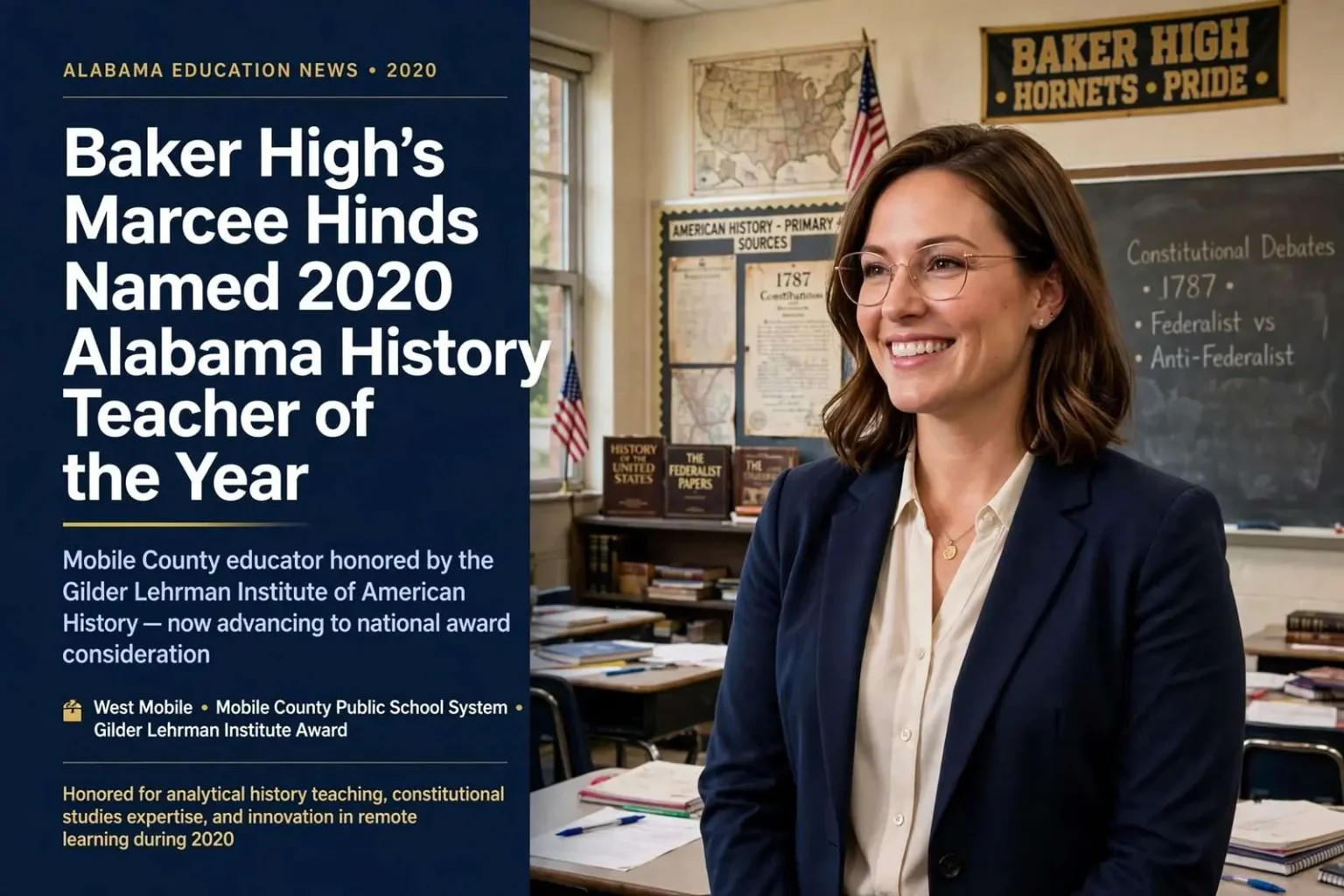
A Mobile County educator has picked up one of the top honors in her field. Marcee Hinds, who teaches at Baker High School, has been named the 2020 Alabama History Teacher of the Year — a statewide recognition that places the Mobile classroom teacher at the top of her profession in Alabama and puts her in the running for national honors in the same program.
The award comes from the Gilder Lehrman Institute of American History, the nation’s leading organization dedicated to American history education in grades K-12. The institute’s annual awards program honors one history teacher from every state, selected for demonstrated excellence in the classroom, depth of knowledge and the ability to bring American history alive for students. State winners are considered for the institute’s National History Teacher of the Year award, making the Alabama designation both a personal honor and a signal of Baker High’s strength in the subject.
For Baker High School, a west Mobile campus in the Mobile County Public School System, the award highlighted the work happening in a single classroom that has drawn recognition far beyond the district. Hinds joined a select group of Alabama educators recognized by the institute, and the honor arrived during a year when history teaching — through a pandemic, remote learning and a national conversation about the past — had never been more demanding.
A Career Built on History
Hinds’ path to the award ran through two of Mobile’s institutions of higher learning. She holds a bachelor’s degree in secondary education from the University of South Alabama, completed in 2011, the credential that launched her teaching career in the Mobile County system. She followed it with a master of liberal arts in history from Spring Hill College, earned in 2016 — a degree that deepened her command of the discipline she teaches and reflected the scholarly habits she brings to her classroom.
Her credentials kept growing after that. In 2019 she added the James Madison Fellowship, a highly competitive national fellowship awarded to teachers with a commitment to the study of the Constitution, and began pursuing a master’s in education with a concentration in constitutional studies. The fellowship, named for the nation’s fourth president and principal architect of the Constitution, supports graduate study focused on the founding document and its history, and recipients commit to teaching American history and government — a natural fit for a history teacher already recognized statewide.
The progression — education degree, history master’s, constitutional fellowship — traces a teacher who treats her own learning as part of the job. Hinds’ academic career has moved steadily deeper into the subjects she teaches, and the 2020 award from Gilder Lehrman effectively certified what her transcript already suggested: a teacher whose command of American history extends well beyond the state’s course standards.
Teaching History Analytically, Not Memorably
In her Baker High classroom, Hinds pairs her interest in history with a strong embrace of technology. Rather than asking students to simply absorb dates and facts, she challenges them to examine the past analytically and form their own conclusions about why events unfolded the way they did. The approach reflects a broader shift in history education — away from memorization and toward the evaluation of sources, arguments and evidence — and it uses the digital tools students already carry to put primary documents within reach.
That method asks more of students than a lecture-and-test model. Analytical history teaching requires them to weigh evidence, consider multiple perspectives and defend conclusions — skills that transfer well beyond the history classroom. It also requires more of the teacher: designing questions that open genuine inquiry, curating sources students can handle, and building the classroom culture where disagreement is part of the work. The Gilder Lehrman award recognized precisely that kind of practice.
Technology plays a supporting role in that classroom vision. Digital archives put students in front of the letters, photographs, maps and records that historians actually work with, and online platforms let students present their arguments in formats that reach beyond the essay. In a west Mobile classroom, the combination — serious historical content delivered through modern tools — has produced the kind of teaching that stands out on a national scale.
The Gilder Lehrman Program and What the Award Means
The Gilder Lehrman Institute has operated for decades as one of the country’s principal private supporters of American history education, running teacher seminars, document archives, traveling exhibitions and the annual awards program that bears the institute’s name. Its Teacher of the Year program moves through a cycle of nominations — from students, parents, colleagues and supervisors — followed by state-level selection and national review. State winners receive recognition and prize materials for their school libraries, and each state winner becomes a candidate for the national award announced later in the year.
The institute’s emphasis falls on teachers who bring primary sources and rigorous inquiry into the classroom, a standard that matches the practice Hinds has built at Baker High. Alabama’s winner each year joins a national cohort of recognized educators, and the designation connects the winner’s school to the institute’s network of resources — seminars, document collections and professional development that continue after the award year ends.
For Mobile County Public Schools, the honor adds to the district’s record of nationally recognized educators. The state’s largest school system has produced teachers honored across subjects and grade levels, and a history teacher of the year in 2020 underscored the depth available in the system’s high schools. For Baker High’s students, the more immediate meaning was simpler: the teacher guiding them through American history had just been judged the best in Alabama at doing exactly that.
History Teaching in a Demanding Year
The 2020 recognition arrived during the most disrupted school year in generations. The pandemic closed Alabama’s classrooms in March 2020 and pushed instruction onto remote platforms through the following school year, forcing every teacher — history teachers included — to rebuild their practice for screens and distance. A teacher whose method already leaned on technology held an advantage in that transition, and Hinds’ digital approach to historical inquiry translated to the online classroom more readily than traditional models would have.
The year also brought heightened public attention to how American history is taught, with debates over curriculum and content playing out nationally and in statehouses. Against that backdrop, an award-winning teacher’s method stands out for its premise: that students learn history best by examining evidence and reaching their own conclusions, guided by a teacher who knows the discipline deeply enough to steer the inquiry. That is the practice the Gilder Lehrman Institute exists to reward, and in 2020 it found its Alabama exemplar teaching at Baker High School in Mobile.
From a bachelor’s degree at South Alabama to a Spring Hill College master’s, a James Madison Fellowship and a state teaching award, Hinds’ career marks the path of an educator who keeps deepening her subject while lifting her students into it. The 2020 Alabama History Teacher of the Year title recognized the teacher her students already knew — and placed her west Mobile classroom on the national stage.
Baker High and Its Community
Baker High School sits in west Mobile, one of the comprehensive high schools in the Mobile County Public School System serving students from suburban neighborhoods across the western part of the county. The school’s academic programs span the standard Alabama curriculum and beyond, and its history department carries the responsibility of guiding students through the state’s required American history sequence — the courses where high schoolers encounter the founding era, the Civil War, the civil rights movement and the modern presidency, often for the first time with the analytical tools to handle them seriously.
Awards like the Gilder Lehrman honor ripple outward from the classroom that earned them. Students in the winning teacher’s courses gain access to the kind of enriched materials and recognition that follow the award, and the school community takes pride in a distinction that few campuses in any state collect in a given year. For a west Mobile public high school, having the state’s history teacher of the year on staff is both a credential and a resource — the kind of distinction that shapes a department’s ambitions.
The honor also speaks to the pipeline that produced it. The University of South Alabama’s College of Education has prepared Mobile County teachers for generations, and Spring Hill College’s master of liberal arts program offers area teachers a route to deep disciplinary study without leaving the city. Hinds’ academic path through both institutions traces the local infrastructure that develops the educators Mobile’s classrooms depend on — and shows how that infrastructure, combined with national programs like the James Madison Fellowship, builds careers that earn statewide recognition.
The James Madison Fellowship and Constitutional Studies
The James Madison Fellowship deserves its own note in Hinds’ story. Awarded by the James Madison Memorial Fellowship Foundation, established by Congress in 1986, the fellowship supports graduate study of the Constitution for secondary teachers of American history and government. Fellows complete graduate coursework focused on the founding document, attend the foundation’s Summer Institute on the Constitution in Washington, D.C., and commit to teaching the subject in American schools — a compact designed to strengthen constitutional literacy one classroom at a time.
Hinds earned the fellowship in 2019, one year before the state history award, and began pursuing a master’s in education with a concentration in constitutional studies. The pairing of credentials — a history master’s completed in 2016, then constitutional specialization — positioned her to teach both the survey of American history and the deeper questions of founding-era thought that the fellowship supports. For a high school teacher, that combination is rare, and it aligned closely with what the Gilder Lehrman Institute looks for in its honorees: demonstrated content knowledge, continuing scholarly growth and classroom practice built on both.
Together, the 2019 fellowship and the 2020 award charted a teacher at the height of her professional development — studying the Constitution nationally, recognized statewide, and teaching a full schedule at Baker High. In a profession where the demands of the classroom often crowd out continued study, the sequence represented an unusually deliberate commitment to mastering the subject she teaches, and it gave her students a teacher whose education in their subject never stopped.