Baldwin Judge Denied Medical-Transfer Request in 2007 Crash Case
A 2007 WKRG report covered a judge's denial of a medical-transfer request by a defendant charged after two bicyclists were killed.
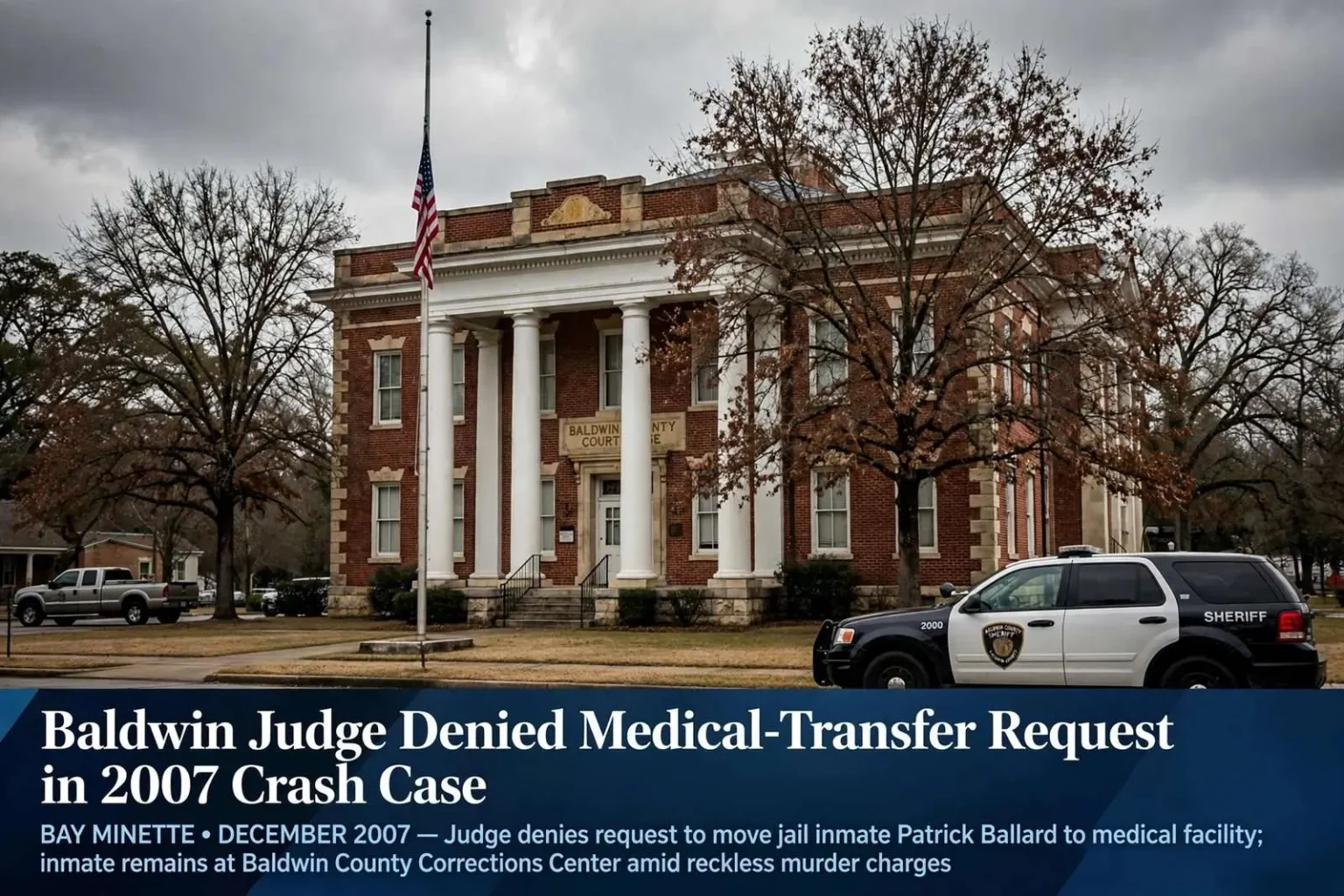
BAY MINETTE — A Baldwin County judge in December 2007 denied a request to move jail inmate Patrick Ballard from the county jail to a medical facility, according to a report by a local station at the time, leaving the man facing reckless murder charges to continue receiving care behind bars.
Ballard, who was charged with reckless murder in the Labor Day deaths of bicyclists Art Clemmons and Bill Imle, said through his attorney that he was not receiving proper treatment for injuries he suffered in the crash. The dispute over his medical care landed before a Baldwin County judge, who held a hearing on the request before ruling.
A jail doctor testified that adequate care was being provided to Ballard at the Baldwin County Corrections Center, and the judge denied the motion to transfer him to an outside medical facility. The ruling meant Ballard would remain at the county jail as his case moved through the courts, with his medical treatment continuing under the jail’s supervision.
Prosecutors alleged that Ballard had been drunk and speeding when his truck struck the cyclists on Bromley Road near Stapleton, a rural stretch in northern Baldwin County. The Labor Day crash killed Art Clemmons and Bill Imle, two bicyclists whose deaths shocked the Gulf Coast cycling community and drew sustained public attention to the case from the day it happened.
This is a historical account of allegations and court proceedings reported at the time, not a final case outcome. The descriptions here reflect what was alleged and argued in court in 2007, and nothing in this article should be read as a determination of guilt beyond what the legal process established.
The crash that set the case in motion
The wreck occurred on Labor Day 2007 on Bromley Road near the Stapleton community, an area of two-lane rural roads in Baldwin County popular with cyclists for its low traffic and gently rolling terrain. Authorities alleged that Ballard’s truck struck the two riders, killing them at the scene. The charges that followed — reckless murder — carried the weight of Alabama law governing deaths caused by driving with conscious disregard for the safety of others.
Reckless murder is among the most serious charges available in Alabama for a fatal traffic crash. Unlike standard traffic offenses, it treats a death caused by extreme disregard behind the wheel as a form of murder, exposing a defendant to a lengthy prison sentence if convicted. Prosecutors in Baldwin County argued that Ballard’s alleged drinking and speeding rose to that level, and the case drew close attention as it moved through the early stages of the court system.
The deaths of Clemmons and Imle resonated far beyond Baldwin County. Cyclists across the Gulf Coast knew the risks of riding on rural roads, and the crash prompted an outpouring of grief from the riding community, along with renewed calls for drivers to share the road and for authorities to take crashes involving cyclists seriously. Rides and memorials honoring the two men followed in the weeks after the wreck, and their deaths became a reference point in discussions about cyclist safety across the region.
For the courts, the case was one of several high-profile prosecutions Baldwin County handled in that era involving fatal crashes. The county’s circuit court system in Bay Minette handles the docket for cases from across Baldwin County, and jail facilities at the county complex house defendants awaiting trial, including those facing the most serious charges.
The medical-transfer fight
The December 2007 hearing focused on a narrow but important question: whether Ballard’s medical needs could be met at the county jail, or whether they required a transfer to a medical facility. His attorney argued that he was not receiving proper treatment for injuries sustained in the crash itself — a reminder that defendants accused of serious crimes may also arrive at jail as injured patients with ongoing treatment needs.
Jails are constitutionally required to provide medical care to the people they hold, and disputes over the adequacy of that care surface regularly in high-profile cases. Inmates cannot simply check themselves into a hospital, so their access to care runs through jail medical staff, court motions and, ultimately, a judge’s decision. When a defense attorney files a motion seeking a medical transfer, it puts the jail’s medical operation on trial in miniature, with testimony from the providers themselves.
That is what happened in Ballard’s case. A jail doctor testified that adequate care was being provided, and the judge sided with the jail, denying the request to move Ballard. The ruling closed one front in the case but left the underlying prosecution to proceed, with Ballard still housed at the county jail as the legal process continued.
The hearing also offered a glimpse into the practical realities of the Baldwin County jail system. County jails across Alabama house a mix of pretrial detainees and sentenced inmates, and their medical units handle everything from routine care to the management of serious injuries. When an inmate’s needs exceed what the jail can provide, transfers are arranged; when jail medical staff believe they can manage the care, judges frequently defer to that judgment, as happened here.
For Ballard’s defense team, the denial of the transfer was one more step in a case that would continue to unfold in the months ahead. Pretrial litigation in reckless murder cases typically covers bail, evidence, medical issues and, eventually, trial preparations. Each ruling along the way shapes the record that prosecutors and defense attorneys build before a trial ever begins.
The setting and the legacy
Bromley Road and the surrounding communities near Stapleton sit in the agricultural heart of northern Baldwin County, where farms and rural residences line roads that carry little traffic but are popular with cyclists training on long, quiet stretches. The region’s cycling clubs had long used such roads for group rides, and the deaths of two riders on one of them forced a conversation about safety that continues in Gulf Coast cycling circles to this day.
In the years since the 2007 crash, Alabama has seen continued advocacy on behalf of cyclists, including education campaigns and discussions of stronger legal protections for riders on the state’s roads. The deaths of Art Clemmons and Bill Imle remain among the most remembered cases in that ongoing effort, cited by advocates whenever the question of driver responsibility for cyclists’ lives comes up.
As for the legal case itself, this account records only what was reported in December 2007: a judge’s denial of a medical-transfer request, testimony from a jail doctor that care was adequate, and the allegations that prosecutors had filed. The full outcome of the prosecution of Patrick Ballard is beyond the scope of this historical report, which preserves a snapshot of the case as it stood at that moment in the Baldwin County courthouse.
Labor Day 2007 fell in early September, and the crash that killed the two riders came at the end of the summer riding season, when Gulf Coast cyclists take advantage of holiday rides on cooler morning hours. The holiday timing contributed to the attention the wreck received, as news of the deaths spread quickly through the cycling community and the broader public across Baldwin County and Mobile.
The charge of reckless murder under Alabama law requires prosecutors to show that a defendant drove with a conscious disregard for an extreme risk to human life — a higher bar than simple negligence or even ordinary recklessness in traffic cases. The allegations that Ballard had been drinking and speeding went directly to that standard, and the case became one of the region’s most closely watched examples of a fatal crash prosecuted as a homicide rather than as a routine traffic offense.
Defendants facing such charges, like any inmate, retain the right to adequate medical care while in custody, and the December hearing was the vehicle through which Ballard’s side pressed that right. Court filings and testimony in such disputes are part of the public record, and the local station’s report on the ruling preserved the details of what was argued that day: a defense claiming inadequate treatment for crash injuries, a jail doctor defending the care provided, and a judge concluding that the jail’s medical operation could meet the inmate’s needs.
The denial also carried practical consequences for how the case proceeded. Ballard remained in the county jail rather than a hospital or medical detention facility, which affected everything from his ability to meet with his attorneys to the logistics of transporting him to hearings. County facilities in Bay Minette house detainees for court appearances at the nearby courthouse complex, and medical issues add layers of planning to each of those movements.
Nearly two decades later, the December 2007 ruling stands as a documented moment in the long history of the case — one piece of the litigation that followed a crash that two families, one cycling community and an entire county spent years processing. What this article preserves is the record of that moment: the request, the testimony, and the judge’s decision.