Baldwin County Burn Ban Stays in Effect Through Oct. 31 as Isaias Cleanup Continues
Baldwin County’s seasonal ban on burning leaves, limbs and brush runs through Oct. 31, and local rules still apply after it ends. Here’s what residents cleaning up after Isaias need to know.
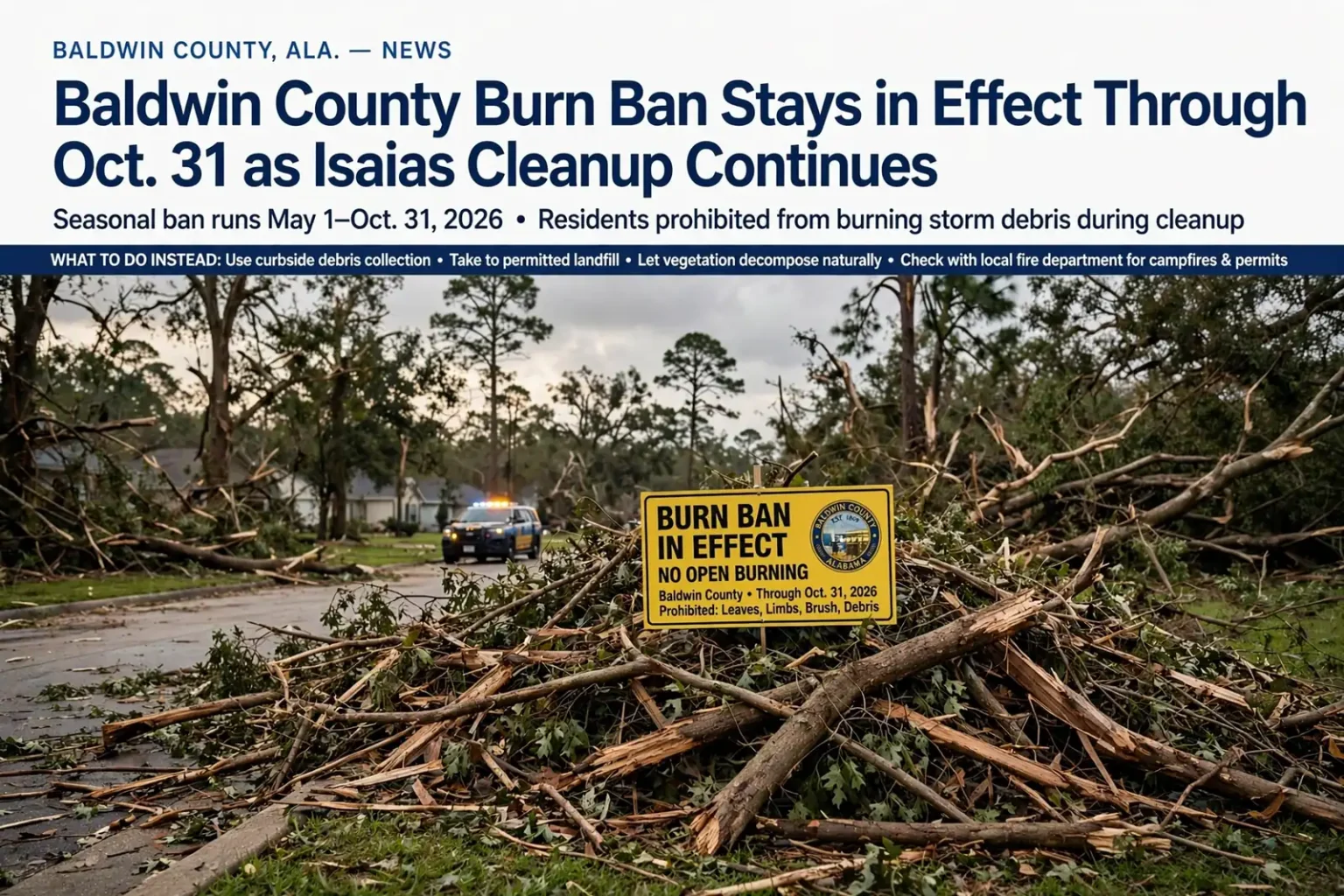
BALDWIN COUNTY, Ala. — The seasonal Baldwin County burn ban remains in effect through Oct. 31, meaning residents across the county still cannot burn leaves, limbs or brush piles, including tree limbs and brush left behind by Hurricane Isaias.
The restriction applies countywide, both inside city limits and in unincorporated communities. It lifts after Oct. 31, but state environmental officials and local fire departments stress that the end of the seasonal ban does not mean residents are automatically free to burn.
What the ban covers
Under Alabama Department of Environmental Management rules, the annual outdoor burning ban in Baldwin County runs from May 1 through Oct. 31, 2026. During that period, residents may not burn:
- Leaves
- Limbs
- Brush piles
- Debris from land clearing
The ban applies in Orange Beach, Gulf Shores, Foley, Fairhope, Daphne and Bay Minette, as well as elsewhere in unincorporated Baldwin County.
Baldwin is one of 12 Alabama counties subject to the annual restriction.
Why the ban exists
The seasonal ban is an air quality measure. It is designed to limit smoke and pollutants during the warmer months, when those emissions contribute to the formation of ground-level ozone.
Unlike the ozone layer high in the atmosphere, ground-level ozone is a pollutant that forms near the surface when emissions from sources such as vehicles, industry and burning react in heat and sunlight. It is a key ingredient in summertime smog and can aggravate asthma and other breathing problems, particularly for children, older adults and people with lung disease. Reducing open burning during the hottest months is one way the state works to keep ozone levels down in faster-growing counties.
Storm cleanup and the burn ban
The ban is in effect at a time when many Baldwin County yards are full of storm debris. Hurricane Isaias made landfall near Destin, Florida, on the night of Oct. 9 as a Category 2 hurricane, and although Baldwin County avoided a direct hit, the storm brought down trees and limbs across the county.
Because the seasonal ban covers leaves, limbs and brush, burning that vegetation is not an option through the end of October. ADEM lists alternatives to burning, including:
- Taking vegetation to a permitted landfill
- Allowing vegetation to decompose naturally
ADEM also warns that moving vegetation to another property does not get around the rule. Vegetation hauled to another location cannot be burned there as a disposal shortcut.
Residents dealing with storm debris should also check with their city or the county about curbside debris collection, which is often the simplest option after a storm.
Seasonal ban vs. emergency no-burn orders
The seasonal air quality ban is different from an emergency no-burn order issued because of wildfire danger.
Alabama Forestry Commission fire alerts can limit the burn permits the agency issues when conditions are dry and fire danger is high. A drought emergency declared by the governor can go further, prohibiting a broader range of outdoor fires.
That distinction matters because those wildfire-related restrictions can be in place at any time of year, including after the seasonal ban ends.
Separately from the seasonal ban, the Alabama Forestry Commission requires a burn permit for larger outdoor burns, such as fires covering more than a quarter acre or burns within 25 feet of woodland, forest or grassland. Those permits can be limited when fire danger alerts or drought restrictions are in place, so residents planning a larger burn after Oct. 31 should check conditions with the Forestry Commission first.
Campfires and fire pits
According to ADEM guidance, the seasonal debris ban does not prohibit campfires or outdoor fireplaces unless drought or safety restrictions are in effect.
Even so, residents should check with their local fire department before starting a recreational fire. Municipal rules may impose additional restrictions beyond the state’s seasonal ban.
Agricultural and forestry exceptions
Some agricultural and forestry burns may qualify for exceptions to the ban, but they require prior approval from ADEM and the Alabama Forestry Commission.
Property owners should not assume a debris pile qualifies for an exception simply because it is on rural land. A brush pile on a farm or a large tract is still subject to the ban unless the burn has been approved.
After Oct. 31
The seasonal restriction ends Nov. 1, but that does not mean residents can light a pile of leaves the next morning without checking first. Local ordinances, permit requirements and any emergency fire restrictions remain in effect.
Daphne, for example, directs residents to contact its Bureau of Fire Prevention for burn permits once the seasonal restriction ends. Other cities have their own rules, and the requirements in unincorporated areas can differ from those inside city limits.
Anyone planning to burn should also keep basic safety in mind once burning is allowed: burn only natural vegetation, keep fires small and attended, keep water and tools nearby, and avoid burning on dry, windy days.
Quick guide for Baldwin County residents
- Ban dates: May 1 through Oct. 31, 2026
- Where: All of Baldwin County, inside and outside city limits
- Prohibited: Burning leaves, limbs, brush piles and land-clearing debris
- Generally allowed: Campfires and outdoor fireplaces, unless drought or safety restrictions apply or local rules say otherwise
- Exceptions: Some agricultural and forestry burns, with prior approval from ADEM and the Alabama Forestry Commission
- Alternatives: Take vegetation to a permitted landfill or let it decompose naturally
- After Nov. 1: Check with your local fire department about permits and local rules before burning
Local fire departments can explain which rules apply to individual properties.