Baldwin County College Basketball Programs Received $863,512 in Funding During 2023
Baldwin County's college basketball programs drew $863,512 in 2023, with the women's team receiving $440,860 as athletic costs keep climbing.
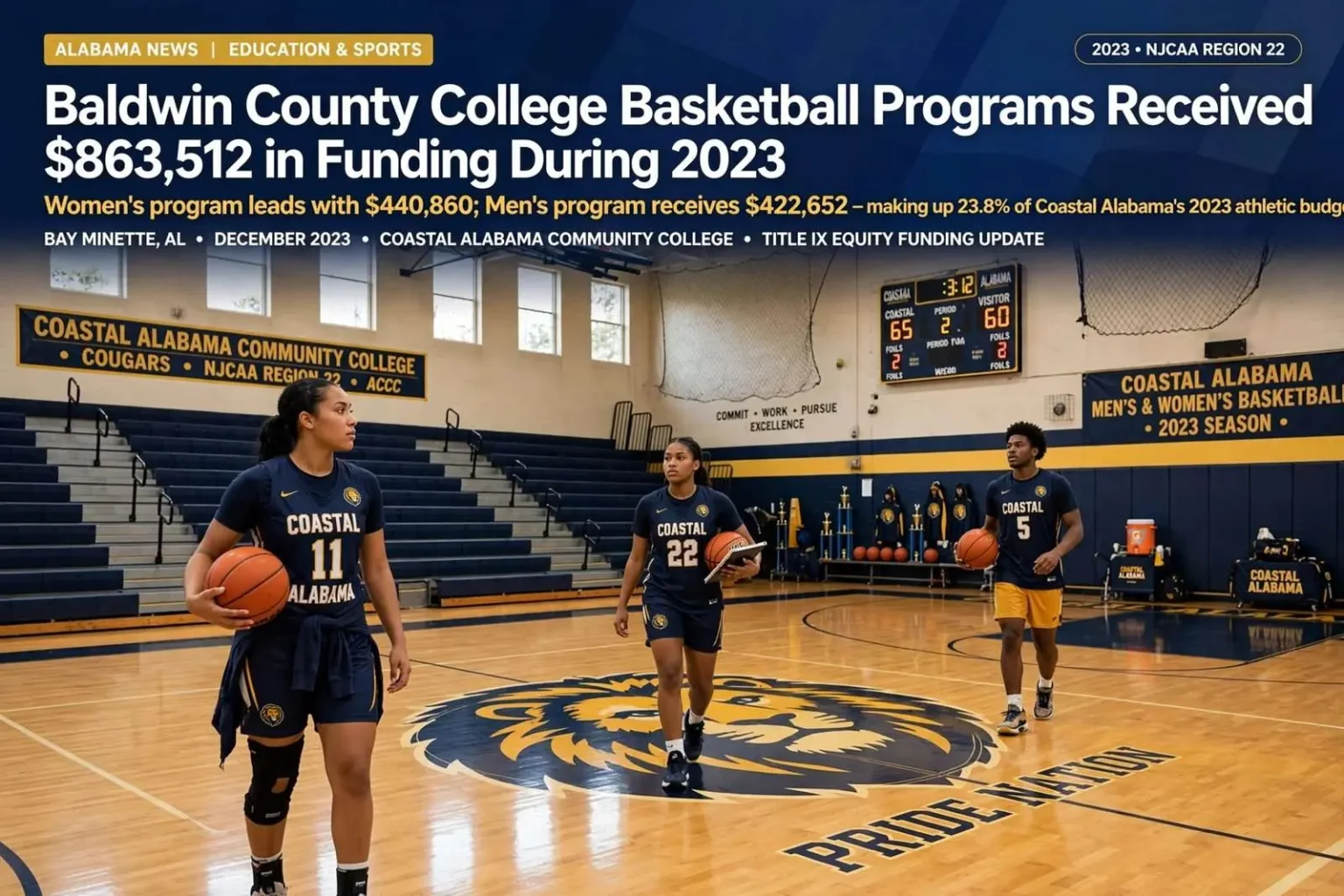
College basketball accounted for a sizable slice of Baldwin County’s collegiate sports budget in 2023. Athletics disclosure figures submitted to the Alabama Commission on Higher Education show the county’s basketball programs received $863,512 in funding during the year — nearly a quarter of all the money invested in sports teams at Coastal Alabama Community College, the county’s primary public two-year institution.
Basketball spending made up 23.8 percent of total athletic investment in 2023, and the women’s program claimed the larger share of the basketball budget, receiving $440,860 compared to $422,652 for the men’s program. That allocation reflects both the operational costs of maintaining competitive rosters and the institution’s ongoing compliance with Title IX gender-equity requirements, which mandate substantially proportional athletic opportunities and funding relative to student enrollment.
A Budget That Keeps Climbing
The figures cap a long upward trend. Average sports expenses at Coastal Alabama Community College have grown 256.5 percent since 2010, mirroring the escalating cost of running college athletic programs across the country. In 2010, the college’s total athletic expenditure sat at roughly $1.1 million; by 2023, that figure had climbed past $3.6 million, with basketball alone consuming nearly as much as the entire department spent thirteen years earlier.
Several factors drive this trajectory. Insurance and medical costs for student-athletes have risen sharply, particularly as concussion protocols and year-round strength-and-conditioning programs have become standard. Athletic accident insurance premiums, which cover injuries sustained during games and practices, have increased nearly 80 percent over the past decade as providers adjust for rising claims. Travel budgets have expanded as conferences realign and regional rivals shift, forcing longer trips for away games and overnight stays in hotels. The ACCC spans from Huntsville in the north to Mobile in the south, meaning teams routinely drive four to six hours for conference matchups. Facilities maintenance—including the resurfacing of the Bay Minette campus gymnasium floor in 2022 and ongoing upgrades to lighting, sound, and HVAC systems—adds recurring capital costs. And coaching salaries, while modest compared to four-year Division I programs, have crept upward in recent years to retain staff in an increasingly competitive hiring market.
Coastal Alabama Community College in Context
Coastal Alabama Community College, formed in 2017 through the consolidation of Alabama Southern Community College, Faulkner State Community College, and Jefferson Davis Community College, serves more than 8,000 students across campuses in Bay Minette, Fairhope, Gulf Shores, Atmore, Brewton, Gilbertown, Jackson, Monroeville, and Thomasville. The Bay Minette campus houses the college’s athletic department, which fields teams in men’s and women’s basketball, baseball, softball, and volleyball. The college competes in the Alabama Community College Conference (ACCC), part of Region 22 of the National Junior College Athletic Association (NJCAA).
Campus life at Coastal Alabama centers around the Bay Minette facility, where the main gymnasium—with a seating capacity of 2,200—hosts not only basketball games but also commencement ceremonies, community forums, and high-school rivalry matchups. The gymnasium floor, installed in 2009 and resurfaced in 2022, bears the college’s lion mascot and the words “Pride Nation” in bold lettering at center court, a design chosen by student vote in 2018. The weight room and cardio suite, upgraded in 2021 with new equipment from Life Fitness and Rogue, support both athletic training and general fitness classes for the broader student body.
For a two-year college in a largely rural service area, athletics serves multiple missions. Basketball games draw alumni and local residents to campus, strengthening community ties in a region where the college is often the largest public institution for miles. The programs provide a pathway for student-athletes—many of them first-generation college students from Baldwin, Escambia, Conecuh, Monroe, and Clarke counties—to earn associate degrees while competing, with many transferring to four-year universities on athletic scholarships. In 2023, six basketball players from Coastal Alabama moved on to NCAA Division II and NAIA programs, continuing both their academic and athletic careers.
Gender Equity and the Women’s Program
The women’s program’s slightly larger budget share—$440,860 versus $422,652 for the men’s side—is noteworthy in a landscape where men’s basketball often commands disproportionate resources. Title IX, enacted in 1972, requires that athletic financial assistance be awarded substantially proportionally to the ratio of male and female athletes. At Coastal Alabama, women comprise approximately 56 percent of the student body, and the athletic department has worked to align participation rates accordingly. The women’s basketball roster typically carries 15 players compared to 13 for the men, and the program invests in additional academic support services, including a dedicated study hall coordinator and tutoring partnerships with the college’s learning resource center.
Head coach Kristen McDonald, who took over the women’s program in 2021, has emphasized player development and academic success alongside on-court performance. Her teams have posted winning records in two of three seasons, and the program’s graduation rate exceeds the department average. The budget allocation supports recruiting travel across Alabama, Mississippi, and the Florida Panhandle, as well as equipment upgrades including new shooting machines installed in the practice facility in 2022. Several players have gone on to compete at Auburn University at Montgomery, Belhaven University, and William Carey University, using their Coastal Alabama experience as a launching pad for higher-level competition.
The Men’s Program and Regional Recruiting
The men’s program, led by head coach Kevin Carlisle since 2019, operates on a leaner budget but has maintained competitiveness in the ACCC’s South Division. Carlisle’s recruiting strategy focuses on Alabama high schools—particularly in Mobile, Baldwin, and Escambia counties—supplemented by junior-college transfers from Georgia and Florida. The 2023 roster included eight Alabama natives, reinforcing the program’s role as a local talent incubator. Budget expenditures cover game-day operations, including officials’ fees (set by the ACCC at $185 per official per game), scoreboard operators, and statistical crew, as well as team meals and lodging for multi-game road trips to conference opponents such as Bishop State, Chattahoochee Valley, and Lurleen B. Wallace Community College.
Carlisle has built a reputation for developing players who might otherwise go unnoticed in the recruiting landscape. Three of his 2022 graduates earned spots on the NJCAA All-Region team, and two signed with NCAA Division II programs in 2023. The men’s team practices in the same gymnasium as the women, sharing court time in the mornings and evenings, which has required careful scheduling coordination but also fosters a sense of shared purpose among the players.
National Context: NCAA Revenue and the NIL Era
Nationwide, the economics of college basketball keep evolving. NCAA revenue distributed through the basketball fund reached roughly $168.57 million in the 2020–21 academic year, driven primarily by the Division I men’s tournament television contract with CBS and Turner Sports. While that revenue flows to four-year institutions, the trickle-down effect shapes expectations at every level. Community colleges face pressure to provide “Division I-caliber” experiences—film rooms, analytics software, nutrition plans—on a fraction of the budget.
Since 2022, student-athletes have been able to profit from their names, images, and likenesses (NIL) following a wave of new state laws and an NCAA policy change. Alabama’s NIL law, enacted in July 2021 and amended in 2023, permits college athletes to engage in endorsement deals provided they do not conflict with institutional contracts. At the community college level, NIL activity remains modest but growing. Several Coastal Alabama basketball players have secured local partnerships—auto dealerships in Bay Minette and Daphne, a regional restaurant group, and a physical therapy clinic—typically structured as social-media promotions or appearance agreements worth a few hundred to a few thousand dollars annually. The athletic department has partnered with the college’s business division to offer NIL financial-literacy workshops, helping athletes understand tax implications and contract basics.
Impact on Students and the Community
For Baldwin County residents, the basketball programs represent more than line items in a budget. Home games at the Bay Minette gymnasium draw 300–500 spectators on average, with rivalry games against Faulkner State (now the Coastal Alabama Fairhope campus) and Bishop State pushing attendance past 800. Ticket revenue—$10 for adults, $5 for students and seniors—offsets a portion of game-day costs, while concession sales support the booster club’s scholarship fund, which awarded $12,000 in supplemental aid to student-athletes across all sports in 2023.
The booster club, established in 2018, meets quarterly and includes current and former players, parents, faculty, and local business owners. Its fundraising activities include an annual golf tournament in October, a spring auction during graduation weekend, and ongoing solicitations to local businesses for equipment donations. These efforts have funded new uniforms in 2022, travel-size luggage sets for road trips, and a new video-analysis system installed in the coaching office.
The programs also serve as a retention tool. Institutional research shows that student-athletes at Coastal Alabama persist to degree completion at a rate 12 percentage points higher than the general student population. The structured schedule of practices, study halls, and travel builds time-management skills, and the coaching staff monitors academic progress weekly, intervening early when grades slip. For many athletes, the basketball program is the primary reason they enrolled—and stayed—in college.
Basketball players at Coastal Alabama typically carry 12 to 16 credit hours per semester, often including developmental math and English courses. The athletic department provides a peer mentor—an upperclassman who has successfully navigated the same curriculum—to help newcomers adjust to college-level coursework. Academic mentors also assist with financial aid applications, scholarship renewals, and career counseling, ensuring that the athletic experience translates into long-term educational outcomes.
Looking Ahead: Sustainability and Strategic Choices
As the 256.5 percent expense growth since 2010 suggests, the current trajectory poses sustainability questions. The Alabama Commission on Higher Education’s annual athletic financial report, which provided the 2023 figures, flags community colleges where athletic spending exceeds 3 percent of total educational and general expenditures. Coastal Alabama sits at 2.8 percent—below the threshold but trending upward. College leadership has convened a strategic-planning committee to evaluate revenue diversification, including expanded corporate sponsorships, summer camps, and facility rentals for community events.
The summer camp initiative, launched in 2022, has shown early promise. Day camps for children ages 6 to 12 run in June and July, supervised by college players and coaches. Revenue from camp fees has offset approximately 4 percent of the basketball budget in its first year, and organizers expect that figure to grow as awareness spreads throughout Baldwin County and neighboring Mobile and Escambia counties.
Meanwhile, the NJCAA’s ongoing governance reforms—including potential changes to scholarship limits and transfer rules—could reshape the competitive landscape. The association voted in 2023 to allow two-time transfers immediate eligibility under certain conditions, aligning more closely with NCAA rules. For Coastal Alabama, this means roster turnover could accelerate, requiring more aggressive recruiting and potentially higher scholarship costs. The college awarded 38 basketball scholarships in 2023, covering tuition, fees, and books but not room and board, which many students still finance through federal Pell Grants and work-study employment.
Baldwin County’s population growth—the county added more than 40,000 residents between 2010 and 2023, making it one of Alabama’s fastest-growing counties—offers a long-term tailwind. A larger local population means a deeper talent pool, more potential ticket buyers, and a stronger case for public and private investment. But it also means greater demand for the college’s academic programs, workforce training, and student services, all competing for the same finite resources.
The college’s 2024–25 strategic plan, approved by the board of trustees in June 2024, prioritizes a 3 percent annual increase in athletic funding paired with a commitment to maintain or improve graduation rates among student-athletes. This dual mandate requires balancing the short-term costs of competitive athletics with the long-term goal of educational success—a tension that defines community-college athletics across Alabama and the nation.
For now, the $863,512 invested in basketball in 2023 buys more than games. It buys a Friday night gathering place in Bay Minette, a scholarship pathway for a guard from Robertsdale or a forward from Atmore, and a visible reminder that the community’s college is still in the game—competing, teaching, and building something that lasts beyond the final buzzer.