Baldwin County Commission Limits Building Heights on Fort Morgan Peninsula Over Fire Safety Fears
The Baldwin County Commission has approved zoning changes that cap building heights on the Fort Morgan peninsula, responding to warnings from fire officials and residents that overcrowded, hard-to-reach rental homes could turn deadly in a fire.
The Baldwin County Commission has voted to amend the zoning ordinance governing the Fort Morgan peninsula, eliminating the area’s High Density Residential designation and establishing a two-story height limit for single-family and two-family homes. The change follows months of debate over whether some of the peninsula’s newer rental properties pose a serious danger to guests and to the firefighters who would have to respond in an emergency.
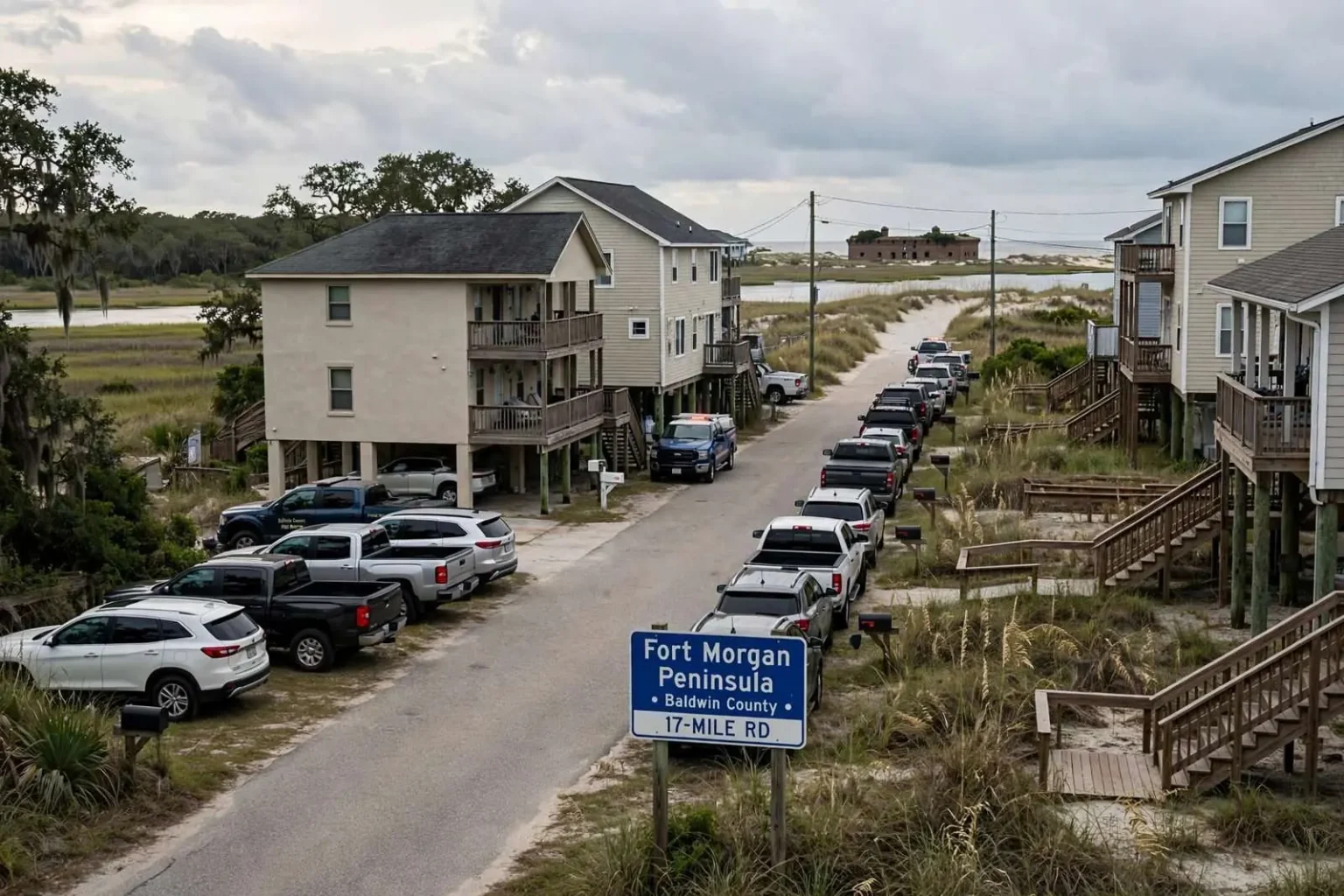
The vote came during a public hearing that grew tense at times, as residents described a stretch of the 20-mile peninsula where large rental houses have been built to accommodate dozens of overnight guests. Much of that growth has clustered around the 17-mile mark, where narrow streets, packed driveways and towering structures have raised alarms among local fire officials.
Paul Stanton, a Fort Morgan resident, read a letter to commissioners from Ernie Church, president of the board of directors of the Fort Morgan Volunteer Fire Department. Church wrote that property owners who rent out their homes often go to extreme lengths to maximize the number of people who can sleep there, creating conditions that make it dangerous for both occupants and firefighters.
According to the letter, firefighters have encountered cots stacked on top of other cots in hallways, bunk beds crammed into rooms the size of closets, and narrow stairways leading to attic spaces filled with similar bedding. Church wrote that in some homes, emergency responders would have almost no reasonable way to reach attic areas or third floors during a fire, and that the setup endangers both occupants and the firefighters trying to save them. He added that narrow streets and driveways clogged with multiple vehicles from renters further slow emergency access.
Stanton pointed to a fire that broke out on nearby Ono Island on Oct. 5, which destroyed two homes but caused no injuries. The blaze burned for roughly 45 minutes before fire crews from Orange Beach, Gulf Shores and Escambia County, Florida, arrived and brought it under control.
Stanton noted that while Ono Island is densely populated, it consists mostly of single-family homes, unlike the rental-heavy development taking shape on Fort Morgan. He also pointed out that response times from Gulf Shores and Orange Beach fire crews to the peninsula can run 30 to 45 minutes, longer than the time it took the Ono Island fire to spread.
To illustrate his concern, Stanton displayed a photograph of a three-story home built under the peninsula’s existing High Density Residential zoning. The house, he said, has 18 bedrooms, 18 full bathrooms and two half-bathrooms.
“This is not a beach house. This is a hotel,” Stanton told commissioners. “And it’s a hotel without a parking lot, and it’s dangerous.” A second photo he presented showed the same property surrounded by parked cars.
Thelma Strong, a member of the Fort Morgan Planning and Zoning Advisory Board, told commissioners the board had spent nearly three years working to bring the proposed amendments forward.
She described the peninsula as a uniquely fragile area compared with the rest of Baldwin County and said the new restrictions were necessary for the safety of both residents and visitors.
Not everyone at the hearing supported the changes. Robert Isakson, whose family’s development company has built projects across the country and on Fort Morgan, argued that height alone should not be the deciding factor. He noted that more than 500 buildings or lots on the peninsula are currently exempt from the ordinance and would still need to be addressed by fire crews regardless of the new height limits.
Isakson said the real problem is occupancy, describing a two-story duplex he knew of where each side sleeps 28 people, for a total of 56 occupants in a building only two stories tall. Isakson also told commissioners that a legislative amendment passed sometime after 2010 prohibits Baldwin County from requiring sprinkler systems in residential homes, regardless of how many people they are built to accommodate.
He urged commissioners to instead ask state legislators to require sprinklers based on a property’s occupancy, or to reconsider how the county defines a “residential” structure altogether.
“Where are we all going to be when we have 50 people die in one house?” Isakson asked. “Or God forbid, two houses like on Ono Island? One hundred people?”
Baldwin County Planning Director Vince Jackson told the commission that while sprinklers would help, that issue falls under the building code rather than zoning and can’t be resolved through the ordinance alone. He also cautioned that occupancy limits can be difficult to enforce.
Jackson noted that the two-story height restriction was developed with input from the fire department and is not an entirely new idea for the peninsula — before 1999, Fort Morgan was already subject to a two-story height limit.
Commissioner Joe Davis said he was surprised some of the peninsula’s recent rental developments were ever approved in the first place, adding that he was particularly concerned about occupants being able to escape from above a home’s second story in an emergency. “This is the first step in correcting that,” Davis said.
Commissioner Billie Jo Underwood said she was hesitant to support any rule that limits how many people can live in a single-family home, warning that such restrictions could unintentionally affect multi-generational families living together under one roof. She said she would be open to exploring sprinkler system requirements in the future as a separate solution.
After hearing from residents, board members and county staff, the commission voted unanimously to approve the amended ordinance. In addition to eliminating the High Density Residential designation and capping building heights at two stories for single- and two-family homes, the new rules also set updated construction standards for dune walkovers throughout the district.
About the Fort Morgan Peninsula
The peninsula takes its name from Fort Morgan, the brick fort at its western tip at Mobile Point. The fort was completed in the 1830s and guarded the entrance to Mobile Bay during the Civil War’s Battle of Mobile Bay in August 1864.
Zoning in unincorporated Baldwin County applies district by district, in areas whose residents have voted to adopt it. Changes to a district’s rules go through the county planning commission and then to the County Commission for a final public hearing and vote, as happened with this amendment.