Baldwin County Finishes Repaving on Five Local Roads in Annual Resurfacing Program
Crews have finished asphalt overlays and new striping on five Baldwin County roads under the County Commission’s annual resurfacing program, work funded in part by the state gas tax.
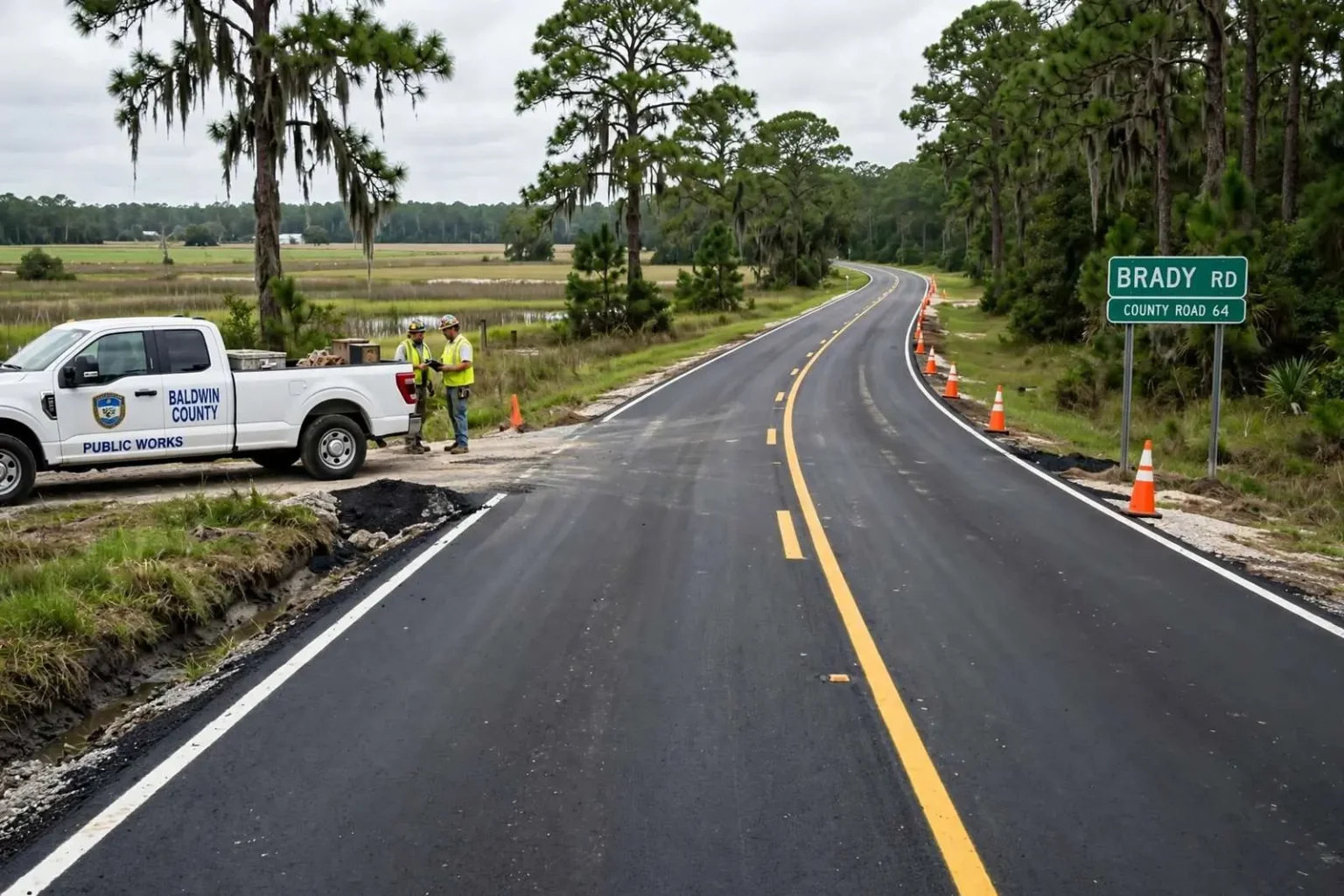
BAY MINETTE — Baldwin County has completed resurfacing work on five local roadways under the County Commission’s annual resurfacing program, the county announced.
The finished projects cover Brady Road, Durbin Fork Road, Three Rivers Road, Brown’s Landing Road and Waterworld Road. According to a county news release, the improvements are intended to provide smoother driving conditions, better visibility and more dependable travel for residents who use the roads each day.
What the Work Involved
The county described a sequence that began well before any asphalt was laid. Crews first evaluated each roadway to identify the repairs that would be needed. In selected locations, drainage maintenance was performed to help protect the new pavement from future damage.
After those preparations, crews applied a new asphalt surface to each road. The county said the work is designed to extend pavement life while improving overall ride quality. Once the asphalt had cured, crews installed fresh striping to give motorists clear, visible markings.
Why Drainage Comes Before Pavement
The order of operations is not incidental. Water is the primary enemy of an asphalt road, and it does its damage from below as much as from above.
An asphalt roadway is a layered system. The visible surface sits on a base course, which in turn sits on compacted subgrade soil. When water is allowed to stand in the ditches, saturate the shoulders or migrate under the pavement, the subgrade loses strength. Traffic loads that the road handled easily when the base was dry begin to flex the pavement, and flexing produces cracks. Once cracks open, more water gets in, and in a coastal climate with heavy rainfall the cycle accelerates.
That is why cleaning ditches, clearing pipes and restoring positive drainage before an overlay is standard practice. Paving over a drainage problem produces a road that looks new and fails early. The same logic explains the pre-paving evaluation: an overlay is only appropriate where the underlying structure is sound enough to support it. Where it is not, spot repairs, base repair or full-depth reconstruction are required first.
What an Overlay Does and Does Not Fix
Resurfacing — placing a new layer of asphalt over an existing road — is a preservation treatment rather than a rebuild. It restores the riding surface, seals the pavement against water intrusion, improves skid resistance and buys years of additional service life at a fraction of the cost of reconstruction.
What it does not do is add structural capacity or change the geometry of a road. An overlay will not widen a narrow lane, add a shoulder, flatten a curve, improve sight distance at an intersection or raise a low-lying segment above flood level. Those are separate and far more expensive projects, typically requiring engineering design, right-of-way acquisition and, where wetlands or waterways are involved, permitting.
The economics are what drive agencies to resurface on a cycle rather than wait. Pavement deteriorates slowly at first and then rapidly, and the cost of intervention rises sharply once deterioration reaches the base. Treating a road while it is still in fair condition is dramatically cheaper per mile than rebuilding it after failure — which is why county road departments spread a limited budget across many miles of preservation work rather than concentrating it on a few full reconstructions.
The Striping Step
The fresh striping installed after the asphalt cured is the most visible part of the job and one of the more consequential for safety. New pavement is uniformly dark, and without markings a driver has no reference for lane position, no centerline to judge oncoming traffic against and no edge line to indicate where the pavement stops.
Edge lines matter most at night and in rain, when the boundary between asphalt and shoulder becomes hard to distinguish. Pavement markings are typically made retroreflective with embedded glass beads so that headlight beams are returned toward the driver rather than scattered. Those markings wear under traffic and weather, which is why restriping is a recurring maintenance item and not a one-time task.
How the Program Is Paid For
The county said the projects were partially funded through the Alabama state gas tax, which supports transportation improvements throughout Baldwin County.
Alabama’s motor fuel tax is collected at the pump and distributed among the state, counties and municipalities for transportation purposes. The state increased the tax in 2019 under the Rebuild Alabama Act, which phased in an added charge per gallon over multiple years and directed a share of the resulting revenue to county and city road programs. Counties receiving those funds are required to plan and publicly report the projects they are spent on, which is part of why resurfacing lists like this one are announced as they are completed.
The phrase “partially funded” is meaningful. County road budgets are assembled from several streams — fuel tax distributions, general fund appropriations, and in some cases grants tied to specific corridors — and the annual resurfacing list is generally built against the total, with roads selected according to condition ratings, traffic volumes and the cost of the treatment each road needs.
Why Roads Like These Matter Locally
The five roads in this round are local county routes rather than state highways. Roads in that category rarely appear in regional traffic reports, but they carry the daily trips that residents cannot avoid: getting to work, to school, to a grocery store or to the nearest state route.
In Baldwin County the maintenance burden is unusually heavy. It is the largest county in Alabama by land area, and its road network stretches across farmland, timberland, riverfront communities and rapidly growing suburban areas. Population growth adds traffic to roads originally built to rural standards, while a hot, wet Gulf Coast climate with heavy summer rainfall and occasional tropical systems shortens pavement life relative to drier regions.
What Comes Next
The County Commission said it remains focused on maintaining roadway conditions and supporting safe, reliable travel for residents, visitors and businesses. Additional resurfacing work will continue across the county through the annual program.
Motorists on newly paved roads should expect the usual short-term adjustments that follow this kind of work: a slightly raised pavement edge where the new surface meets an unpaved shoulder, driveway transitions that may be regraded, and markings that are at their most reflective when new and will need renewal on a cycle of their own.