Newcomer Outraises the Field in Baldwin County District Attorney’s Race
Magnolia Springs attorney David Green raised more than his three Republican rivals combined and enters the final six weeks with nearly twice the cash of incumbent Judy Newcomb.
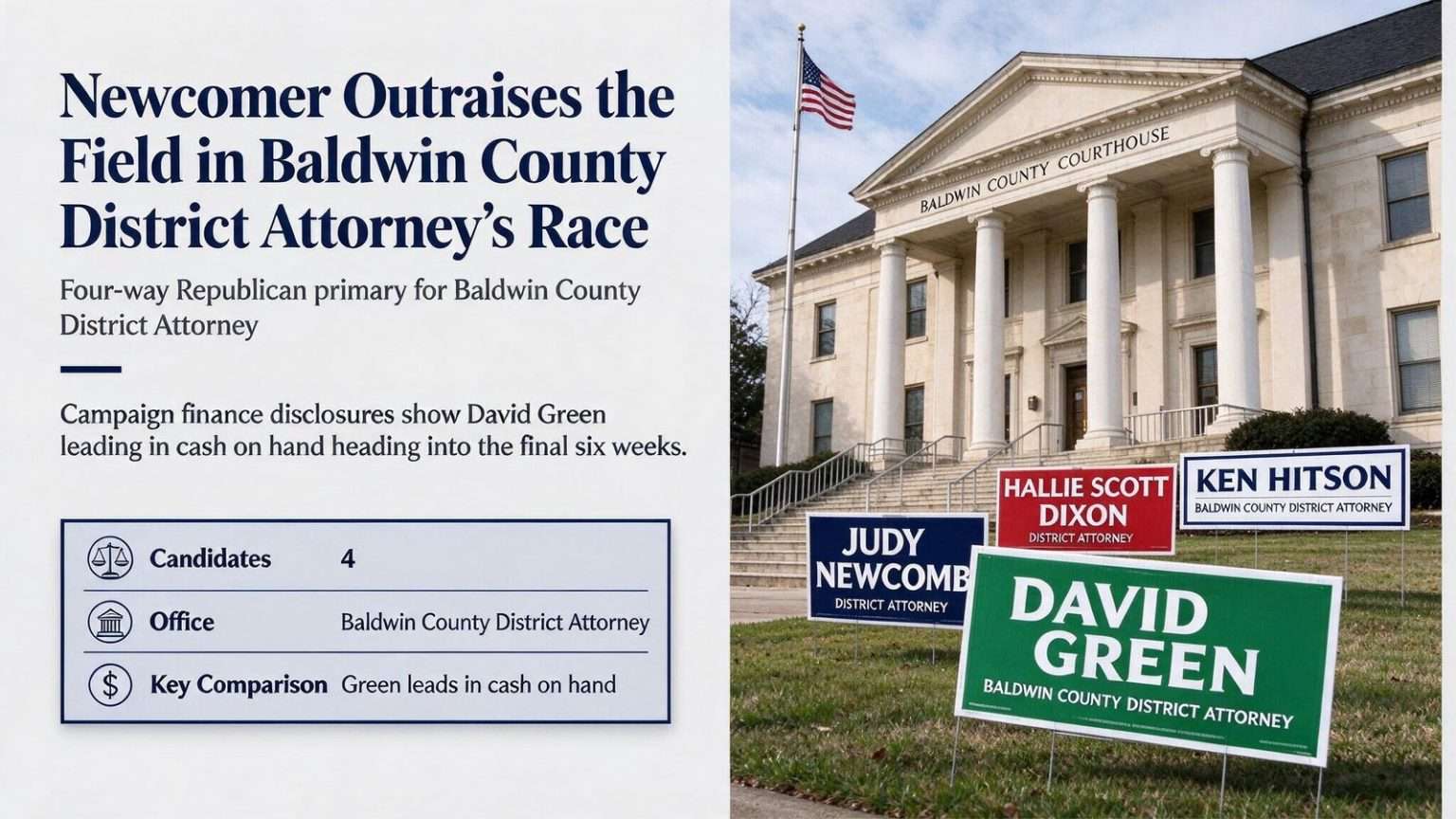
Magnolia Springs attorney David Green, the newcomer in a four-way Republican primary, raised more money than his three opponents combined and enters the final six weeks of the Baldwin County district attorney’s race with almost twice as much cash on hand as the incumbent, according to campaign financial disclosures filed with the Secretary of State.
The numbers
Green reported contributions of $50,540, including more than $16,000 from relatives and supporters in Louisiana. After spending $38,700.67, he ended the reporting period with $40,189.33 in the bank.
Incumbent District Attorney Judy Newcomb generated $22,817 in contributions — a figure that includes a $10,000 personal loan to her own campaign — and finished with a balance of $21,537.68 after spending $24,824.32.
Hallie Scott Dixon, a Silverhill native, former Newcomb assistant and more recently an assistant attorney general, raised $17,748.41. Heavy spending of $22,396.53 left her campaign with $4,944.91.
Ken Hitson, an Eastern Shore attorney and also a former assistant attorney general, was the last of the four to enter the race and raised $7,715. He spent $7,098.57, leaving a balance of $2,616.43 that reflects a $2,000 personal loan.
Together the four campaigns’ ledgers show a race shaped less by party — all four candidates are Republicans in a county where the Republican primary has long been the decisive contest — than by money, name recognition and network.
What the money says
Money is not votes, and a first-time candidate with a full war chest can still lose to an incumbent with a courthouse network. But the disclosures tell a story that Baldwin County Republicans will recognize: an incumbent under pressure, two challengers with prosecutorial credentials but thin resources, and a fourth candidate who has bought himself the ability to be heard.
Green’s haul came in significant part from a network of family and personal supporters, including a $10,000 contribution from Lawrence Green and several gifts of $2,500 and $5,000 from individual donors. He also drew from the Baldwin County business community — trucking and paving companies, a real estate firm, a masonry contractor, a restaurant — the sort of ledger that reflects both the county’s growth-industry economy and a candidate’s ability to ask.
The concentration of Green’s giving is itself a data point. More than $16,000 arriving from relatives and supporters in Louisiana signals that the Magnolia Springs attorney’s network reaches beyond Baldwin County — a private-practice lawyer with personal wealth and friends willing to fund a first campaign at levels local challengers rarely reach. Loans and family money dominate the ledgers of self-funded candidates, and how voters read that — as independence or as buying a race — tends to shape the campaign’s narrative.
Newcomb’s numbers tell a different story. An incumbent district attorney rarely needs to raise heavily in a county where the office carries built-in name recognition, and her $22,817 total — with a $10,000 loan of her own — suggests a campaign leaning on personal commitment and a courthouse network rather than broad solicitation. But outspent two-to-one in cash on hand heading into the final six weeks, the incumbent faces an advertising gap that name recognition must close.
Dixon’s campaign spent more than it raised — $22,396.53 against $17,748.41 — leaving just under $5,000 in the bank. The pattern of a challenger spending early and heavily is familiar: money buys the yard signs, mailers and media that introduce a candidate whose name is not yet known, and the gamble is that an investment made early converts to votes before the account runs dry. Her credentials — a Silverhill native, a former assistant to Newcomb, and an assistant attorney general — give the spending something to sell.
Hitson’s late entry shows in his totals. Raising $7,715 as the last candidate into the race, and lending his campaign $2,000 of it, left the Eastern Shore attorney with the thinnest resources of the four. Late-starting campaigns trade money for time, leaning on personal networks and free appearances rather than paid media.
The concentration of Green’s giving is itself a data point. More than $16,000 arriving from relatives and supporters in Louisiana signals that the Magnolia Springs attorney’s network reaches beyond Baldwin County — a private-practice lawyer with personal wealth and friends willing to fund a first campaign at levels local challengers rarely reach. Loans and family money dominate the ledgers of self-funded candidates, and how voters read that — as independence or as buying a race — tends to shape the campaign’s narrative.
Newcomb’s numbers tell a different story. An incumbent district attorney rarely needs to raise heavily in a county where the office carries built-in name recognition, and her $22,817 total — with a $10,000 loan of her own — suggests a campaign leaning on personal commitment and a courthouse network rather than broad solicitation. But outspent two-to-one in cash on hand heading into the final six weeks, the incumbent faces an advertising gap that name recognition must close.
Dixon’s campaign spent more than it raised — $22,396.53 against $17,748.41 — leaving just under $5,000 in the bank. The pattern of a challenger spending early and heavily is familiar: money buys the yard signs, mailers and media that introduce a candidate whose name is not yet known, and the gamble is that an investment made early converts to votes before the account runs dry. Her credentials — a Silverhill native, a former assistant to Newcomb, and an assistant attorney general — give the spending something to sell.
Hitson’s late entry shows in his totals. Raising $7,715 as the last candidate into the race, and lending his campaign $2,000 of it, left the Eastern Shore attorney with the thinnest resources of the four. Late-starting campaigns trade money for time, leaning on personal networks and free appearances rather than paid media.
The four-way dynamic complicates every candidate’s math. In a one-on-one race, fundraising gaps translate directly into media gaps; in a four-way field, the second-best-funded campaign can split the same anti-incumbent vote as the best-funded one, and the incumbent can survive a money deficit if her support is deeper than her rivals’. Challengers who attack each other spend money softening votes that another challenger might capture — one reason four-way primaries often stay polite on the surface even as the spending escalates beneath it.
The geography of the money also matters in a county of Baldwin’s size. Green’s base around Magnolia Springs and the south county’s bayside communities, Hitson’s Eastern Shore network, Dixon’s Silverhill roots and Newcomb’s countywide courthouse ties each map to a different slice of the electorate, and the campaigns’ final-week schedules — which communities get the candidates’ time and remaining dollars — will reflect those maps.
The stakes in the prosecutor’s race
The district attorney’s office is the most powerful elective office in Baldwin County’s criminal justice system. The DA decides which charges are brought, which defendants are offered pleas, which cases go to trial and which crimes get the office’s attention — from violent offenses to drug trafficking to the property crimes that come with one of the state’s fastest-growing counties. Baldwin’s population growth has pushed caseloads steadily upward, and whoever wins the office inherits a staff of prosecutors and investigators stretched across courthouses in Bay Minette, Foley, Fairhope and Robertsdale.
That breadth makes the race more than an intraparty spat. The four candidates offer voters a genuine choice about the office’s direction: an incumbent defending her record, a former insider who knows the office from within, and two lawyers from private practice promising a fresh approach.
Reading the final six weeks
With the reporting period closed and six weeks to election day, the campaigns’ positions can be sketched from their balances. Green, with $40,189.33, can afford a sustained media and mail presence across a county that stretches from Mobile Bay to the Florida line — expensive geography for any campaign. Newcomb, with $21,537.68, has half that reach but the incumbent’s intangibles. Dixon and Hitson, with $4,944.91 and $2,616.43, must make the remaining stretch count through retail politics: courthouses, civic clubs, church suppers and the door-to-door work that Baldwin County’s Republican primary voters traditionally reward.
Endorsements, debates and the county’s active Republican political network will fill the weeks ahead. In a four-way race, a plurality can win — which changes the arithmetic for every campaign, and means the candidate with the most dedicated, identifiable voters, not simply the biggest budget, can prevail.
The disclosures offer one more lesson about Baldwin County politics: the county’s growth economy funds its campaigns. The trucking, paving and development interests that appear in Green’s report are the same industries reshaping the county’s landscape, and prosecutors’ races increasingly draw that money because the office touches the questions — growth, crime, courts — that growth itself creates.
Whatever the outcome, the money race has already reset expectations. An incumbent district attorney being outraised and out-banked in her own primary, by a first-time candidate with family money and a business community’s backing, is not the shape a Baldwin County courthouse race was expected to take — and it ensures the final six weeks will be watched closely from Bay Minette to Gulf Shores.