What Baldwin County Gets From Alabama’s $144 Million Rural Health Grant Round
Gov. Kay Ivey announced 138 Rural Health Transformation Program grants totaling more than $144 million on Aug. 24. Here is the Baldwin County breakdown, from a mobile women's health program to residency training, nursing faculty and behavioral health telehealth.
Alabama handed out a large amount of health care money in late August, and a meaningful share of it lands in Baldwin County — not as one headline check, but spread across mobile clinics, physician rotations, behavioral health telehealth, nursing instructors, tuition aid and cybersecurity for rural providers.
Gov. Kay Ivey announced Aug. 24 that the state had awarded 138 grants totaling more than $144 million to health care providers and institutions across Alabama through the Rural Health Transformation Program. According to a news release from Ivey’s office, the projects are intended to improve health care access, quality and outcomes in rural communities.
Several of those grants include Baldwin County among the areas served. Below is the county breakdown, followed by what each category of spending actually addresses.
Infirmary Health: More Than $5.3 Million Across Southwest Alabama
Infirmary Health received more than $5.3 million through the program for projects across southwest Alabama.
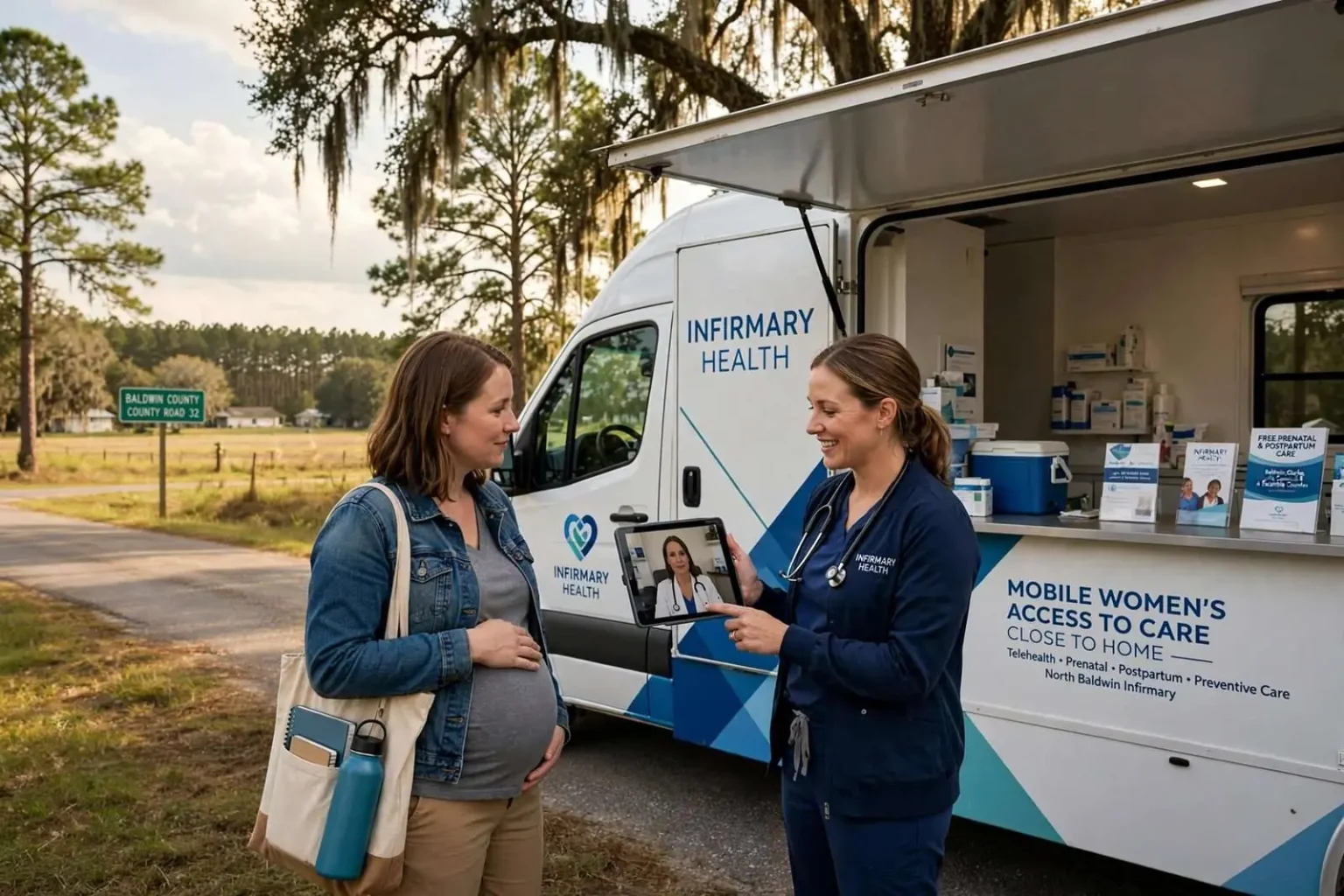
The single largest Baldwin-specific piece is $1.12 million for its Women’s Access to Care Close to Home Initiative, which will expand preventive, prenatal, postpartum and specialty-connected care in Baldwin, Clarke, Conecuh and Escambia counties. Plans include a mobile, telehealth-enabled program through North Baldwin Infirmary.
“Investing in rural healthcare means investing in the future of our communities. Southwest Alabama has a strong healthcare foundation, and this funding allows Infirmary Health to build on it by expanding services and meeting the growing needs of the communities we serve,” Scott Fenn, Senior Vice President – Strategy and Government Relations, Infirmary Health, said in the release from the health system.
The health system’s other awards in the round:
- $342,147 to establish rural clinical rotations for internal medicine residents in Baldwin, Clarke, Escambia, Mobile and Washington counties, intended to strengthen the physician pipeline in rural communities.
- $386,000 to establish the Rural Women’s Health Hub of Southwest Alabama in Clarke and Washington counties.
- $3.5 million to create a regional referral and technology network connecting rural hospitals and clinics in Clarke, Mobile and Washington counties.
The Other Baldwin County Awards
Several statewide and regional organizations also received grants naming Baldwin County among the counties served.
- Alabama Primary Health Care Association — $867,102 to establish a shared rural health technology and care coordination framework serving 43 counties, including Baldwin.
- AltaPointe Health Systems — $457,073 to strengthen cybersecurity across its rural behavioral health network in seven counties, including Baldwin.
- Franklin Primary Health Center — $574,091 to establish a rural behavioral health telehealth program serving Baldwin, Choctaw, Conecuh, Escambia and Monroe counties.
- Franklin Primary Health Center — $1.1 million to develop a rural training track within its family medicine residency program, to strengthen the pipeline of primary care physicians in Baldwin County.
- Alabama Community College System — $319,540 to establish a registered earn-and-learn apprenticeship designed to expand the nursing faculty workforce in 21 counties, including Baldwin.
- Alabama Community College System — $464,000 to create accelerated healthcare credential pathways for veterans.
- Faulkner University — $975,000 for a rural healthcare workforce program providing tuition assistance to eligible health profession students who commit to five years of employment in rural Alabama, including clinical rotations in 58 counties, including Baldwin.
- University of Alabama at Birmingham — $7 million to strengthen the rural primary care workforce through physician recruitment, training and retention efforts serving 35 counties, including Baldwin.
Read as a list, those awards look scattered. Read as a strategy, they are not. Only a portion of the money buys direct patient services; most of it buys people, training and infrastructure.
Why ‘Rural’ Applies to a Fast-Growing County
Baldwin County is one of Alabama’s fastest-growing counties, which can make its inclusion in a rural health program look odd at first glance. It is not.
Baldwin is geographically enormous — the largest county by land area in the state — and its growth has been concentrated unevenly. The coastal and Eastern Shore corridor has added population, retail and medical capacity at a rapid clip. Large stretches of the county’s interior and north end have not grown at the same pace and remain genuinely rural in the way that matters for health care: long distances to a hospital, thin provider coverage, fewer specialists and a population that skews older and less mobile.
Health care access is measured in drive time, not county population totals. That is the gap the Women’s Access to Care Close to Home Initiative — and its mobile, telehealth-enabled component through North Baldwin Infirmary — is aimed at.
Prenatal and postpartum access is one of the sharpest pressure points in rural American health care. Labor and delivery units require round-the-clock staffing by specialized clinicians whether or not a patient walks in, and in low-volume rural settings that arithmetic often does not work. When such units close, the effect reaches well beyond delivery day: prenatal visits, postpartum follow-up and routine women’s health care all become longer trips.
Distance matters here more than it might seem. Prenatal care works through frequency — repeated visits that catch problems such as high blood pressure or gestational diabetes early enough to manage them. A patient facing a half-day round trip for each appointment attends fewer of them, and missed visits are how manageable conditions turn into emergencies.
A mobile, telehealth-enabled program attacks that in two directions at once. The mobile piece moves the visit to the patient, cutting the travel burden that drives missed appointments. The telehealth piece connects a local visit to specialists who are not physically present, so a patient can get a consultation without a separate trip to a larger city — which is what “specialty-connected care” means in practice.
Residencies, Apprenticeships and the Workforce Pipeline
The largest theme in Baldwin County’s share of this round is not equipment. It is people — and specifically where they are trained.
Physician placement follows a well-documented pattern: doctors disproportionately end up practicing near where they completed residency, because residency is where they build professional networks, learn a region’s referral relationships, and often where they and their families settle. A medical student trained entirely in a large urban academic center, who has never worked in a small-town clinic, is unlikely to choose one afterward.
That explains why so many of these awards target training rather than hiring. Infirmary Health’s $342,147 for rural clinical rotations puts internal medicine residents in rural counties — including Baldwin — during the formative years of their careers. Franklin Primary Health Center’s $1.1 million rural training track does the same within a family medicine residency. UAB’s $7 million package pairs recruitment with training and retention across 35 counties, retention being the half of the equation that is usually harder than recruitment.
The Alabama Community College System’s $319,540 apprenticeship targets a bottleneck that gets less attention but constrains everything downstream: nursing faculty. Nursing programs routinely turn away qualified applicants because they do not have enough instructors, and instructors are hard to recruit because experienced nurses can often earn more at the bedside than in a classroom. An earn-and-learn apprenticeship to build faculty capacity is an attempt to widen the neck of the funnel rather than push more people into it.
Faulkner University’s $975,000 program takes the most direct approach available: tuition assistance in exchange for a five-year commitment to work in rural Alabama, plus clinical rotations across 58 counties. Service-obligation scholarships are a long-standing tool in rural health precisely because they address cost and placement in a single transaction — and because five years in a community is often long enough for a clinician to put down roots.
The separate $464,000 award for accelerated healthcare credential pathways for veterans draws on an existing pool of trained people. Military medical training produces medics and corpsmen with substantial clinical experience that does not automatically convert into civilian licensure. Credential pathways shorten that conversion, and veterans are frequently already living in the smaller communities that need staff.
Behavioral Health, Telehealth and Cybersecurity
Behavioral health is the other clear priority, and the field where rural shortages are most severe. Psychiatrists and specialized therapists concentrate in metropolitan areas even more heavily than primary care physicians, and small communities often have no practitioner within a reasonable drive.
Franklin Primary Health Center’s $574,091 telehealth program addresses that directly across Baldwin, Choctaw, Conecuh, Escambia and Monroe counties. Behavioral health is unusually well suited to remote delivery: much of it is conversation, which means a video connection preserves most of what happens in the room. It also sidesteps a barrier specific to small towns, where a patient may hesitate to walk into the one local counseling office where a neighbor might see them.
That makes AltaPointe Health Systems’ $457,073 cybersecurity award less peripheral than it first appears. Once behavioral health care moves onto networks, those networks hold some of the most sensitive records in medicine, and rural providers with thin IT staffing are attractive ransomware targets. An attack that locks up records or forces a provider offline interrupts care for patients who have few alternatives. Funding security is part of the cost of funding telehealth.
The Alabama Primary Health Care Association’s $867,102 for a shared technology and care coordination framework across 43 counties, including Baldwin, works on the same logic at a larger scale. Small independent clinics cannot each build their own records systems and coordination tools. A shared framework spreads that cost, and care coordination — making sure a patient’s hospital visit, specialist referral and primary care follow-up connect to one another — is where rural patients most often fall through the gaps.
How the Program Works and What Comes Next
“Alabama is serious about creating systematic changes through the ARHTP to ensure every citizen has access to quality care. This program is enabling institutions covering every part of the state to improve healthcare for Alabamians through projects that are both innovative and sustainable,” Ivey said in the release. “From the federal policymakers and state administrators to our professional healthcare leaders, I commend all the thoughtful work dedicated to ensuring the success of this program.”
The initial round of funding covers five of the program’s 11 initiatives: Rural Health, Rural Workforce, Mental Health, Rural Health Practice and Collaborative Electronic Health Record, and IT and Cybersecurity. Additional grants are expected to be announced later — meaning this round is a first installment rather than the full picture, and organizations serving Baldwin County may appear again in later announcements.
The program is administered by the Alabama Department of Economic and Community Affairs and supported by the Centers for Medicare & Medicaid Services within the U.S. Department of Health and Human Services, with 100% of funding provided by CMS/HHS.
What to Watch in Baldwin County
Grant announcements are promises; the useful measure arrives later. A few things will show whether the money does what it was awarded to do:
- Whether the mobile, telehealth-enabled women’s health program through North Baldwin Infirmary reaches the parts of the county farthest from existing providers, rather than the areas already best served.
- Whether behavioral health telehealth translates into shorter waits for an appointment, which is the real bottleneck in most rural mental health systems.
- Whether residents and students rotating through Baldwin County under the training grants stay in the region after their programs finish.
- Whether the shared technology and coordination framework actually links providers, rather than adding another system that does not talk to the others.
Workforce grants in particular are slow instruments. A rural training track, a nursing faculty apprenticeship or a tuition-for-service commitment produces its first working clinicians years after the check clears. That is not a flaw in the design — it is what building a pipeline means — but it does mean the effects of this round will show up in Baldwin County gradually, in the form of appointments that are easier to get and drives that are shorter, rather than in a ribbon cutting.