Baldwin Prep Senior Builds Smartphone-Controlled 3D-Printed Prosthetic Hand, Reaches HOSA State Competition
Baldwin Preparatory Academy senior Carlos Alejo Flores designed a low-cost, 3D-printed prosthetic hand controlled by a smartphone app, and with classmate Emily Marie Locke took it to HOSA’s state competition.
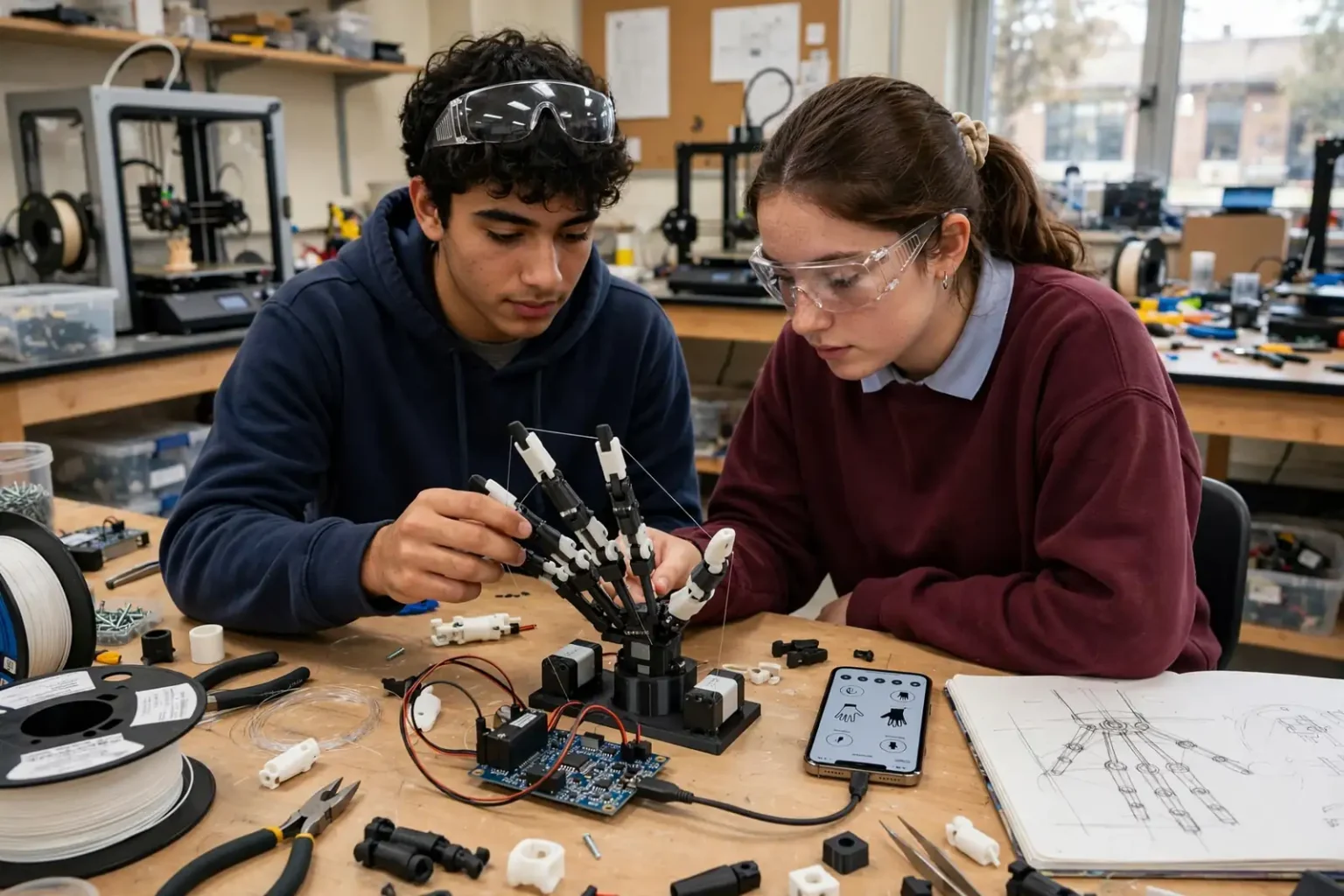
LOXLEY, Ala. — A Baldwin Preparatory Academy senior has designed a 3D-printed prosthetic hand that can be controlled wirelessly from a smartphone, a project he hopes could one day lead to a cheaper option for people who have lost a limb. Carlos Alejo Flores built the device over 14 design revisions, and with classmate Emily Marie Locke handling the presentation, the project carried the pair to the state level of a HOSA medical innovation competition.
The invention blends engineering, computer programming and health science. It remains a prototype, but Flores already has plans for where it could go next.
A conversation that sparked an invention
Flores said the idea grew out of a conversation with a man who used a prosthetic leg. Talking with him opened Flores’ eyes to how hard it can be for people to obtain prosthetic devices, especially because of the cost.
“It was just a conversation we had, and that was just kind of what inspired me,” Flores said. “I always wanted to do an engineering project during high school.”
Flores explained that there is a wide gap between basic mechanical prosthetics and more advanced myoelectric devices. Mechanical prosthetics typically rely on physical mechanisms to produce movement. Myoelectric prosthetics use the electrical signals generated by a user’s own muscles to control the device. The technology difference often comes with a large difference in price.
“The main issue we were addressing was that there’s such a big gap, and obviously when you have the need to get a prosthetic, you kind of don’t have the financial freedom you would have normally,” Flores said.
He noted that people who depend on their hands for a living, such as carpenters and others in hands-on trades, can face even steeper financial challenges after losing a limb. His goal was to see whether a less expensive device could offer some of the functions associated with higher-end prosthetics.
From cardboard to 3D printer
Flores started with a cardboard prototype that used a claw-style grip. He studied how much movement and grip strength a hand would need to pick up objects, then translated those calculations into computer code.
After 14 rounds of revisions, he turned to a 3D printer to produce the individual components of the hand. The design uses a microcontroller, servo motors and even fishing line to make the fingers move.
The concept is that a user would choose a movement in a smartphone app, such as opening or closing the hand, rotating it or positioning the palm, and the hand would carry it out.
“So the prosthetic would work by having set point directions,” Flores said. “So you could have it like opening, closing, twisting, open palm, and just kind of being able to select that.”
During an interview about the project, Flores picked up a marker and sketched out how the pieces fit together. A command sent from a smartphone goes to the microcontroller, which processes it and sends signals to the motors that move the fingers.
“It’s just the component. It’s kind of like the computer chip,” Flores said of the microcontroller. “It processes the signal and then translates it into the motors.”
He also used his own hand to demonstrate how the fishing line would be pulled through the joints of each finger to make them bend, much as tendons do in a human hand. His proposed design adds sensors meant to regulate grip strength, so the hand does not squeeze an object too hard.
That combination of parts reflects a common approach among hobbyists, students and researchers working on low-cost prosthetics. Consumer 3D printers can produce lightweight plastic parts cheaply, small programmable microcontroller boards are widely available and inexpensive, and hobby servo motors can provide the pulling force needed to move printed fingers. Using a phone as the controller takes advantage of a device most people already carry.
A partnership built for competition
While Flores developed the engineering, he credits Locke with turning the project into a competitive medical innovation entry.
Locke, also a student in Baldwin Prep’s Health Sciences pathway, was new to the school and had not yet found a partner for HOSA, a student organization that prepares young people for careers as health professionals. Teachers connected her with Flores.
At first, she was not entirely sure what she had signed up for.
“We’re gonna be making a whole, like, prosthetic arm? Like, that’s what we’re gonna do?” Locke recalled asking.
Flores, she said, was fully committed. The two split the work, with Flores focusing on the engineering, programming and 3D printing and Locke taking charge of much of the presentation, artistic design and organization.
“I was more on the creative aspect and organized side of it,” Locke said. “So I did the poster, I had organized my speech, and then he was just doing the arm and 3D printing stuff.”
They entered the project in HOSA’s Medical Innovation competition, which challenges students to develop and present ideas related to health care. The competition gives students the chance to advance through several levels, including state and international events, and Flores and Locke advanced to the state competition.
Flores said Locke deserves much of the credit for that success.
“Getting placed in HOSA as a finalist was mainly due to her job with the artistic design, the presentation and the oral speech,” he said.
Locke said the experience taught her about teamwork while introducing her to an entirely new field of technology. She also remembers the nerves on presentation day.
“The day of, we had showed up and me and him were both pretty nervous,” Locke said.
Through it all, she said, Flores stayed supportive.
“He was a good teammate. Anytime I was overwhelmed about something and stressed out about the situation, he definitely was just like, you know, it’s okay, we still got time.” — Emily Marie Locke
What HOSA is
HOSA-Future Health Professionals is a national career and technical student organization for middle school, high school and college students interested in health care careers. Members join through chapters at their schools, usually tied to health science classes, and compete in events that test medical knowledge, health care skills, leadership and teamwork.
Students typically compete first at the regional or state level, and top finishers in each state can qualify for the organization’s international leadership conference, where students from across the United States and other countries compete. Medical Innovation is one of the events in which teams present a health-related invention or idea to judges.
How Baldwin Prep shaped the project
Baldwin Preparatory Academy, a Baldwin County Public Schools career-technical high school in Loxley, enrolls students from across the county in career pathways that range from health sciences to skilled trades and engineering-related programs. Through a partnership with Coastal Alabama Community College, students can also earn dual-enrollment college credit and industry credentials before they graduate.
Flores originally studied mechatronics, a field that combines mechanical engineering, electronics and computer control, before transferring into the school’s Health Sciences pathway. He said both programs contributed to the prosthetic.
“The school itself did teach me a lot on the mechanical side, on the engineering side of the project, but also on the health science side,” Flores said.
Learning more about human anatomy, he said, helped him rethink parts of the design to make the hand simpler and more efficient.
His interest in engineering also runs in the family. Flores grew up partly inspired by his father, an electrical engineer.
What comes next
After high school, Flores hopes to study biomedical engineering and biomechanics. He does not plan to leave his invention behind, saying he would love to keep developing the hand as a personal project, possibly seek a patent and use more advanced technology to move the concept closer to practical use.
His long-term vision is an affordable transitional prosthetic, a device that would help people recovering from an amputation handle everyday tasks while they work through the often lengthy process of getting a permanent prosthesis.
“So people who just got out of an amputation accident and needed a temporary fix that was economic to help them restart their lives and get on with it,” Flores said.
Locke’s experience has helped shape her own plans. She hopes to pursue medical science, specifically diagnostic testing that helps physicians identify and treat illnesses.
Both students are continuing to explore medical innovation through HOSA. For Flores, what started with a conversation and a cardboard claw may be the first step toward an invention that one day gives someone a helping hand.