Baldwin Preparatory Academy Opens 2026-2027 Year With Expanded Career and Technical Programs
Baldwin Preparatory Academy has opened the 2026-2027 school year with 233 new 10th graders and an expanded Cosmetology Program now open to the public each Monday.
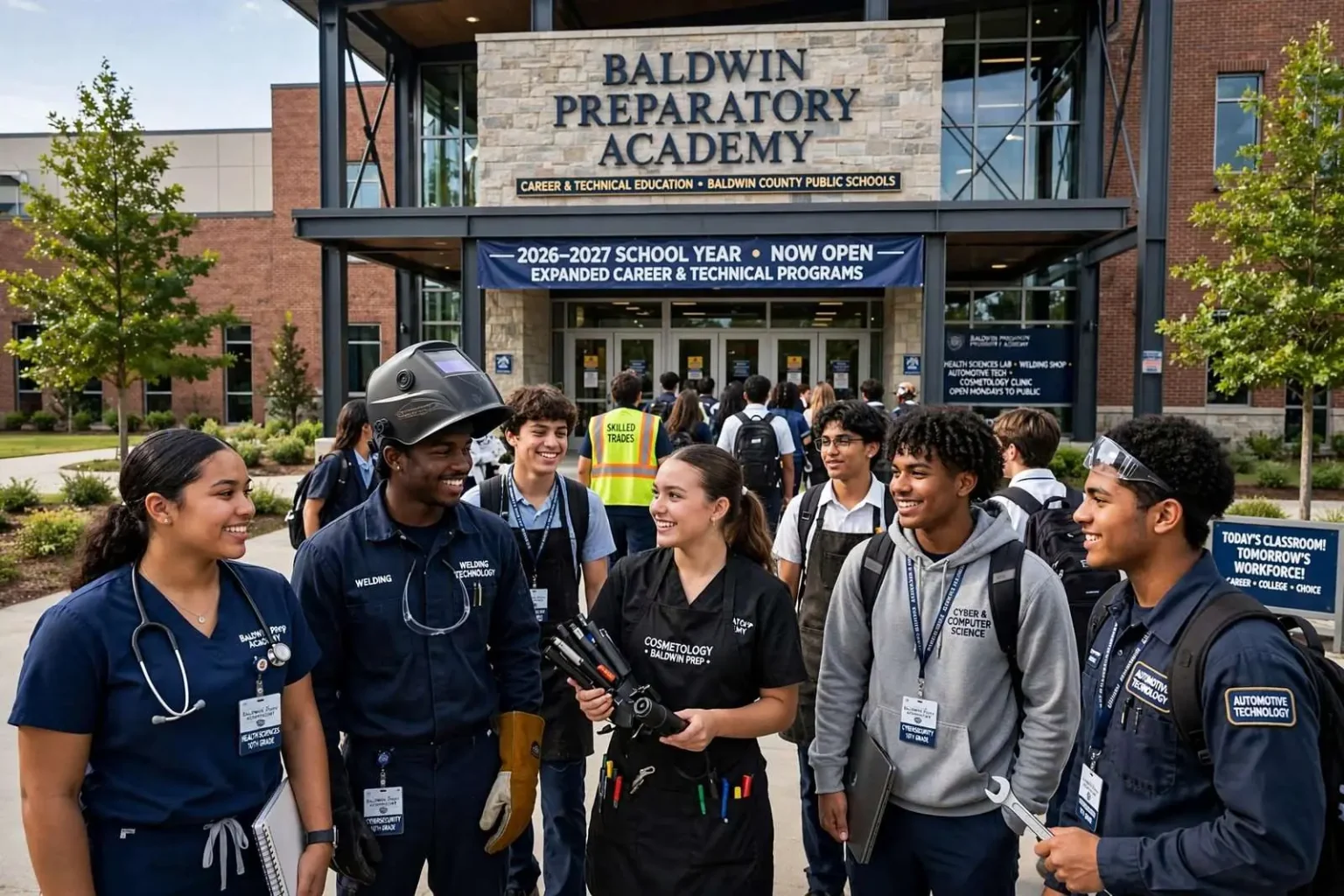
Baldwin Preparatory Academy has kicked off the 2026-2027 school year with a wave of new career and technical offerings, welcoming 233 incoming 10th-grade students to its Baldwin County campus. The full-time, magnet-style school operates out of a 200,000-square-foot facility and blends rigorous academics with hands-on, real-world training designed to prepare students for college, technical careers, or direct entry into the workforce.
Baldwin Prep represents one of the most ambitious career and technical education ventures in Alabama. Baldwin County Public Schools, the largest county school system geographically in the state, built the academy to solve a problem familiar to fast-growing regions: high school students spread across a county the size of some New England states had limited access to specialized training labs that no single campus could afford alone. By concentrating programs in one facility, the district gives students from Gulf Shores to Bay Minette access to industry-grade equipment and instructors that individual high schools could never sustain.
The facility’s scale tells the story. Two hundred thousand square feet houses training spaces for health sciences, welding, automotive technology, cyber and computer science, hospitality, and skilled trades, each outfitted to mirror the workplaces students will enter. Rather than splitting their days between a home high school and a career tech center, students at Baldwin Prep attend full time, weaving academic coursework into a schedule dominated by their chosen field.
Students are held to professional standards from day one, including industry-specific uniforms and expectations around time management and accountability. The approach is deliberate: employers in construction, healthcare, and hospitality tell educators that the biggest workforce gaps are often in professionalism — attendance, communication, and reliability — rather than technical skill alone. Baldwin Prep’s model treats the school as a workplace, with the same expectations a student would face on a job site or in a clinic.
New for This Year: A Cosmetology Program Open to the Public
Among the new offerings this year is an expanded Cosmetology Program, which will open to the public every Monday beginning in September. The change gives students real-world experience working with clients while they train for careers as licensed cosmetologists or barbers.
The client-day model is a staple of quality cosmetology training. Alabama’s licensing rules require students to complete a set number of practical hours working on real clients before they can sit for the state board examination, and schools that operate public clinics let students accumulate those hours under instructor supervision. For Baldwin County residents, the Monday clinic offers salon and barber services at student prices, with the understanding that supervised trainees are performing the work — an arrangement that benefits both sides and turns the classroom into a functioning small business.
The program also plugs into a genuine workforce need. Salons and barbershops across Baldwin County’s booming communities from Foley to Daphne regularly report openings, and the trade offers graduates a path to licensure, immediate employment, and eventual ownership — all without a four-year degree. Baldwin Prep’s expansion signals that the academy intends to serve trades alongside its technology and health science tracks.
A Milestone: The First Full Three-Year Class
The new school year follows a milestone for the academy: the graduation of its first class of students to complete all three years at Baldwin Prep at the close of the 2025-2026 school year. During that same year, 564 students took part in dual-enrollment coursework through Coastal Alabama Community College, together earning 106 industry credentials.
The three-year completion milestone matters because Baldwin Prep’s model is built on depth rather than exposure. Students who spend their final three years of high school inside one program emerge with hundreds of hours in their field, not a semester’s sampling. That depth is what industry certification exams and apprenticeship programs expect, and the first graduating class gave the academy its first proof that the model works end to end — from a 10th grader’s first day to a diploma carried alongside credentials employers recognize.
The dual-enrollment numbers show the academy’s scale of ambition. Coastal Alabama Community College, whose campuses and sites serve Baldwin County and much of southern Alabama, partners with school systems statewide to let high schoolers earn college credit and technical certifications before graduation. With 564 students enrolled through the partnership and 106 industry credentials earned in a single year, Baldwin Prep has built one of the larger dual-enrollment pipelines on the Gulf Coast, shortening the path to degrees and certifications its students might otherwise take years to finish.
Leadership’s Vision
“We are excited to welcome our students back for another year of learning, growth and opportunity,” said Adam Sealy, principal of Baldwin Preparatory Academy. “Whether they choose to pursue college, a career or enter the workforce, we want them to leave Baldwin Prep with the confidence, professionalism and hands-on experience they need to succeed.”
The framing is notable for what it doesn’t do: it refuses to rank the three destinations. Career academies have historically fought the perception that they are the fallback for students not headed to college. Baldwin Prep’s leadership has pushed back on that, pointing to students who leave with both a trade certification and the academic record to enter a university — a combination increasingly valuable in fields like healthcare and engineering technology, where employers hire technicians and often fund their continued education.
School leaders say the goal is to keep programs aligned with what local employers need. “Our goal is to give students the education, skills and real-world experiences to build their own future,” Sealy said, pointing to the school’s updated motto — “Today’s Classroom! Tomorrow’s Workforce! Career – College – Choice” — as a reflection of that mission.
Why Baldwin County Built an Academy
Baldwin Prep exists because of the county’s own economics. Baldwin is among the fastest-growing counties in Alabama, with a coastal tourism economy, expanding healthcare systems, a construction boom that stretches from Daphne to Gulf Shores, and industrial employers along the Interstate 10 corridor. Each of those sectors reports the same problem: more jobs than qualified applicants. The school system’s answer was a dedicated campus where students could train for those industries while completing their high school diplomas, shortening the distance between a Baldwin County classroom and a Baldwin County paycheck.
The magnet-style admission model also sets the academy apart within the district. Rather than offering scattered career tech electives at each high school, Baldwin Prep draws motivated students from across the county into a single full-time program, concentrating equipment, instructors, and employer partnerships that would otherwise be diluted. Students apply, choose a program track, and spend three years immersed in it — a structure that mirrors the early-college academies popular in larger metro systems but scaled to a suburban-rural county.
Professionalism as a Curriculum
The uniforms and workplace standards that greet Baldwin Prep students serve a purpose employers notice. Health science students wear scrubs; trades students don the gear of their fields; hospitality and cosmetology students dress as they would on the job. The habit-building is intentional — showing up on time, dressed correctly, accountable to a team — and academy leaders describe it as teaching the “soft skills” that technical training alone cannot supply. Graduates who interview with local employers arrive already fluent in the expectations of a workplace.
That philosophy extends to how the academy measures success. Beyond test scores, Baldwin Prep tracks industry credentials earned, dual-enrollment credits accumulated, apprenticeships and internships landed, and graduates’ transitions into jobs, military service, or college programs. The 106 credentials earned through the Coastal Alabama partnership in a single year represent that scoreboard in action.
What the 2026-27 Year Holds
With 233 new 10th graders joining returning cohorts, Baldwin Prep’s enrollment continues to climb as word spreads across the county’s high schools. The expanded cosmetology clinic, new program offerings, and the continued Coastal Alabama dual-enrollment pipeline give this year’s students more pathways than the academy’s first classes had. School leaders enter the year with the confidence of a proven model — a full class of three-year graduates now out in the workforce and on college campuses — and the ambition of a school whose motto promises that its classrooms are tomorrow’s workforce.
The academy’s growth also reflects deliberate community investment. Baldwin County voters and school leaders have backed career technical education at the ballot box and in budget cycles, betting that graduates who stay in the county to work — in its hospitals, shipyards, restaurants, and construction firms — repay the investment through the very workforce the region’s economy demands. Each September’s new class, including this year’s 233 incoming sophomores, represents that bet compounding.
Baldwin Preparatory Academy is part of a growing push across Baldwin County to expand career and technical education options for high school students, a push that has made the county one of the state’s leaders in connecting high school training to the employers who need it most.