BASF Donates $25,000 to Red Cross Sally Recovery Telethon
McIntosh chemical maker BASF pledged $25,000 to the Red Cross Sally recovery telethon, funding relief for families in Mobile and Baldwin counties.
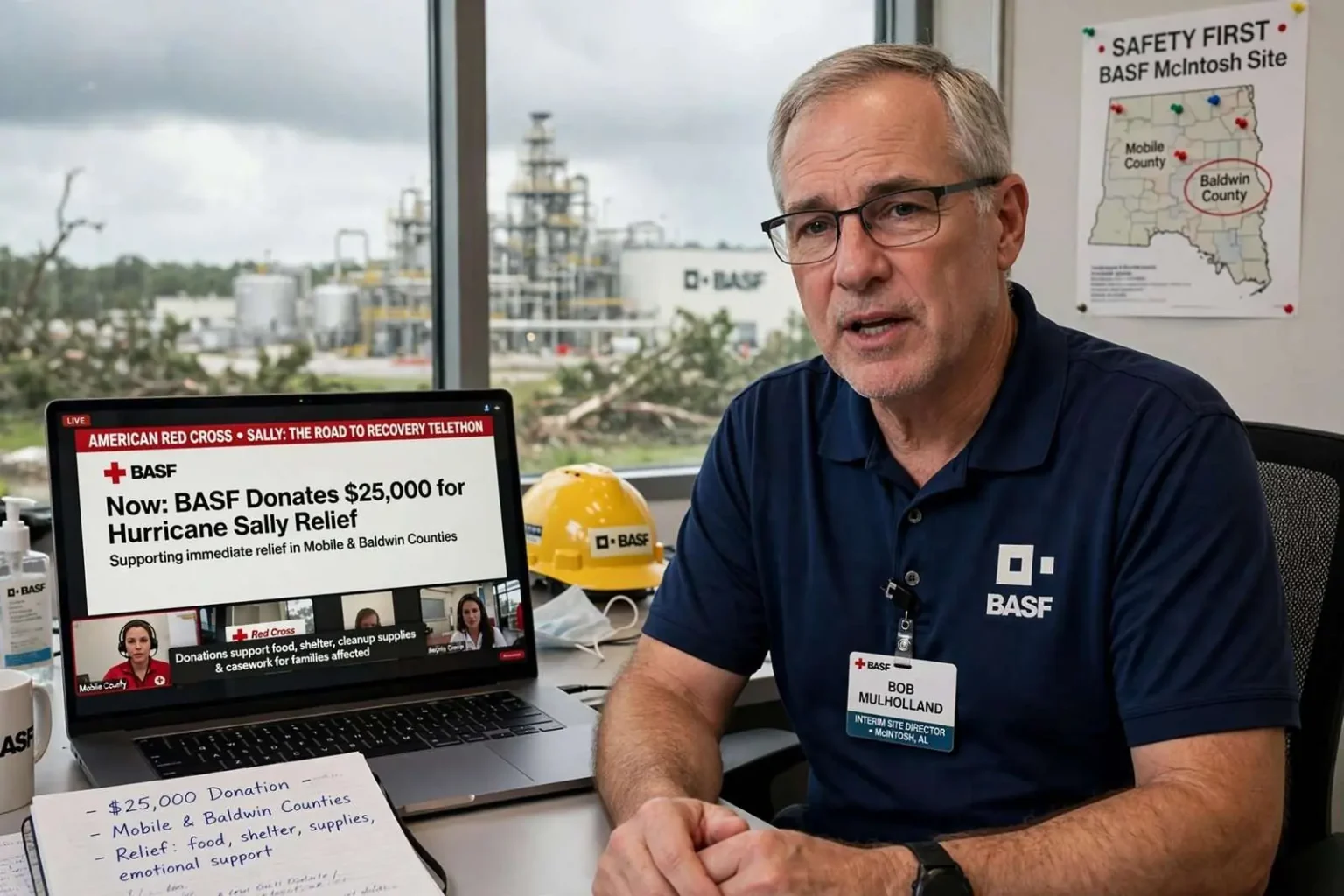
A McIntosh chemical maker is putting $25,000 behind the Gulf Coast’s recovery from Hurricane Sally. BASF Interim Site Director Bob Mulholland joined the American Red Cross’s virtual Sally: The Road to Recovery Telethon on Thursday to announce the contribution, which will support immediate relief efforts in Mobile and Baldwin counties.
“We know this donation will allow the Red Cross to continue to help in recovery efforts such as providing food, shelter, relief supplies, and emotional support,” Mulholland said. “Our hearts go out to those affected and we gladly leverage our resources to assist where needed.”
The announcement came during a live segment of the telethon, a fundraising broadcast organized by the American Red Cross to channel donations directly into the ongoing response across south Alabama. Because the event was held in a virtual format, supporters were able to follow along and give remotely rather than gathering in person, an approach that let organizers reach donors across the region even as many communities were still dealing with debris-clogged roads and widespread power interruptions in Sally’s aftermath.
Telethons of this kind have long been a staple of Red Cross fundraising after major disasters, combining on-air appeals with pledges from corporate partners and individual donors. In the weeks after Sally, the need was acute: thousands of households across the two-county area were coping with damaged roofs, fallen trees, spoiled food, and the disruption of schools and workplaces, and relief organizations were stretched across a long ribbon of affected territory from the bayfront communities of Mobile to the beach towns of Baldwin County.
For BASF, the gift extends a pattern of engagement that has made the company a familiar presence in civic life around McIntosh. The company’s site there employs more than 600 people in its performance chemicals division, making it one of the larger industrial employers in rural Washington County, where the plant sits along the Tombigbee River. Plants of that scale are more than payrolls: they anchor supplier relationships, volunteer pipelines, and charitable giving in the small towns around them, and local officials routinely point to them when describing the economic base of the region north of Mobile Bay.
The McIntosh operation’s involvement in the telethon also reflected the practical reality that chemical manufacturing sites along the Gulf Coast sit in the same hurricane-prone geography as their neighbors. When a storm like Sally moves through, plant employees are themselves residents of the affected area, dealing with the same outages, damage, and recovery headaches as the surrounding communities, which gives corporate relief contributions from such employers a distinctly local character.
Why the Red Cross Turned to a Virtual Telethon
The Sally: The Road to Recovery Telethon was designed to convert public attention on the storm’s lingering damage into usable funds. Rather than a single evening appeal, the format emphasized sustained recovery: donations announced during the broadcast were earmarked for immediate relief work, the phase of a disaster response that covers the basics families need most in the days and weeks after impact.
That phase includes traditional Red Cross pillars such as emergency lodging for people displaced from damaged homes, distributed meals in neighborhoods where grocery stores and restaurants were knocked offline, cleanup supplies for households mucking out flooded or wind-damaged properties, and casework that connects individual families with the specific help they need. The BASF contribution was framed by organizers as supporting that full range of services in Mobile and Baldwin counties.
Corporate gifts like the one Mulholland announced also serve a signaling function in post-storm fundraising. Large early commitments from established local employers tend to encourage smaller donations from businesses and individuals who see that the effort has credible backing, and fundraisers frequently build telethon segments around such announcements for exactly that reason. Thursday’s segment gave viewers a concrete example of a major regional employer stepping forward, alongside the emotional appeals that carried the rest of the broadcast.
Sally’s Devastating September Landfall
Hurricane Sally came ashore near Gulf Shores in mid-September 2020 as a Category 2 storm, and its slow crawl toward land turned it into one of the more punishing storms the region has weathered in recent years. Because the system moved at a glacial pace as it approached the coast, bands of rain swept over the same communities again and again, piling up rainfall totals that flooded streets and homes well inland of the shoreline. For residents of Mobile and Baldwin counties, the experience was defined less by a single violent pass of the eyewall than by hours upon hours of wind, water, and falling trees.
The storm’s most visible calling card across south Alabama was the damage to the tree canopy. Saturated ground and sustained winds combined to topple oaks and pines onto houses, power lines, and roads, and utility crews spent days and then weeks restoring service to neighborhoods where nearly every line had been brought down. Roof damage was similarly pervasive, with shingles and decking peeled back by hours of wind and rain driving into the same weak points. Coastal communities dealt with the added burden of storm surge, which pushed water into low-lying streets and left behind the sodden cleanup that follows every surge event.
Recovery from a storm of that character is measured in months, not days. Long after the immediate rescue phase ends, families are still negotiating with insurers, replacing roofs, clearing lots, and replacing what the water ruined, and that is precisely the stretch of a disaster when public attention drifts and charitable giving slows. Relief organizations describe the period after the cameras leave as the hardest stretch to fund, which is what the Sally telethon was built to address.
The American Red Cross, which has responded to Gulf Coast hurricanes for generations, maintains the kind of standing infrastructure that a fast-moving response requires: pre-positioned supplies, trained volunteers, shelter agreements with schools and churches, and mobile feeding capability that can reach neighborhoods cut off by debris. Mobilizing that machinery is expensive, and it begins before the first donation arrives, which makes contributions like BASF’s a form of replenishment for resources the organization has already spent on the ground.
In the weeks after Sally’s landfall, Red Cross teams across south Alabama were doing the unglamorous work that defines recovery: handing out meals in parking lots, distributing rakes, shovels, tarps, and cleanup kits, and sitting down with families whose homes had been damaged to work through what assistance they might qualify for. Casework of that sort is labor-intensive, one household at a time, and it is the piece of the operation that telethon donations were designated to sustain in Mobile and Baldwin counties.
The geography of the response mattered as well. Mobile County’s damage was concentrated in older neighborhoods with mature trees, along the bay, and in the western communities that took the storm’s eastern rain bands for a full day. Baldwin County’s eastern shore, closest to the landfall point, absorbed some of the worst wind damage in the state, and communities up the bay dealt with surge and flooding that lingered well after the skies cleared. A single telethon serving both counties had to speak to audiences whose experiences of the same storm differed sharply.
What the Donation Funds on the Ground
The Red Cross uses telethon donations for the concrete elements of relief: shelter operations for displaced residents, meals served out of mobile kitchens, cleanup supplies handed to families stripping damaged homes, and casework support that helps people navigate the long path from a damaged house to a recovered one. Mulholland’s announcement specifically cited food, shelter, relief supplies, and emotional support, the core categories the organization emphasizes in the weeks after a hurricane.
Emotional support is an often-overlooked line item in disaster response, but it is a real one. Red Cross workers and partner counselors staff recovery centers and shelters, helping residents process the strain of loss and disruption, and the organization treats that work as central rather than incidental. For a storm like Sally, which upended daily life across an entire metro area for weeks, the psychological toll was a consistent theme in the recovery effort.
Corporate Neighbors and the Recovery Economy
The BASF contribution also underscores the role large industrial employers play in Gulf Coast disaster recovery. Companies with major manufacturing footprints in the region have both the resources and the institutional incentive to invest in recovery: their workforces live in the damaged neighborhoods, their supply chains run through the affected ports and highways, and their community standing depends in part on being visible when the region hurts. A $25,000 gift announced on a public telethon is a statement to employees and neighbors as much as a line of charitable spending.
McIntosh itself is a small community whose identity is closely tied to the industrial corridor along the Tombigbee River in Washington County, where chemical and paper manufacturing has operated for decades. Plants there coexist with small-town life, and the relationship runs in both directions: the facilities draw workers from across the surrounding counties, and the towns around them benefit from the payroll, tax base, and civic involvement that come with a major employer. When a hurricane strikes, that interdependence becomes obvious, and corporate donations to relief efforts are one of its most visible expressions.
For the Red Cross, corporate partners are a critical piece of the funding model. Individual donations after a named storm arrive in a surge and then taper off, while recovery costs accumulate steadily for months. Multi-thousand-dollar commitments from employers with deep local roots help carry the operation across that gap, and relief organizations publicly acknowledge them both to thank the donor and to model the behavior for other businesses watching.
Mulholland’s language in announcing the gift reflected that dual message of capacity and compassion. By emphasizing that the company “gladly” leveraged its resources to assist where needed, he tied the donation to the site’s identity as a community member rather than an outside benefactor, a framing that resonates in small communities where the plant and the town share the same zip code, the same schools, and increasingly the same recovery from the same storm.
How Residents Can Support the Ongoing Recovery
Relief officials consistently make the same points to residents who want to help after a hurricane, and they apply to Sally’s recovery as much as any storm. Financial donations to established relief organizations stretch further than material goods, because purchased supplies can be matched exactly to caseworkers’ identified needs rather than sorted, stored, and distributed from an unpredictable stream of donated items. Giving through the Red Cross’s established channels ensures that money reaches the shelters, feeding operations, and casework programs actively working in Mobile and Baldwin counties.
Volunteering is the other major avenue. The Red Cross and partner agencies train volunteers for shelter work, damage assessment, and distribution operations, and the recovery phase after a storm like Sally creates sustained demand for that labor well beyond the emergency period. Local residents who can commit even a few days bring valuable capacity, particularly when they know the affected neighborhoods firsthand.
For households still recovering themselves, the guidance is more basic: document damage thoroughly for insurance and assistance claims, be wary of contractors soliciting repair work door to door in the aftermath of a major storm, and connect with caseworkers through the established recovery channels rather than relying on informal offers of help. The casework services that telethon donations fund exist in part to walk families through exactly those decisions.
The broader lesson of the Sally recovery, which officials have repeated since the storm’s September landfall, is that the Gulf Coast’s cycle of storm, damage, and rebuilding is a permanent feature of life in the region, and the institutions that respond to it depend on the same communities they serve. A chemical plant in McIntosh writing a five-figure check on a Thursday afternoon telethon, and an interim site director making the announcement personally, is a small illustration of that loop: the region’s economy funding the region’s own recovery, one contribution at a time, while the Red Cross converts the money into meals, shelter, supplies, and support for the families still digging out.
Updates on the telethon total and the status of relief operations were expected to continue through the Red Cross’s regional channels as the Sally response moved from emergency relief into the longer recovery phase across south Alabama.