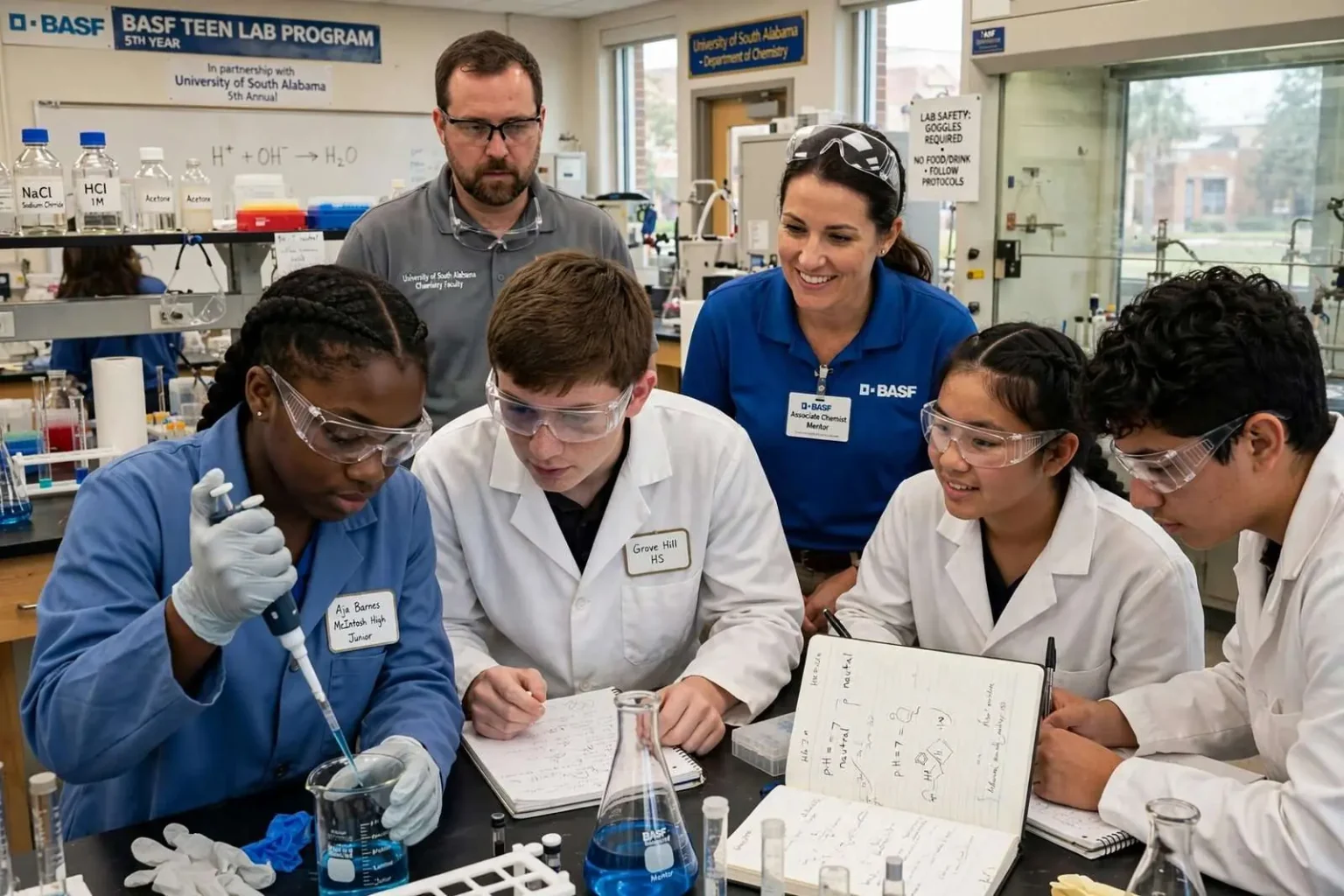
Students from Washington and Clarke County high schools traded their regular classrooms for a college chemistry lab this week, taking part in the BASF teen lab program at the University of South Alabama in Mobile. Twenty-nine students from seven local high schools — all with an interest in science — spent the day running experiments in the chemistry lab and touring campus, getting a firsthand look at where a STEM career could take them. For a day, high schoolers from two of southwest Alabama’s rural counties worked in the same labs where university students train for careers in chemistry.
The program, now in its fifth year, is taught by BASF associates working alongside university professors, pairing industry mentors with academic faculty. That combination is the point: students meet chemists who do the work for a living and professors who teach it, seeing two versions of the same career path. The annual visit has become a fixture of the relationship between the global chemical company and the region’s rural schools, and each year’s class returns home with a picture of college that is more concrete than any brochure.
For many of the rural students, the experience was a first on more than one front. “The high schools that these students are in may not have laboratories, so for some of them it may be the first time they’ve been in a chemistry laboratory,” said Dr. Christy West, an associate professor at the University of South Alabama. “It’s probably the first time they’ve been on a college campus, so they get to come and see what they could do in two years as chemistry students.”
First Time in a Real Lab
West’s observation describes a gap that rural students across Alabama know well. High schools in small districts often lack the facilities of their suburban and city counterparts — few have dedicated chemistry laboratories with fume hoods, professional-grade glassware and the safety equipment that real lab work requires. Students can complete high school chemistry from textbooks, worksheets and demonstrations, never running the experiments themselves. When those same students walk into a university lab, they are encountering the discipline for the first time as something you do rather than something you read about.
The day’s experiments put that experience in the students’ hands. Working in the South Alabama chemistry lab, the 29 students ran procedures under the guidance of BASF associates and university faculty — handling equipment, following protocols and seeing reactions happen in front of them. The campus tour that accompanied the lab work added context: classrooms, facilities and the everyday environment of a university where chemistry students spend four years preparing for careers.
West’s framing — “what they could do in two years as chemistry students” — refers to the community college and university pathway that most of these students would follow: two years of foundational coursework before the advanced laboratory work of a chemistry degree. Seeing the destination matters for students deciding whether the path is worth taking, and it matters especially for first-generation college students who have no family experience of campus life to draw on.
Five Years of Hands-On Science
The teen lab program is now in its fifth year, a run that has made it an institution rather than an experiment. Each year BASF selects partner high schools from Washington and Clarke counties — the rural counties where the company operates major manufacturing sites along the Alabama coast — and brings students with an interest in science to Mobile for the day. The consistency matters for rural schools: programs that appear once and disappear teach students not to plan on anything, while a program that has run five consecutive years becomes something teachers can build around and students can aim for.
The teaching model pairs BASF associates with university professors, and each side brings something the other cannot. The BASF chemists show students the industrial application — what a chemistry career actually looks like at a working chemical plant, what the jobs pay and what the work involves. The professors show the academic path — the coursework, the lab discipline, the progression from introductory classes to research. Together they present a complete picture that neither a classroom lecture nor a corporate recruiting visit provides alone.
Aja Barnes, a junior at McIntosh High School, said the day gave her a clearer picture of her own path. “I love science. I’m learning firsthand some of the stuff that I would get to do if I actually go into this field,” Barnes said. Her comment captures what the program is designed to do: move the idea of a science career from the abstract to the specific, so that a student who loves her chemistry class can see herself in a lab coat a few years from now.
BASF’s Stake in the Rural Schools Next Door
BASF operates a large chemical manufacturing presence along the Alabama coast, with significant operations in Washington County near McIntosh and related facilities in the region. The sites produce industrial chemicals for markets around the world, and they are among the largest employers in what is otherwise a rural, agricultural part of the state. For a company of that scale, the local schools are not an abstraction — they are the source of the technicians, operators, engineers and chemists the operation will need over the coming decades.
Programs like the teen lab are aimed at building a pipeline of future chemists and engineers from nearby rural counties. The logic is straightforward: a student from McIntosh or Grove Hill who completes a chemistry degree has every reason to bring her career home, where a major employer operates within driving distance of her front door. Rural counties lose their talented young people to cities when no one shows them the local path; a student who has stood in a university lab at 16, hosted by the plant up the road, has been shown exactly that path.
The investment also reflects how the chemical industry has changed its approach to workforce development. Modern plants need employees who can work with automated systems, follow rigorous safety and quality protocols, and advance into technical and supervisory roles — qualifications that begin with strong science education. By putting company associates into the classroom and students into the university lab, BASF is seeding its own future workforce while giving the region’s schools an experience they cannot provide on their own.
What a Day in the Lab Can Change
Twenty-nine students is a small number against the scale of two counties’ high school enrollments, but the program’s design targets the students most likely to act on it — those who already have an interest in science. For a rural junior like Aja Barnes, a single day can reframe her course selections, her college search and her sense of what is possible. Teachers in the participating schools report the same pattern year after year: students return from Mobile talking about the experiments they ran and the campus they walked.
The visit also carries a message about geography. Washington and Clarke County students live within commuting distance of a university — South Alabama sits in Mobile, just down the highway — but distance in rural Alabama is measured as much by familiarity as by miles. A student who has never set foot on a campus treats it as another world; one who has spent a day there treats it as an option. That shift, multiplied across five years of classes, is the quiet work of the program.
The partnership structure — a global company, a regional university and seven rural high schools — is also a model worth noting. No one of the three could deliver the experience alone: the schools lack the labs, the university lacks the industrial mentors and the outreach structure, and the company lacks the academic setting that shows students the education half of the path. Together they have produced five consecutive years of a day that some of these students will describe, years later, as the moment they decided what they wanted to be.
Looking Down the Pipeline
The students who ran experiments at South Alabama this week went back to their classrooms in Washington and Clarke counties with lab notebooks, memories and — if the program works as designed — a plan. Some will take the two-year pathway West described and finish chemistry degrees at the university; others will pursue engineering, process technology or the skilled trades the chemical industry depends on; all of them now know that the careers they read about in science class are practiced in buildings they have visited, by professionals they have met.
For the region, the fifth year of the BASF teen lab marks a program that has moved from novelty to expectation. Rising juniors at the seven participating high schools now hear about the trip from the students who took it, and the teachers who select participants know what a day in Mobile can do for a promising student. The pipeline the program is meant to build fills one class at a time — and it starts with 29 students, one chemistry lab and a day at the university.