Bay Minette and Satsuma police departments awarded $48,000 in state grants
Gov. Kay Ivey awarded 8,000 in grants to the Bay Minette and Satsuma police departments to fund rifles, radar, fingerprint scanners and other equipment.
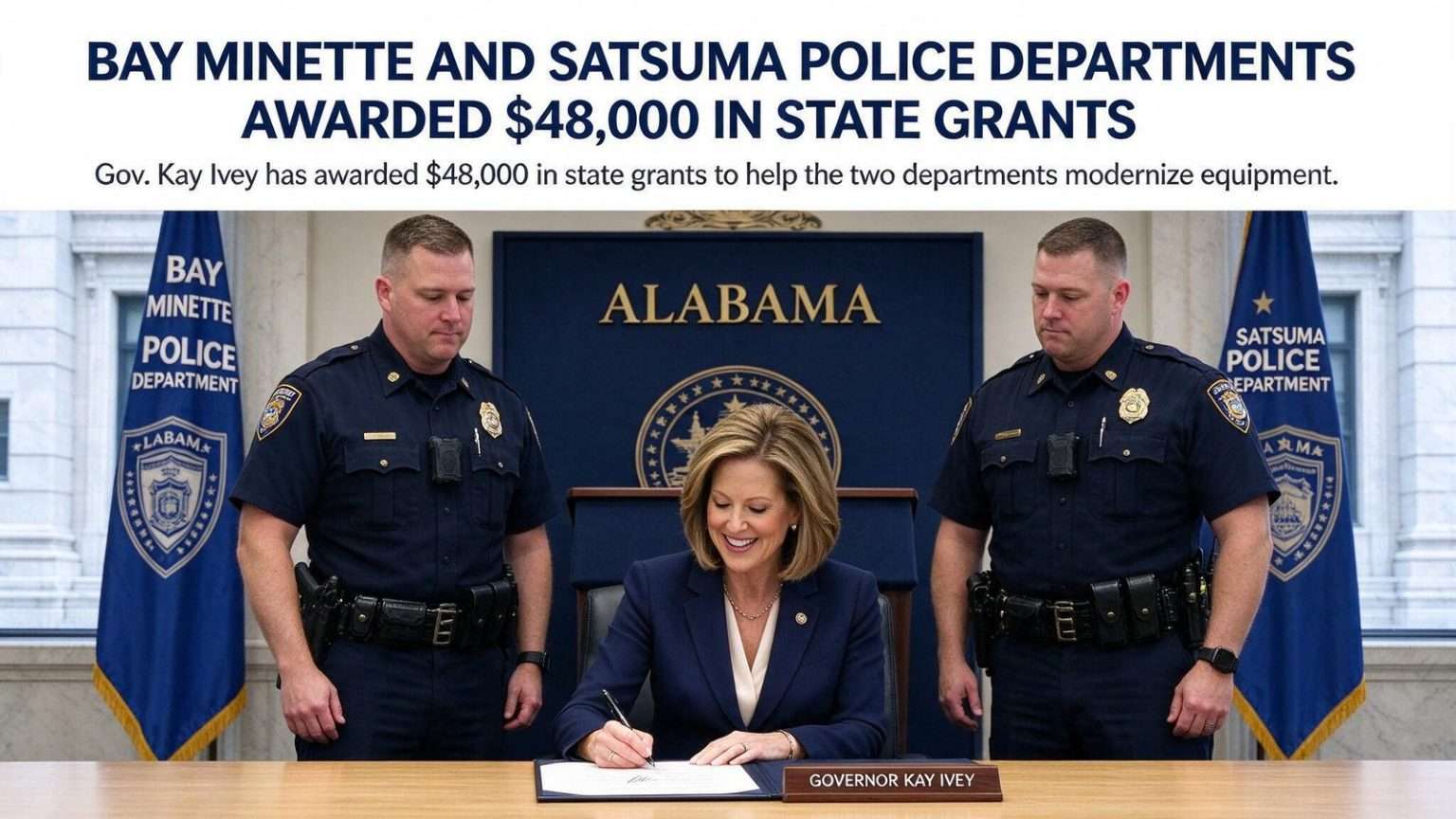
BAY MINETTE, Ala. — Gov. Kay Ivey has awarded $48,000 in grants to the police departments in Bay Minette and Satsuma, giving two north-county law enforcement agencies state help in paying for upgraded equipment. The funding, which comes from dollars the state received through the U.S. Department of Justice, will be used to modernize equipment ranging from firearms to fingerprinting technology.
The Bay Minette Police Department will use its share of the funding to purchase rifles, adding to the weapons available to its officers. The Satsuma Police Department plans a broader equipment upgrade, with plans to buy vehicle-mounted radar systems, an electronic fingerprint scanner, and additional firearms. Both departments serve communities in the northern half of their respective counties — Bay Minette as the seat of Baldwin County and Satsuma in northern Mobile County — and both operate with municipal budgets that rarely leave room for major equipment purchases.
The Alabama Department of Economic and Community Affairs, the state agency that administers federal pass-through public safety funding, is handling the grants. ADECA’s law enforcement and public safety division distributes justice-related funding to cities, counties, and nonprofits across Alabama, reviewing applications and managing the paperwork that accompanies federal dollars. The agency has long served as the conduit between federal justice programs and the local departments that benefit from them.
For Bay Minette, the grant arrives in a city that serves as the governmental center of Baldwin County, one of the fastest-growing counties in the United States. The Bay Minette Police Department patrols a city of more than 8,000 residents spread across a large land area, and its jurisdiction includes the county courthouse square, the schools, and the industrial and transportation corridors that run through the city. Equipment modernization is an ongoing concern for a department with that footprint, and rifle purchases are typically justified by the need to match the firepower officers may encounter in active-threat situations.
What the equipment purchases mean
Vehicle-mounted radar systems, the centerpiece of Satsuma’s planned purchases, are the speed-measurement units installed in patrol cars and used in traffic enforcement. Modern radar units allow officers to track vehicle speeds while the patrol car itself is moving, a significant upgrade over older units that required a stationary patrol. For a small department patrolling U.S. Highway 43 and the other corridors that pass through Satsuma, the radar systems extend the department’s traffic enforcement capability, which officials consistently identify as a key tool in reducing speed-related crashes in north Mobile County.
The electronic fingerprint scanner adds a different capability. Traditional ink-and-roll fingerprinting, still used in many small agencies, is slow and produces cards that can be rejected by state and federal databases. A Livescan-style electronic fingerprint system captures prints digitally and transmits them directly to the state repository, speeding background checks and improving the quality of the records that flow into Alabama’s criminal history database. For a small department, an in-house scanner eliminates trips to larger agencies to process arrests.
The firearms purchases in both cities reflect a broader trend in municipal policing. Patrol rifles have become standard equipment for American police departments over the past two decades, driven by the recognition that officers may face threats beyond the capability of service pistols. Departments typically acquire rifles through surplus programs, grants, and phased purchases, and training requirements accompany any addition to an agency’s weapons inventory.
Grant funding like the $48,000 awarded here plays an outsized role in small-department budgets. Municipal police budgets in cities like Satsuma are built around salaries, vehicles, and fuel, with little discretionary spending available for equipment that can cost tens of thousands of dollars. Federal pass-through grants administered by ADECA fill that gap, and Alabama’s smaller cities have historically been among the most consistent applicants.
Satsuma, the second grant recipient, is a city of roughly 6,000 residents in northern Mobile County, incorporated in the 1950s and known for its schools, its residential neighborhoods, and its position along U.S. Highway 43 between Saraland and Creola. The Satsuma Police Department is a small municipal force, and its equipment decisions are closely tied to the traffic corridors and residential streets it patrols. Vehicle-mounted radar, an electronic fingerprint scanner, and additional firearms together represent a package that touches nearly every major function of the department: traffic enforcement, bookings and records, and officer equipment.
Bay Minette, meanwhile, occupies a distinctive position in Baldwin County. As the county seat, it anchors the northern end of a county whose population growth is concentrated along the coast, and the city’s location puts it astride the highways that connect the coast to Interstate 65. The Bay Minette Police Department’s responsibilities include everything from courthouse-area patrol to school resource duties, and the rifles the department plans to purchase with its grant funding will be assigned under the department’s existing weapons policies.
Governor Ivey’s award of the grants follows the standard process for federal justice funding in Alabama. Dollars flow to the state through U.S. Department of Justice programs, and ADECA issues solicitations through which local governments apply for specific projects. Applications typically describe the need, the equipment or program to be funded, and the local agency’s capacity to use it, and awards are announced by the governor’s office once approved. The announcement of the $48,000 for Bay Minette and Satsuma fits the pattern of awards the state makes to municipalities across Alabama each year.
The role of ADECA in local public safety
The Alabama Department of Economic and Community Affairs occupies a central place in how federal money reaches Alabama’s communities. Beyond justice-related grants, ADECA administers funding for water and sewer projects, energy programs, workforce development, and senior services, making it one of the most consequential state agencies for small-town budgets. Its law enforcement grants section specifically manages the pass-through of federal justice programs, and the agency’s administration of the Bay Minette and Satsuma awards means the departments will purchase their equipment under the accountability requirements that come with federal funding — documentation, procurement rules, and reporting.
For the officers who will use the equipment, the purchases translate into practical changes. Modern radar units are more accurate and easier to operate than the aging systems many small departments have carried for years, and electronic fingerprinting removes one of the slowest steps in booking an arrest. Firearms purchases come with training obligations, and departments receiving grant-funded weapons typically schedule qualification sessions to bring officers up to standard on the new equipment.
Residents of both cities will see the effects in ordinary interactions with police. Speed enforcement on the highways that pass through Bay Minette and Satsuma will rely on the new radar systems; people arrested in either city will be fingerprinted electronically, with cleaner records and faster processing; and the additional rifles add to the equipment officers carry for the rare but serious situations in which patrol long guns are deployed. None of it changes the departments’ daily mission, but all of it updates the tools available to two of the region’s smaller forces.
The $48,000 award to the two departments is modest by the scale of state budgeting but significant for the agencies receiving it. For Bay Minette and Satsuma, the grants mean equipment that municipal budgets alone could not have funded in a single year, acquired under the oversight that ADECA’s administration provides. The purchases are expected to proceed as the departments complete their procurement under the grant terms, adding updated gear to the fleets and duty equipment of two north-county police forces.
Small-department equipment needs in north Baldwin and north Mobile counties reflect the realities of policing in this part of the Gulf Coast. Both patrol areas cover territory that mixes residential neighborhoods with high-speed corridors, and both agencies operate fleets of patrol vehicles that age quickly under constant use. Radar units wear out, fingerprint equipment becomes obsolete, and firearms reach the end of their service life, so grants that refresh one or more of those categories at once are prized by departments whose capital budgets are thin.
The rifle purchases in Bay Minette also fit within a training and accountability structure that Alabama departments maintain. Patrol rifles are stored according to department policy, issued under supervisory authorization, and require documented qualification, typically on an annual or semiannual cycle. Departments that add rifles to their inventory also update their use-of-force policies to cover the weapons, and the grant funding covers acquisition rather than the ongoing training costs, which the department absorbs through its normal training calendar.
Electronic fingerprinting deserves particular attention for what it changes in daily police work. When an agency books an arrestee, fingerprints are matched against state and federal databases to confirm identity and uncover outstanding warrants. Ink-based prints from a small agency can take days or weeks to process, and illegible cards get rejected outright, leaving identity questions unresolved. Digital capture with a Livescan device sends prints to the Alabama Law Enforcement Agency’s repository within minutes, returning warrant checks quickly and producing records that meet federal standards. For a department like Satsuma’s, that capability means arrests are processed correctly the first time.
Vehicle-mounted radar has a similar day-to-day payoff. The corridors that pass through north Mobile County and north Baldwin County carry commuters, school traffic, and commercial vehicles, and speed enforcement on those roads is a persistent concern for residents who live along them. Moving-mode radar allows an officer to log violations without parking the patrol car, multiplying the amount of traffic supervision a small shift can deliver, and the data from modern units documents the enforcement for court proceedings.
Grant announcements of this kind also signal the ongoing relationship between Alabama’s smaller municipalities and the federal justice system. The U.S. Department of Justice programs that fund local equipment have channeled support to state and local agencies for decades, and ADECA’s role ensures the money reaches agencies that would otherwise fall through the gaps in federal grant-making. For Bay Minette and Satsuma, the $48,000 announced by Gov. Ivey continues that pipeline — federal dollars, administered by a state agency, purchased locally by two police departments whose residents will encounter the results in traffic stops, bookings, and the equipment officers carry.