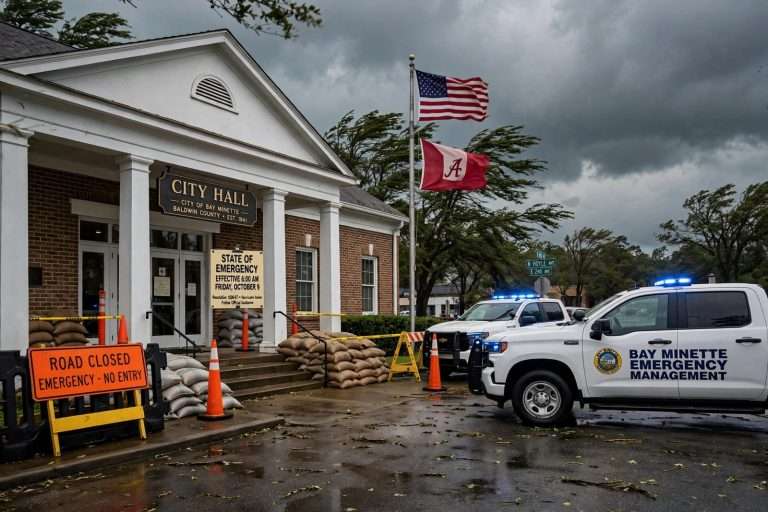
Bay Minette Standoff Ends With Arrest on Domestic Violence Charges
A standoff at a Taylor Street home in Bay Minette ended Sunday with a man under arrest on domestic violence charges.
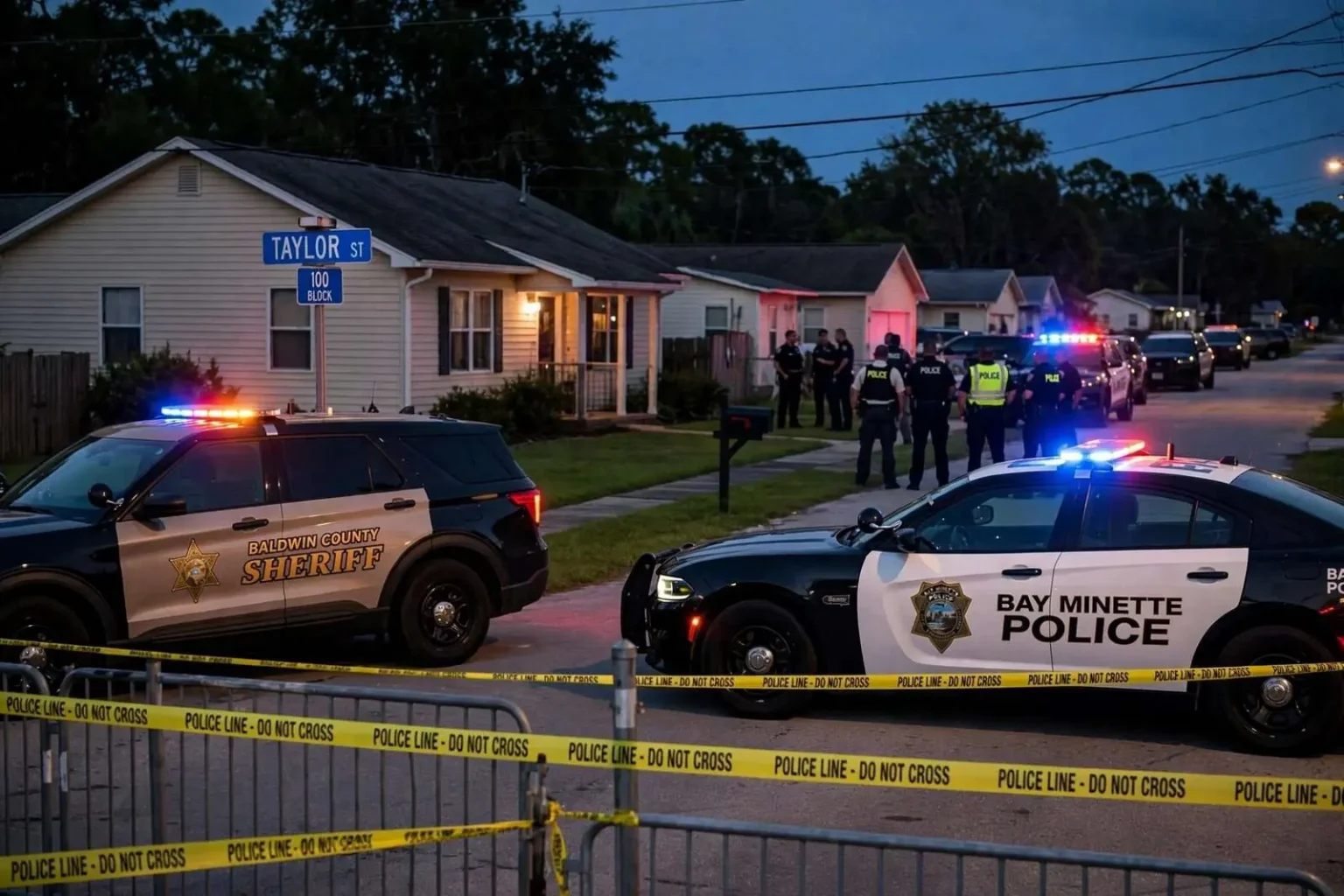
A standoff at a Bay Minette home ended Sunday evening with a man in custody on domestic violence charges, according to police.
Officers were called to a residence on Taylor Street after reports of a man and woman fighting in the front yard. What began as a disturbance call became something far more dangerous, police said, when the man escalated his threats and took a child back inside the home.
Police said Tashawm Quamaine Mallory threatened to shoot officers if they didn’t leave, then grabbed a one-year-old child and went back inside the house. The threat turned a routine disturbance response into a barricade situation, with officers pulling back to cover positions while the department’s response shifted into negotiation mode.
The confrontation developed into a standoff as officers worked to resolve the situation safely. It ended with Mallory’s arrest, and no injuries were reported — not to the child, not to the woman involved, and not to any officer on the scene.
Details about additional charges or the condition of the child and woman involved were not immediately released, as is common in the hours after a domestic barricade, when investigators are still sorting out what happened inside the home and determining what charges apply.
From Disturbance Call to Standoff
The sequence that unfolded on Taylor Street follows a pattern police departments across the country train for constantly. A fight in a front yard is one of the most common calls officers answer, and most end with warnings, separation of the parties or an arrest at the scene. The call becomes a barricade when someone retreats inside with a weapon available, a hostage — in this case, a toddler — or both.
A threat to shoot officers changes the calculus immediately. Officers on scene stop advancing, establish a perimeter and wait, because a forced entry into a home where an armed man holds a child risks exactly the outcome the department is trying to prevent. The priority list in a barricade is fixed: protect the hostage, contain the scene, negotiate, and use force only when all else fails or when the hostage’s life is in immediate danger.
Bay Minette police likely received help as the standoff stretched on. Small municipal departments routinely call on the Baldwin County Sheriff’s Office for crisis negotiation teams and tactical support, and neighboring departments send officers to hold the perimeter while the primary agency works the phone or a throw-phone inside the house. The presence of additional units also lets the first responding officers, who may have been on duty all day, rotate out before exhaustion leads to mistakes.
How Standoffs Are Resolved
Negotiation in a domestic barricade is slow, deliberate work. Trained negotiators talk the person inside toward surrender, establishing contact, asking about the child’s needs and pressing practical questions — is anyone hungry, does the baby need formula, is there a safe room — that keep dialogue alive while time passes. Time is the negotiator’s tool: incidents that look frozen from outside are, from inside, hours of the suspect’s anger burning down while officers learn everything they can about the home’s layout and the people in it.
Every standoff ends in one of a handful of ways: the suspect surrenders, officers enter and take him into custody, or he harms himself or others. The overwhelming goal of the first two hours is to make surrender the easiest path. Police in cases like this often coordinate with family members who can speak to the suspect, keep the neighborhood cleared so there is no audience or interference, and hold fire even under provocation unless someone is in danger.
That a one-year-old was inside the home throughout makes the peaceful ending stand out. Children in barricade situations are at risk not only from gunfire but from the chaos itself, and negotiators press for the child’s release early in nearly every such case. Details of how the toddler came out — whether Mallory released the child or the child was recovered when he was taken into custody — were not immediately released.
The Charges He Faces
Mallory was booked on domestic violence charges, and the threat he made to officers and the child’s involvement open the door to more. Alabama law treats domestic violence as a set of specific offenses with escalating degrees, and strangulation, aggravated assault and certain acts against family members can carry felony penalties. Threatening a police officer is separately chargeable, and taking or holding a child during a confrontation can support charges of reckless endangerment or worse, depending on what investigators learn about the hours inside the home.
Prosecutors in Baldwin County review the full picture once investigators complete their work: what started the fight in the yard, whether weapons were present, what the woman involved experienced, and what condition the child was in when officers finally got him or her to safety. Additional charges, if any, would come after that review.
The woman involved has not been identified, and police did not describe her injuries or her account of the fight. In domestic cases, her safety remains a concern long after the arrest — advocates note that the days and weeks after a domestic violence arrest are among the most dangerous for the victim, and coordination between police, prosecutors and support services typically continues after the tape comes down.
Domestic Violence and Small-City Policing
Bay Minette, the county seat of Baldwin County, is a small city where the police department answers a steady share of domestic disturbance calls each year. Departments of this size handle them with the same structure as big-city forces — mandatory arrest policies in cases of physical violence, connection to county prosecutors, and referral to shelters and advocacy organizations that serve the Gulf Coast — but with fewer specialized units to draw on when a call turns into a crisis.
That is why the region’s mutual aid network matters. Baldwin County’s sheriff’s office maintains crisis negotiation capability and tactical teams that serve municipalities across the county, and departments train together on exactly the kind of scenario Taylor Street produced Sunday: a family fight, a weapon threat, a child inside, and hours of waiting.
The peaceful ending on Sunday — a suspect in custody, a child unharmed, officers unhurt — is the outcome every agency trains for and the one that statistics show is far from guaranteed. Police said the investigation continues, and additional charges or details would be released as they are confirmed.
Domestic Violence and Small-City Policing
Bay Minette, the county seat of Baldwin County, is a small city where the police department answers a steady share of domestic disturbance calls each year. Departments of this size handle them with the same structure as big-city forces — mandatory arrest policies in cases of physical violence, connection to county prosecutors, and referral to shelters and advocacy organizations that serve the Gulf Coast — but with fewer specialized units to draw on when a call turns into a crisis.
That is why the region’s mutual aid network matters. Baldwin County’s sheriff’s office maintains crisis negotiation capability and tactical teams that serve municipalities across the county, and departments train together on exactly the kind of scenario Taylor Street produced Sunday: a family fight, a weapon threat, a child inside, and hours of waiting.
The peaceful ending on Sunday — a suspect in custody, a child unharmed, officers unhurt — is the outcome every agency trains for and the one that statistics show is far from guaranteed. Police said the investigation continues, and additional charges or details would be released as they are confirmed.
What Neighbors Saw and What Comes Next
For the Taylor Street neighborhood, the standoff meant an afternoon and evening of blocked streets, patrol cars and the tension of waiting. Residents of nearby homes were moved back from the scene as a precaution, and officers kept the area cleared while negotiations went on. In small cities, word travels fast, and by Sunday evening the incident was being discussed across town even as the department released only the outline of what happened.
The release of further details will likely follow the standard path in Baldwin County: booking records showing the charges, a court appearance where bond is set, and statements from investigators once the domestic case file is complete. Police emphasized that the department considers the incident resolved from a tactical standpoint but not from an investigative one.
Child welfare investigators are typically part of that aftermath as well. When a young child is present during a violent standoff, state child protection staff coordinate with police on follow-up to determine where the child will stay and what services the family needs — a process that proceeds separately from the criminal case but on the same timeline.