Bay Minette’s Dr. Don Salls, Oldest Living Alabama Football Alum, Turns 100
Bay Minette resident Dr. Don Salls, the oldest living University of Alabama football alumnus, turned 100 on June 24, prompting a birthday celebration at the Paul W. Bryant Museum honoring his decades as a player, war veteran, coach and educator.
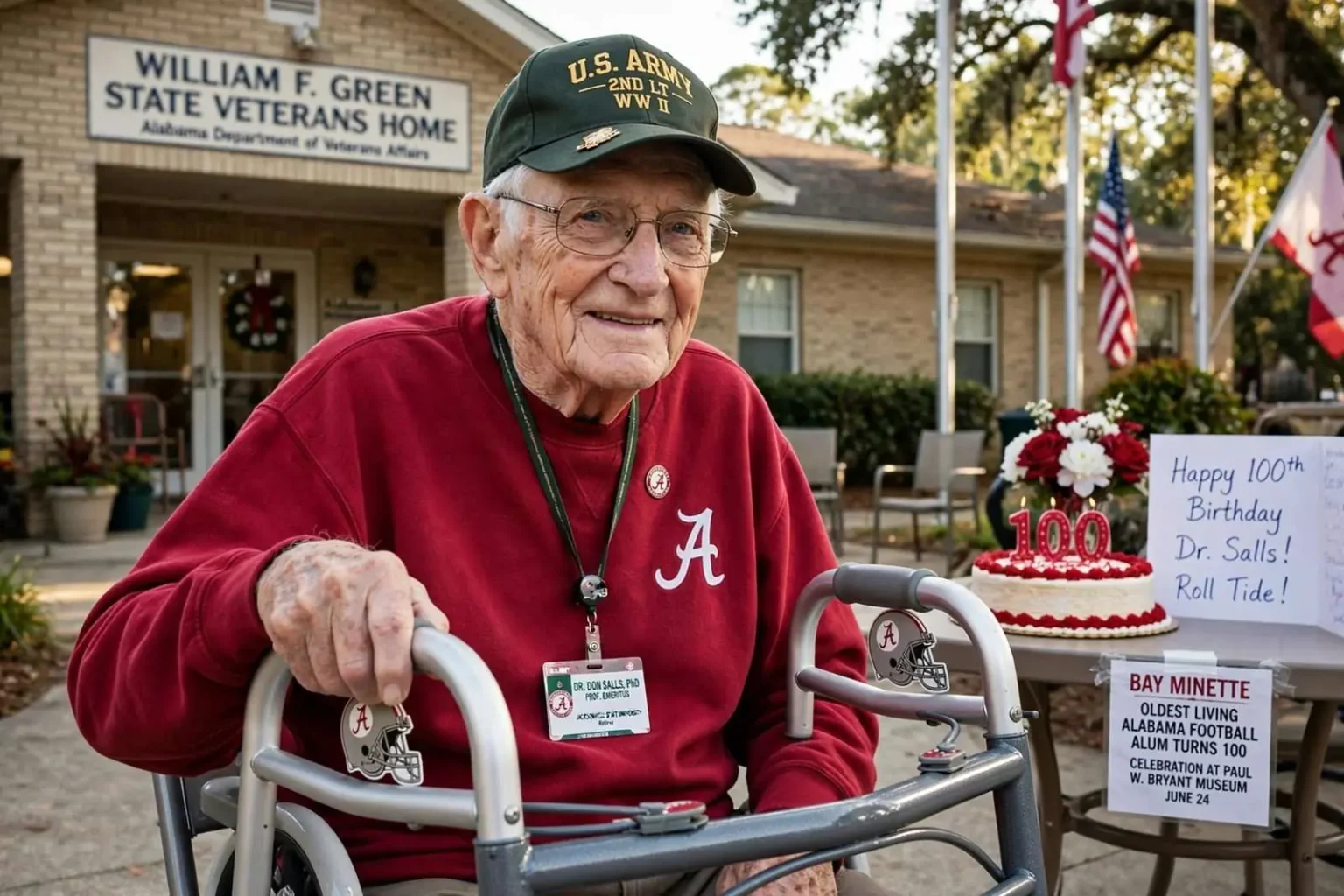
Dr. Don Salls, a Bay Minette resident who once wore a University of Alabama football jersey before trading it for an Army uniform, is celebrating his 100th birthday this week as the oldest living football alumnus of the Crimson Tide. Salls turned 100 on June 24, and the University of Alabama marked the milestone with a public celebration at the Paul W. Bryant Museum in Tuscaloosa. Museum Executive Director Ken Gaddy said the public was invited to join Salls' family and friends for cake and a birthday card for well-wishers to sign. The gathering ran from 2 to 5 p.m., and those with questions were asked to call the museum at 205-348-4668.
Salls now lives at the William F. Green State Veterans Home in Bay Minette, where residents and staff know him simply as Dr. Salls, a nod to the doctorate he earned decades after his playing days ended. He gets around with a walker fitted with front wheels, rubber caps on the back legs and a built-in seat, but still moves at a steady clip and remains one of the most active residents at the home. "He's just an amazing man," said Dave Roberts, the veterans home's activities director. "He's a ray of sunshine around here."
Salls was born and raised in White Plains, New York, far from the Alabama football fields where he would eventually make his name. His father worked as a regional sales manager for a meat packing plant in New York City while his mother ran their household and raised him alongside a brother and a sister. He first took the field for White Plains High School at age 15 and starred as a 5-foot-8, 169-pound quarterback, earning most valuable player honors on a team that was a perennial county champion. That performance opened the door to college scholarship offers from across the country, but a connection between his high school coach and an Alabama assistant coach steered him toward Tuscaloosa, nearly 1,000 miles from the only home he had ever known.
The transition from the New York suburbs to the Deep South was not an easy one. Salls has long recalled the culture shock of his early days on campus, including his unfamiliarity with the smell of onion grass and nearby paper mills that clung to him after games. He nearly went home, he has said, but his scholarship kept him rooted in Tuscaloosa long enough to adjust. The smell followed him home for summer visits, too; he has recalled his mother stepping back and wrinkling her nose at his suitcase, asking what on earth that awful odor was, only to be told it was simply the onion grass and paper mills of Alabama.
Playing for head coach Frank Thomas, himself a former Notre Dame player who understood the challenges of a smaller-framed athlete, Salls suited up at fullback and linebacker for Alabama teams that included a national championship squad and appearances in two bowl games. His scholarship structure allowed him to carry a lighter course load each semester, giving him more time to balance football with his studies. Though he weighed only 169 pounds during his playing days, Alabama's game programs of the era listed him at a heftier 185, a bit of gridiron embellishment meant to make the undersized fullback and linebacker look more formidable on paper than he did lined up across the line of scrimmage.
In 1942, Salls left college football behind for the battlefields of Europe, commissioned as a U.S. Army second lieutenant after his time in ROTC. He was sent to lead an infantry platoon in France as Allied forces pushed toward Germany, despite having no direct combat experience of his own. He has credited an experienced platoon sergeant, who had already seen fighting in Africa, Italy and Sicily, with guiding the unit safely through roughly 60 days and nights of combat, including harrowing night patrols in near-total darkness.
Even the brief breaks from the front lines carried their own discomfort. About once a month, Salls and his fellow soldiers were pulled back long enough for a shower and a change of clothes after weeks spent in the same uniform, a smell so distinct that, as Salls has told it, the enemy could catch their scent before ever spotting them. Salls was eventually wounded by gunfire to the hand, an injury that led doctors in France to discover he had also suffered several fractured vertebrae and fractured transverse processes, likely from the physical toll of combat. The injuries ended his time on the front lines, and he spent the remainder of the war training new troops in physical fitness. Through the fear and exhaustion of those combat nights, Salls has said his faith never wavered. "I love my God and he loves me," he has said. "I talk to him constantly. I knew when he delivered me from that war alive, he had a plan for me."
Returning to civilian life after the war, Salls built a long career in education and athletics at Jacksonville State Teachers College, now Jacksonville State University, where he served as head of the physical education department and head football coach from 1946 to 1964.
He led the program to three bowl appearances and seven conference titles, compiling a winning record that reportedly still stands at the school today. He went on to earn a master's degree from Alabama and, after years of summer study, a doctorate in education from New York University, teaching at Jacksonville State until his retirement in 1981 and remaining a professor emeritus there since.
Salls has attributed part of his longevity to a lifelong commitment to physical fitness. In the early 1960s he developed an isometric exercise routine known as XSXIM, short for "Ten Static Exercises in One Minute," which drew attention from Reader's Digest and other national publications at the time. At age 76, he wrote a book titled "Living and Loving To Be 100," reflecting on the very milestone he has now reached. Longevity runs in his family as well, with both of his siblings living into their 90s.
Family has remained central to Salls' life in his later years. He married his wife, Diane, in 1988 after the two met in 1986 at a party in Eutaw. Diane, a Jackson, Mississippi native who is more than two decades younger than her husband, visits him several times a week from their home in Fairhope.
The two were introduced at that party in Eutaw, a small city about 35 miles southwest of Tuscaloosa, and it took several weeks to arrange their first date. When the day finally came, Salls picked her up in his yellow Cadillac, and the couple were nearly inseparable from that point on. The courtship itself became one of Salls' favorite stories to tell. He was introduced to Diane at the Eutaw party while still dating several other women, and he has laughed that he "soon had to write five 'Dear Jane' letters" once he set his sights on her. Diane has said he fell for her voice and her central Mississippi accent before anything else, and Salls does not dispute it. "When you're hot, you're hot," he has said with a grin. He nicknamed her Lady Di, and decades later still calls her "my all, my sweetheart, my friend and my lover."
Asked what has changed most across his lifetime, Salls has pointed as much to people as to technology. He has said he believes earlier generations of parents, teachers and coaches worked from the same shared playbook in raising children, a cohesion he feels has faded over time. He has also been candid about the digital age reshaping education, noting that students once had to "go to books, read it, write it, learn it the hard way," while today's learners can search for answers instantly.
"Sometimes I wish it would go back to the way it was, before the internet, and Facebook, and all that," he has said. "It was simpler, more direct." Reflecting on a hundred years that spanned the Great Depression, World War II and the digital age, Salls has said his approach has always come down to a few simple constants: a drive to improve and succeed, a commitment to being a good husband and father, and the sense of duty he carried through his military service.
About the institutions
The William F. Green State Veterans Home in Bay Minette is one of Alabama’s state veterans homes overseen by the Alabama Department of Veterans Affairs. Jacksonville State, where Salls spent most of his career, was founded in 1883 and became Jacksonville State University in 1966.