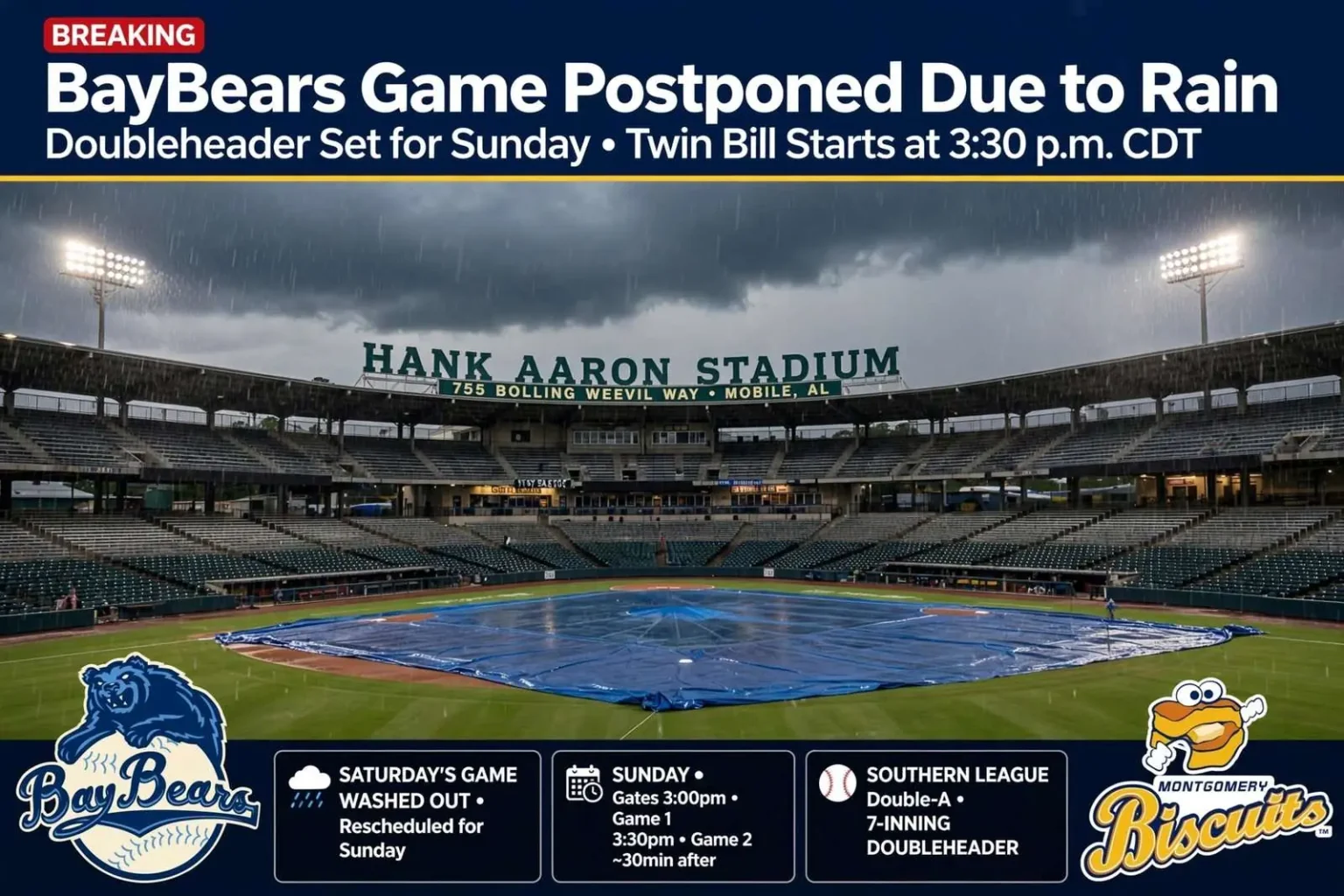
Rain washed out Saturday’s game between the Mobile BayBears and the Montgomery Biscuits at Hank Aaron Stadium, with the contest rescheduled as part of a doubleheader on Sunday. The twin bill is set to begin at 3:30 p.m. CDT, with gates opening at 3:00 p.m. The second game will start approximately 30 minutes after the conclusion of Game 1.
The BayBears, the Double-A affiliate of the Los Angeles Angels, were set to face Montgomery in the Southern League matchup when weather intervened. Instead of a single nine-inning contest, fans holding tickets for Sunday will get two games for the price of one, with both seven-inning games played back to back under minor league doubleheader rules. For the two clubs, the format compresses a lost game back into the schedule without costing either side a true off day later in the season.
Rain-induced postponements are a regular feature of the minor league baseball schedule in the Gulf Coast region, particularly during the humid late-summer months when afternoon thunderstorms frequently move through the Mobile area. The pattern is familiar to anyone who has spent a summer on the central Gulf Coast: mornings build heat, cumulus clouds pile up over the pine flatwoods by mid-afternoon, and strong storms arrive with little notice, drenching ballparks and leaving groundskeepers scrambling to pull tarps and dry the infield before first pitch.
Two longtime rivals on the same diamond
The BayBears and Biscuits are two of the most established franchises in the Southern League, the Double-A circuit that has carried professional baseball across the Deep South for decades. Mobile has hosted minor league ball since the 19th century and counts Hall of Famers Hank Aaron, Willie McCovey, Billy Williams and Satchel Paige among the players who came through the city on their way up. The ballpark at 755 Bolling Weevil Way, renamed Hank Aaron Stadium in honor of Mobile’s most famous son when it opened in 1997, has been the BayBears’ home through affiliate agreements with several major league clubs before landing with the Angels.
Montgomery, the Tampa Bay Rays’ Double-A club, plays up Interstate 65 at Riverwalk Stadium, a converted railroad shop building in the state capital. Games between the two teams form a natural in-state rivalry, drawing traveling crowds from both directions and giving fans in south and central Alabama a taste of major league futures. Rosters at the Double-A level are stocked with the game’s top prospects, which means any regular-season meeting can feature players who will be wearing big league uniforms within a year or two.
For the Angels’ organization, Double-A is where many of the top draft picks and international signees face their first sustained test against advanced pitching and pitching against advanced hitters. BayBears fans in Mobile have watched that development up close for years, and a postponed game matters to more than the standings: every outing is inventory in a young player’s development calendar, which is why teams work doubleheaders into the schedule rather than simply erasing rained-out dates.
What fans need to know for Sunday
Gates at Hank Aaron Stadium open at 3:00 p.m., a half hour before the scheduled 3:30 p.m. start of Game 1. The second game follows roughly 30 minutes after the final out of the opener, a short break that gives grounds crews time to reset the field. Fans who attended the postponed Saturday game should consult the team’s ticket policies for exchange and rain-check options, which minor league clubs typically publish with each postponement announcement.
Doubleheaders carry their own rhythms for players and managers. Pitching usage is the central calculation: clubs generally use a spot starter or a bullpen game in one of the two games to avoid burning through their rotation, and position players who would ordinarily rest are more likely to appear in at least one of the seven-inning games. Managers also manage the ledger differently, since a split preserves a decent day while a sweep can swing a week’s worth of standings momentum in an afternoon.
The seven-inning format, standard for minor league doubleheaders, changes strategy in subtle ways. Relievers are deployed earlier and more aggressively, stolen-base and bunting decisions carry more weight in a shorter game, and a three-run deficit feels considerably larger in the sixth inning than it would in a nine-inning contest. For fans, the compressed format tends to produce brisk, high-leverage baseball, and two of those games in a row make for a long afternoon at the ballpark.
Weather and the Gulf Coast schedule
Mobile’s summer climate makes weather management a season-long part of operating a ballpark. Afternoon thunderstorms along the central Gulf Coast are fed by heat, moisture off the Gulf of Mexico and sea breeze boundaries that collide inland, producing some of the highest rainfall totals in the United States during the summer months. Teams in the region build weather contingencies into their operations, from tarp crews on standby to flexible promotional scheduling, and players grow accustomed to delays and split-schedule days as part of life in the league.
The Southern League’s geography compounds the challenge. Clubs stretch from the Gulf Coast through Mississippi, Alabama, Tennessee, Georgia and Florida, and long bus trips between cities mean that a postponed game often cannot simply be made up the next day without disrupting travel. That is why same-series doubleheaders, like Sunday’s twin bill, are the standard remedy: both teams are already in town, the ballpark is already staffed, and the schedule absorbs the change without adding miles to a bus route.
For fans, the consolation is a full afternoon of baseball at family-friendly prices. Hank Aaron Stadium has long been a fixture of Mobile’s summer entertainment calendar, with the concourse honoring the city’s deep baseball heritage alongside the game itself. Sunday’s doubleheader gives fans two chances to see the BayBears and Biscuits settle the series, and in a season built on prospects and future stars, twice the innings means twice the opportunities to watch a player on the way up.
First pitch for Game 1 is scheduled for 3:30 p.m. CDT, with Game 2 to follow approximately 30 minutes after the final out of the opener.
How rained-out games actually get rescheduled
A postponement triggers a chain of decisions that fans rarely see. Umpires and team officials consult on field conditions as storms approach, weighing the safety of the playing surface, the forecast radar and the travel schedules of both clubs. Once a game is called, the home team updates its ticket policies, notifies season-ticket holders and single-game buyers, and works with the visiting club and the league office to slot the makeup game into the series. The same-series doubleheader is the cleanest solution, because it requires no extra travel and no rearrangement of the rest of the league schedule.
Groundskeeping is the quiet craft at the center of every weather decision. A wet infield is a safety hazard, and a tarp pulled too late or removed too early can cost hours of drying time. Crews use dryers, calcined clay and careful mowing patterns to bring a field back after a soaking, and a doubleheader start time is set partly around how much recovery work the surface needs. A 3:30 p.m. first pitch for the opener gives the grounds crew a full morning to finish that work.
Why Double-A baseball matters in Mobile
Mobile’s claim on baseball history is remarkable for a city its size. Hank Aaron grew up in the Toulminville section of Mobile and came up through the city’s sandlots before breaking into professional ball and eventually setting the major league home run record. McCovey, from the Para-Ship-Brand neighborhood side of town, and Billy Williams, both Hall of Famers, came from the same city, and Satchel Paige, one of the greatest pitchers the game has known, spent formative years there as well. The stadium named for Aaron carries that legacy into every home stand, and it is part of what makes a summer series against a rival like Montgomery feel like a continuation of a long story rather than just another set of games.
For the Angels, Mobile has served as a proving ground where prospects are tested against quality pitching every night. Players who have worn a BayBears uniform have gone on to contribute at the game’s highest level, and local fans take a particular pride in watching a raw talent arrive in April and leave in September visibly transformed. Development is not linear, and neither is a minor league schedule; a rained-out Saturday is a small loss, but teams treat every innings opportunity as valuable because prospects have limited seasons to make their cases.
The Biscuits bring their own draw. Montgomery’s franchise has been among the league’s most successful since its founding, both on the field and at the gate, and its rosters have regularly featured the Rays’ top-ranked prospects. When the two clubs meet, the series often functions as an informal showcase, and scouts from other organizations fill the stands to chart arms and at-bats. Sunday’s doubleheader doubles the scouting opportunities and, for the fans in the seats, doubles the chances to see a highlight before the player wearing it moves up and out of the league.
Planning a Sunday at the ballpark
Fans heading out for the twin bill should plan for a long afternoon. With gates at 3:00 p.m. and two games back to back, the full experience can stretch past four hours, and August heat in Mobile lingers into the evening even after the sun drops behind the third-base grandstand. Sunscreen, hats and water are standard equipment for early-season-afternoon baseball on the Gulf Coast, and shaded seats along the first-base side tend to go quickly on doubleheader days.
Concessions and promotions typically operate through both games, and families often treat the gap between games as part of the outing, letting kids run the bases or explore the stadium’s tribute displays while the field is reset. The doubleheader format has a way of turning a routine series game into a fuller day of baseball than anyone planned, which is one of the small compensations the Gulf Coast’s summer weather occasionally hands to minor league fans. Sunday at Hank Aaron Stadium, the rain that cost the BayBears and Biscuits their Saturday game will, in effect, have bought everyone two.