Bayou La Batre Utility Responds to Sewage Overflow Near Shell Belt Road Bridge
A pump failure at a lift station caused a sanitary sewer overflow near a Shell Belt Road bridge in Bayou La Batre, prompting cleanup and a public health advisory.
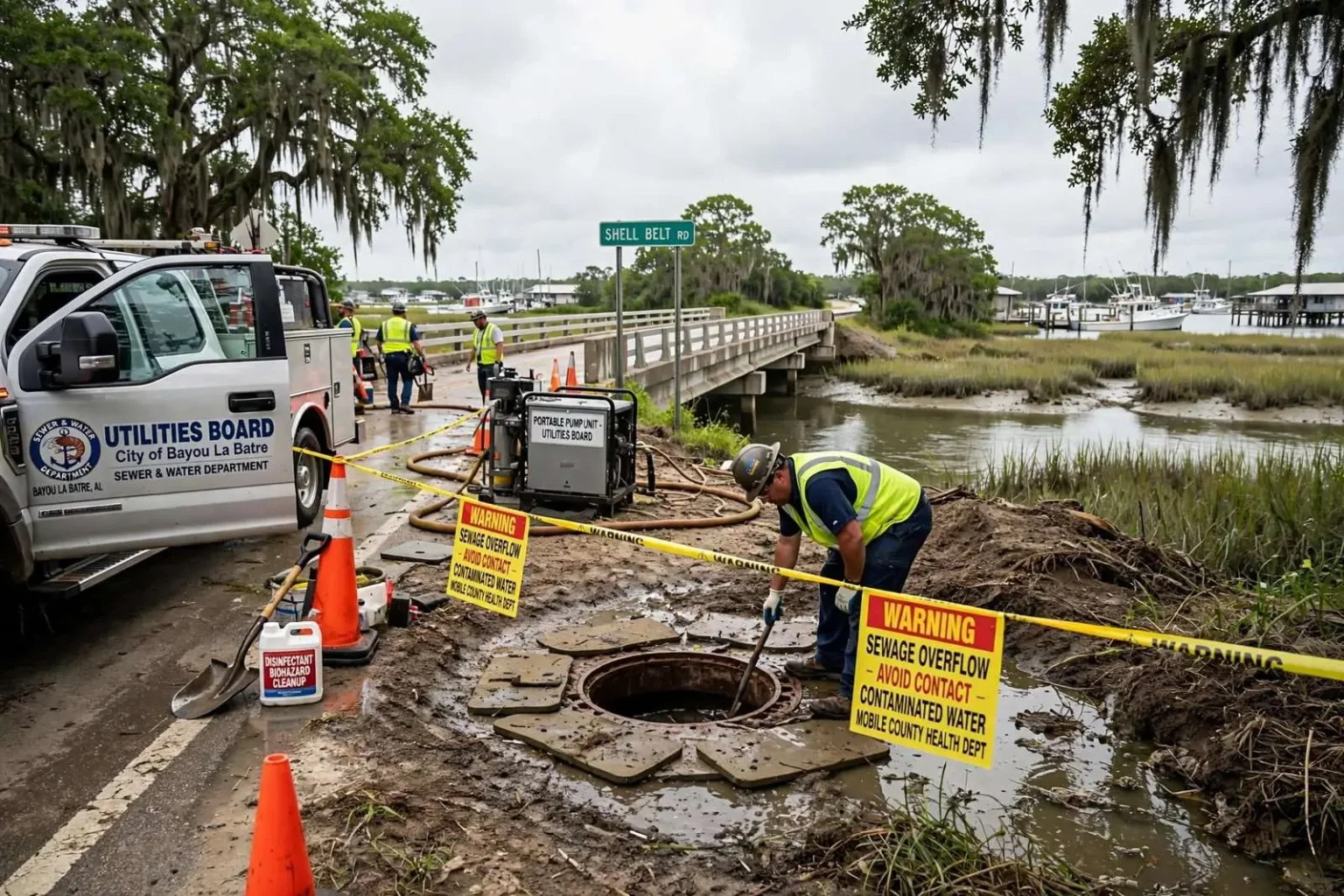
The Utilities Board of the City of Bayou La Batre responded to a sanitary sewer overflow that occurred on Aug. 21 after a pump failure at a lift station sent an estimated 100 gallons of sewage into the ground near a bridge on Shell Belt Road, officials said. Crews cleaned and disinfected the affected area following the incident, and the Mobile County Health Department issued guidance urging residents to avoid contact with potentially contaminated water and soil in the vicinity.
What Happened
According to the utilities board, the overflow occurred from a manhole located near the Shell Belt Road bridge after a lift station pump failed. Lift stations are a standard component of most sewer systems in low-lying, flat terrain like much of coastal Mobile County, where gravity alone often cannot move wastewater efficiently to a treatment plant. These stations use mechanical pumps to lift sewage to a higher elevation so it can continue flowing through the system, which means a pump failure at any single station can cause wastewater to back up and, in some cases, overflow through the nearest access point — in this case, a manhole near the bridge.
Officials estimated that approximately 100 gallons of sewage were absorbed into the ground at the overflow site. Following the discovery of the overflow, utility crews moved to clean and disinfect the affected area, a standard remediation step intended to reduce the risk of bacterial or pathogen exposure in the surrounding soil and any nearby waterways.
Understanding a Sanitary Sewer Overflow
A sanitary sewer overflow, commonly abbreviated as an SSO, occurs when untreated or only partially treated sewage escapes the sanitary sewer system before it reaches a wastewater treatment plant. SSOs can originate from a variety of points in a sewer network, including manholes, broken or cracked pipes, malfunctioning pump or lift stations, or building cleanouts. Common causes include mechanical failures like the pump breakdown reported in this incident, as well as blockages from grease, debris, or tree roots, and system overloads that occur during periods of heavy rainfall when stormwater infiltrates aging sewer infrastructure.
Because raw or partially treated sewage can contain bacteria, viruses, and parasites, SSOs carry genuine public health risks. Exposure to affected water or soil has the potential to cause illnesses including diarrhea, vomiting, and skin infections, which is why local health officials typically respond to overflow reports with public guidance aimed at limiting human contact with the affected area until cleanup is complete.
Health Department Guidance
Dr. Kevin Michaels, Health Officer for Mobile County, urged residents in the vicinity of the overflow to avoid direct contact with any water, soil, or visible sewage in the affected area. Michaels also advised residents to keep children and pets away from ditches, creeks, flooded areas, and any standing water that may have been contaminated by the overflow, and cautioned against swimming, wading, or fishing in posted areas or in water that appears discolored or has an unusual odor.
For anyone who may have already come into contact with potentially contaminated water or soil, Michaels emphasized the importance of thoroughly washing skin and clothing with soap and clean water as soon as possible, describing that step as the most important precaution residents can take after potential exposure.
A Recurring Challenge for Coastal Sewer Systems
Bayou La Batre, like many low-lying coastal communities along the Alabama Gulf Coast, relies on a network of lift stations to keep its sewer system functioning across flat terrain that sits close to sea level. That infrastructure design, while necessary given the area’s geography, also means that mechanical failures at any individual pump station carry a higher risk of triggering an overflow compared with sewer systems that can rely more heavily on gravity flow. Utilities boards along the coast routinely conduct maintenance and monitoring programs aimed at catching pump problems before they cause a failure, though equipment breakdowns can still occur despite those efforts.
The Utilities Board of the City of Bayou La Batre has not indicated whether the Aug. 21 pump failure was tied to any broader equipment issue at the lift station or whether it was an isolated mechanical breakdown. Utilities boards are generally required to report sanitary sewer overflows to state environmental regulators, a process that helps track infrastructure reliability trends over time and can inform decisions about capital investment in aging pump stations and pipe networks.
Residents with questions about current conditions near the Shell Belt Road overflow site, or about the status of cleanup efforts, are encouraged to contact the Utilities Board of the City of Bayou La Batre directly.
How Regulators Track Sewer Overflows
Utilities across Alabama are generally required to report sanitary sewer overflows to the Alabama Department of Environmental Management, or ADEM, which tracks these incidents as part of its oversight of the state’s wastewater infrastructure under the federal Clean Water Act. That reporting requirement exists because SSOs represent an unpermitted discharge of pollutants, distinct from the treated effluent that wastewater plants are authorized to release under their discharge permits. Over time, ADEM’s tracking of overflow reports helps identify utilities or specific infrastructure segments with recurring problems, information that can factor into enforcement actions or state and federal funding decisions for infrastructure upgrades.
Small coastal utilities like the one serving Bayou La Batre often face a particular funding challenge when it comes to proactively replacing aging lift stations and pipe networks before they fail: the cost of comprehensive infrastructure upgrades can be substantial relative to a small municipality’s rate base, leading many utilities to rely on federal and state grant programs, including funding tied to the Clean Water State Revolving Fund, to finance major system improvements rather than relying solely on customer rate increases.
\n
A Pattern Along the Gulf Coast
\n
Bayou La Batre is far from alone in facing sewer infrastructure challenges tied to its coastal, low-lying geography. Numerous small and mid-sized municipalities along the Alabama Gulf Coast rely on decades-old lift station networks originally sized for smaller populations and different rainfall patterns than the area now experiences. As extreme rainfall events have grown more frequent along the Gulf Coast in recent years, aging sewer systems designed under older engineering standards have faced increased strain, a dynamic that environmental regulators and municipal engineers across the region have flagged as a long-term infrastructure planning concern extending well beyond any single incident like the Aug. 21 overflow in Bayou La Batre.
A Working Waterfront With a History of Storm Damage
Bayou La Batre’s vulnerability to infrastructure disruptions is closely tied to the geography and history that also define its identity as one of the Gulf Coast’s most significant seafood communities. Long known as the seafood capital of Alabama, the city sits at sea level along tidal waterways that support a working fleet of shrimp boats and oyster operations, a maritime economy that has shaped the community for generations, including a substantial population with roots in Southeast Asia’s fishing traditions who settled in the area following the Vietnam War and helped rebuild the local shrimping industry. That same low-lying, water-adjacent geography that makes Bayou La Batre such a productive base for commercial fishing also makes its public infrastructure, including sewer lift stations, unusually exposed to the same tidal and storm forces that shape daily life on the water. The city sustained severe damage during Hurricane Katrina in 2005, when storm surge devastated large sections of the waterfront and displaced residents and fishing operations for an extended recovery period, and the local seafood economy absorbed another significant blow five years later when the Deepwater Horizon oil spill disrupted Gulf fishing grounds. Municipal utilities in a community that has already weathered those kinds of compounding disasters often operate with infrastructure that has been repaired, patched, and incrementally upgraded over decades rather than replaced wholesale, a reality that can leave individual components, including aging lift station pumps, more susceptible to mechanical failure even when a utility follows a diligent maintenance schedule.
How Utilities Try to Prevent Pump Failures Before They Happen
Modern lift station design has evolved considerably to reduce the risk of exactly the kind of pump failure blamed for the Shell Belt Road overflow. Many utilities, including smaller coastal systems, have moved toward remote telemetry and SCADA monitoring — supervisory control and data acquisition systems that let operators track pump performance, water levels, and alarm conditions at lift stations in real time from a central office rather than relying solely on physical site visits. Those systems are designed to flag abnormal conditions, such as a rising water level behind a failing pump, quickly enough that crews can respond before an overflow occurs rather than discovering the problem only after sewage has already escaped the system. Backup power is another central piece of overflow prevention, since lift station pumps are entirely dependent on electricity to function; utilities in storm-prone coastal areas frequently invest in generators or portable pump trailers that can be deployed to a failing station during a power outage or mechanical breakdown, reducing the window during which a system is vulnerable to overflow. Redundant pumps at a single station — so that a backup unit can take over automatically if the primary pump fails — represent another common design safeguard, though retrofitting older stations with that kind of redundancy can be costly, particularly for utilities serving smaller, rate-constrained customer bases like Bayou La Batre’s. Even with those safeguards in place, utilities across the industry acknowledge that mechanical equipment operating continuously in a corrosive, humid coastal environment will periodically fail despite preventive maintenance, which is part of why rapid detection and cleanup response, rather than the elimination of all risk, remains the realistic standard most sewer systems are held to.