MOBILE, Ala. — Cheers erupted at Heron Lakes Country Club on Election Night as Ben Reynolds claimed victory in the race for Mobile City Council District 4, capping a campaign that carried the endorsement of the man who has held the seat. The contest had drawn the attention of west Mobile voters for months as the council’s most closely watched local race.
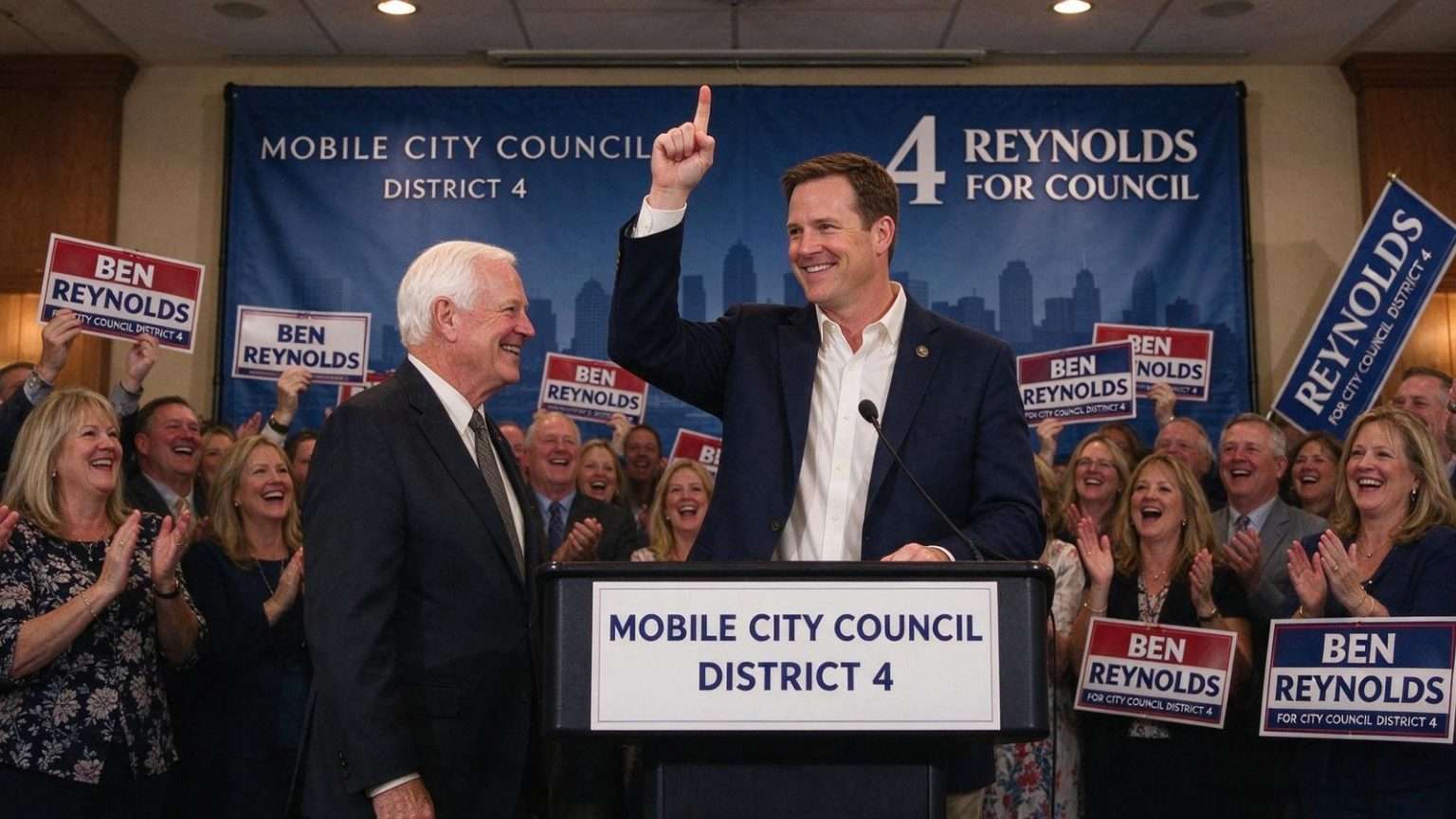
Just after 8 p.m., sitting Councilman John Williams took the podium at Reynolds’ watch party to formally announce Reynolds as the winner. The moment capped a summer of speculation about who would succeed Williams, who announced his retirement earlier in the year and threw his support behind Reynolds as his preferred successor for the district.
Williams’ endorsement shaped the race from its opening weeks. In a district where he had built years of constituent relationships, his public backing signaled to voters that the incumbent considered Reynolds the candidate ready to continue the district’s work, and the victory speech’s setting — with Williams making the announcement in person — underscored how complete that handoff was meant to be.
Reynolds, who defeated businessman Fred Rettig in the contest, will take over the District 4 seat as Williams steps away after years on the council, marking a generational handoff in one of Mobile’s most closely watched local races. District 4 covers much of west Mobile, a fast-growing stretch of the city of neighborhoods, schools and commercial corridors whose voters have historically paid close attention to city hall.
Crime tops the agenda
Reynolds, addressing his supporters, made clear where his priorities would begin. “Crime will continue to be our focus,” Reynolds told supporters. “It’s something that is affecting our city in a major way. I look forward to sitting down and meeting with the administration and police chief and everyone else involved. See what solutions are out there and move us forward.”
The remarks placed public safety at the top of the incoming councilman’s agenda and set the terms of his first weeks in office: meetings with the mayor’s administration and the police chief to review what is working and what is not. Crime has dominated civic conversation across Mobile’s districts, and west Mobile voters made it a recurring theme of the campaign’s forums and door-knocking.
The pledge also connects to the council’s practical role in public safety. The council approves the police department’s budget, shapes staffing levels and funds programs that complement enforcement, giving a council member’s attention to crime policy consequences that reach well past rhetoric.
Reynolds’ promise to work across the dais — with the administration, the chief and fellow council members — framed his approach as collaborative rather than confrontational, a posture consistent with the campaign he ran and the endorsement he carried into it.
Despite the hard-fought campaign, Reynolds struck a gracious tone toward his opponent, saying he had nothing but respect for Rettig. The businessman’s candidacy gave District 4 voters a genuine choice in the race, and Reynolds’ conciliatory words on victory night acknowledged the effort his opponent put into the contest.
Gracious margins matter in municipal politics, where today’s opponent is often tomorrow’s ally on a rezoning vote or a neighborhood project. Reynolds’ remarks suggested he intended to govern a district that included Rettig’s supporters rather than only the voters who put him over the top.
For Rettig, the race’s end returns his attention to the business community, though candidates who run competitive council races often remain engaged in civic life, and west Mobile’s issues — growth, traffic, public safety — are ones he had spent months discussing at length in public forums.
The contest itself reflected the stakes west Mobile voters attached to the seat. With Williams’ retirement leaving an open council seat for the first time in years, both campaigns worked the district’s neighborhoods, civic clubs and social media channels, and turnout reflected an electorate that understood the winner would help set the city’s course.
A district that anchors the city’s growth
District 4’s reach across much of west Mobile places its council member at the center of the city’s fastest-changing geography. The area’s residential subdivisions, shopping corridors and school zones have grown for decades, and the questions that come with that growth — road capacity, drainage, infrastructure maintenance and public safety — land on the district’s council representative first.
Williams’ years on the council gave the district a voice experienced in exactly those questions, from west Mobile traffic projects to citywide budget fights. His retirement marked the end of a long run, and his choice to endorse a successor rather than simply step away reflected his investment in the district’s continuity.
The generational change Reynolds represents was a theme of the night. Newer voices joining the council as veteran members step back is part of the ordinary renewal of municipal government, but in District 4 the transition carried extra weight because of the endorsement lineage — a sitting councilman personally handing his seat’s mandate to his chosen successor.
Reynolds takes office with the expectations such a handoff creates: to honor the continuity his endorser asked voters to trust while establishing his own priorities, with crime policy first among them. The early test will come quickly, in budget deliberations and in the meetings with the police chief he promised supporters on election night.
For now, the Heron Lakes celebration stands as the campaign’s final image: a district’s incoming representative cheered by his supporters, announced by the man he is succeeding, and promising the room that the work on the city’s hardest problem begins the day after the votes are counted.
Election night gatherings at Heron Lakes Country Club carried the feel of a neighborhood victory rather than a downtown political operation. The west Mobile club sits in the heart of the district Reynolds will represent, and the room’s composition — neighbors, supporters and longtime constituents — mirrored the base that carried him to victory.
Williams’ appearance at the watch party just after 8 p.m. served as the race’s formal conclusion. When results confirmed the outcome, the sitting councilman crossed the room to the podium and declared Reynolds the winner, a public blessing that transformed an election result into an endorsement fulfilled.
The retirement that opened the race came earlier in the summer, when Williams announced he would not seek another term. His decision set off the district’s first open-seat contest in years, drawing Reynolds and Rettig into a campaign that dominated west Mobile’s civic conversation through the season and gave voters a rare chance to choose a council member without an incumbent on the ballot.
Reynolds’ victory speech struck the notes his campaign had carried across the district: continuity with the district’s record of representation, urgency about crime, and gratitude — to the man on the podium, to the volunteers who knocked doors, and to the voters who settled the race. The applause that followed each theme suggested the audience in the room had heard the same message all summer.
What the council seat controls
A city council seat in a mayor-council government like Mobile’s carries more influence than its title suggests. Council members approve the city budget — including police staffing and equipment — confirm key appointments, shape zoning decisions that determine how the district grows, and steer infrastructure spending to the roads and drainage projects their districts need.
For District 4, those levers matter daily. West Mobile’s growth puts pressure on intersections, school corridors and stormwater systems, and the district’s council office fields a steady stream of constituent concerns about potholes, drainage, traffic and development proposals. The seat’s day-to-day work is as much casework as legislation.
Reynolds’ emphasis on crime aligns with that practical reality. Constituents who raise safety concerns at council offices are usually asking about specific streets and specific incidents, and the response — coordinating with police precincts, funding lighting or program interventions, pressing the administration on response times — happens through exactly the meetings Reynolds told supporters he intended to request.
The incoming councilman’s meetings with the police chief will also land amid citywide debates over enforcement strategy, community relations and the department’s resources. How a council member engages those debates — as a partner, a critic or a mediator — becomes part of his political identity quickly, and Reynolds used his victory speech to position himself as a collaborator in search of solutions rather than a voice looking for conflict.
West Mobile’s voters will judge the results on their own timetable. The issues the candidates debated — safety, growth, the quality of the district’s services — are the ones that will fill the district’s town halls and constituent emails from Reynolds’ first week in office onward, and his promise to supporters was that the work would start immediately.