Rich Proposes Performance-Tracking Software to Trim Mobile’s Costs
Mobile mayoral candidate Bess Rich proposed adopting CitiStat, a performance-management program pioneered in Baltimore, to track city spending and save money.
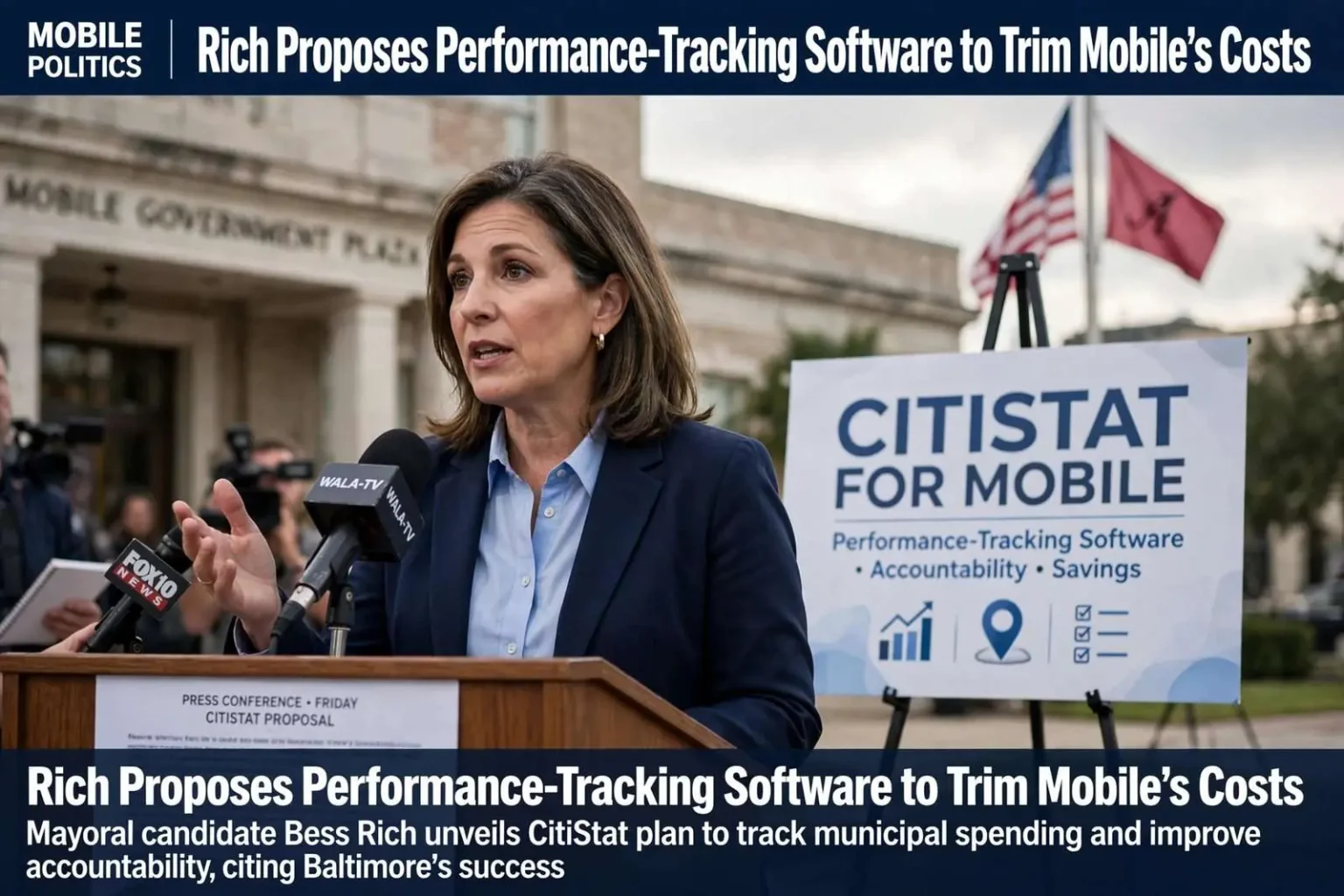
Mobile mayoral candidate Bess Rich proposed that the city adopt a performance-management software program designed to track municipal spending and hold departments accountable for results, pointing to a model that she said had saved Baltimore millions of dollars. In a press release issued Friday, Rich, a former District 6 city councilwoman, called for Mobile to implement CitiStat, a system developed by the city of Baltimore in 2000. The technology integrates database, spreadsheet and mapping tools to collect and report data on how well city services are actually being delivered.
The proposal put a specific, testable management tool at the center of a campaign conversation that had otherwise revolved around broad themes of leadership and change. Rather than promising general efficiency, Rich named a program, a city that had used it, and the measurable outcomes she said it produced. It was the kind of pitch designed to appeal to voters tired of hearing candidates talk about management in the abstract — and it invited scrutiny of whether a system built for a much larger East Coast city could translate to the Gulf Coast.
How CitiStat Works
According to Rich, CitiStat dramatically improved the performance of Baltimore’s agencies and produced substantial savings. She argued the program could be “easily and economically adopted for Mobile.” The system’s premise is straightforward: no program succeeds without data, and no department improves without knowing exactly how it is performing week to week. Under the Baltimore model, agencies submit regular data feeds — response times, overtime hours, work orders completed, complaints received — and managers convene frequent accountability sessions where the numbers are examined line by line.
“CitiStat would enable the city to collect information on and evaluate the performance of a wide variety of functions such as crime fighting, vacant buildings, potholes and summer recreation programs,” she said. The examples were chosen to touch Mobile residents’ daily experience. Pothole repair backlogs, the condition of vacant and abandoned structures, the responsiveness of recreation programs through a long Gulf Coast summer — these are the services whose failures residents notice first, and whose costs are hardest to pin down without systematic record-keeping.
Departments including Public Works, Police, Fire, and Recreation and Parks would be asked to regularly measure and report on how well they served the public. The essential ingredient, Rich said, was leadership — specifically a mayor committed to managing city agencies toward measurable results. Software alone, her argument implied, changes nothing; the difference comes when department heads know the mayor will be reviewing their numbers in person, on a schedule, with consequences attached. As mayor, she said, she would direct departments to use the system to track their own performance routinely rather than waiting for an annual budget review to reveal problems a year after the money was spent.
“By being able to pinpoint the true cost of conducting the business of city government, the citizens of Mobile will get the best and most cost-effective services,” Rich said. The phrase “true cost” carried the proposal’s sharpest edge. Municipal budgets typically show what a department spends, not what a unit of service costs — how much it takes to fill one pothole, board one vacant house, or cut one mile of grass in a city park. Performance-management software is built to close exactly that gap, and Rich framed it as the difference between accounting and management.
The Baltimore Model
CitiStat was developed in 2000 under Baltimore’s city government and quickly became one of the most closely watched municipal management experiments in the country. The name echoed CompStat, the crime-tracking system New York City police had pioneered in the 1990s, which used timely data and repeated accountability meetings to drive down crime rates. Baltimore extended the same logic beyond the police department to every major city agency — public works, housing, health, recreation — and won national recognition for doing so, along with an Innovations in American Government Award. Cities across the country studied the model, and Rich’s argument was that Mobile could adopt the framework without inventing anything new or paying development costs someone else had already absorbed.
The savings she cited were substantial. Baltimore officials credited CitiStat with identifying overtime abuse, reducing absenteeism, speeding up service delivery, and recovering costs that had previously disappeared into departmental routines. For a city of Mobile’s size — roughly 200,000 residents at the time, with a general fund budget a fraction of Baltimore’s — the question was whether the same meetings-and-data machinery could be scaled down without losing its force. Rich’s answer was that the core of the system was not the software but the discipline, and discipline scales in either direction.
The Race to Succeed Dow
The proposal came as Rich campaigned to succeed four-term Mayor Mike Dow, who was leaving City Hall after more than a decade in office. Dow’s tenure had coincided with a period of visible reinvention for Mobile — waterfront redevelopment, a convention center, and an aggressive pursuit of new industry — but by the mid-2000s voters were openly debating what came next, and the field to replace him was crowded and competitive. With city elections scheduled for Aug. 23, Rich faced a field that included community leader Ann Bedsole, District 7 City Councilman John Peavy and Mobile County Commissioner Sam Jones.
Each candidate carried a distinct base. Bedsole, a former state legislator with a long resume in Montgomery, brought name recognition and institutional experience. Peavy represented a City Council district and the incumbent council’s perspective. Jones, a county commissioner, offered countywide governing experience and a coalition that crossed traditional lines. Rich, meanwhile, had built her record on the council as a fiscal watchdog — the member most likely to question spending, audit programs and demand documentation — and the CitiStat proposal extended that brand from the council chamber to the mayor’s office.
By framing her candidacy around measurable efficiency and a specific, off-the-shelf tool already tested in another city, Rich sought to distinguish herself in a race defined in part by competing visions for how Mobile’s government should be run after more than a decade under a single mayor. Where others promised leadership or continuity, she promised instrumentation — a city government that could tell its residents, with numbers, what they were getting for their money.
What Performance Management Asks of a City
The deeper question raised by the proposal is cultural rather than technical. Performance-tracking systems work only when department heads accept that their numbers will be examined publicly and regularly, and when elected officials resist the temptation to use the data selectively. In Baltimore, the system succeeded because it was tied to the mayor’s own authority — agency directors answered directly for their results in meetings the mayor chaired. Any city adopting the model inherits that obligation along with the software: the mayor has to show up, read the data, and act on it.
For Mobile, the appeal was also financial. The city was managing the routine pressures of a Gulf Coast municipality — aging infrastructure, drainage and storm preparation, public safety costs rising faster than revenue — and every dollar lost to inefficiency was a dollar unavailable for those needs. A system that pinpointed the true cost of services, Rich argued, would not just document waste but prevent it, because departments that know they will be measured in a week tend to manage differently than departments that report once a year.
Council Record Behind the Proposal
Rich’s credibility on the issue rested on eight years on the Mobile City Council, where she had represented District 6 — the west Mobile district that includes some of the city’s busiest commercial corridors and largest residential neighborhoods. She had earned a reputation as the council’s most persistent questioner of spending, repeatedly pressing for line-item detail on contracts, travel budgets and departmental requests when colleagues were prepared to vote on trust. Supporters pointed to that record as evidence that the CitiStat proposal was not a campaign-season conversion but an extension of the way she already worked; critics noted that a council member can demand documentation, while a mayor can compel it.
The distinction shaped her pitch. A councilwoman’s oversight is retrospective and negotiated — it depends on what the administration chooses to disclose and on votes that require a majority. A mayor’s oversight, under the CitiStat model, is continuous and unilateral: the department directors serve at the mayor’s pleasure, and the accountability meetings happen on the mayor’s calendar. Rich was effectively telling voters that the tools she had wished for as a council member were available, proven, and waiting for an executive willing to use them.
The Timing of the Rollout
Releasing the proposal on a Friday, weeks before an Aug. 23 election, put it squarely into the campaign’s final stretch, when voters who had paid only passing attention begin to make up their minds. A detailed management proposal is an unusual artifact of that phase, when campaigns typically trade broadsides rather than white papers. The specificity cut both ways: it gave civic-minded voters and the local press something concrete to evaluate, and it handed opponents a target — they could question the cost of implementation, the transferability of Baltimore’s results, or the wisdom of promising savings before studying Mobile’s own baseline data.
The proposal also answered a standing criticism of city government that predated the race: that Mobile’s departments operated with uneven transparency, and that residents’ complaints — about streets, drainage, abandoned properties — too often disappeared into a system that did not systematically track whether they were resolved. CitiStat’s public-facing logic, in which service data is reviewed on a fixed schedule, speaks directly to that frustration. A pothole that takes three weeks to fill is a story; a dashboard showing every pothole in the queue, with its age and cost, is an accountability mechanism.
What Voters Weighed
In the end, the campaign asked Mobile’s voters to choose among experienced public servants with genuinely different theories of the job. Bedsole’s campaign emphasized her state-level experience and relationships. Peavy’s emphasized continuity with a council that had worked alongside Dow. Jones’s emphasized countywide management and a message of inclusion for a city whose population was nearly evenly divided by race. Rich’s emphasized measurable efficiency — the argument that the next mayor’s most important skill would be the disciplined management of a large organization, verified by data rather than asserted in speeches.
The CitiStat proposal fit that argument precisely. It said, in effect, that good intentions in the mayor’s office are not auditable, but numbers are — and that a city willing to measure its services weekly would find the savings to pay for the things it says it values. Whether the tool fit Mobile exactly mattered less to her case than the posture it represented: a government that treats residents’ money as something owed an accounting. The press release closed on that note, promising that with the true cost of city business identified, “the citizens of Mobile will get the best and most cost-effective services” — a sentence that summed up both the proposal and the candidacy it was designed to advance.