Bicyclist Hospitalized After Being Struck by Vehicle in Mobile
A bicyclist suffered non-life-threatening injuries after being struck by a vehicle at Virginia and Owens streets in Mobile.
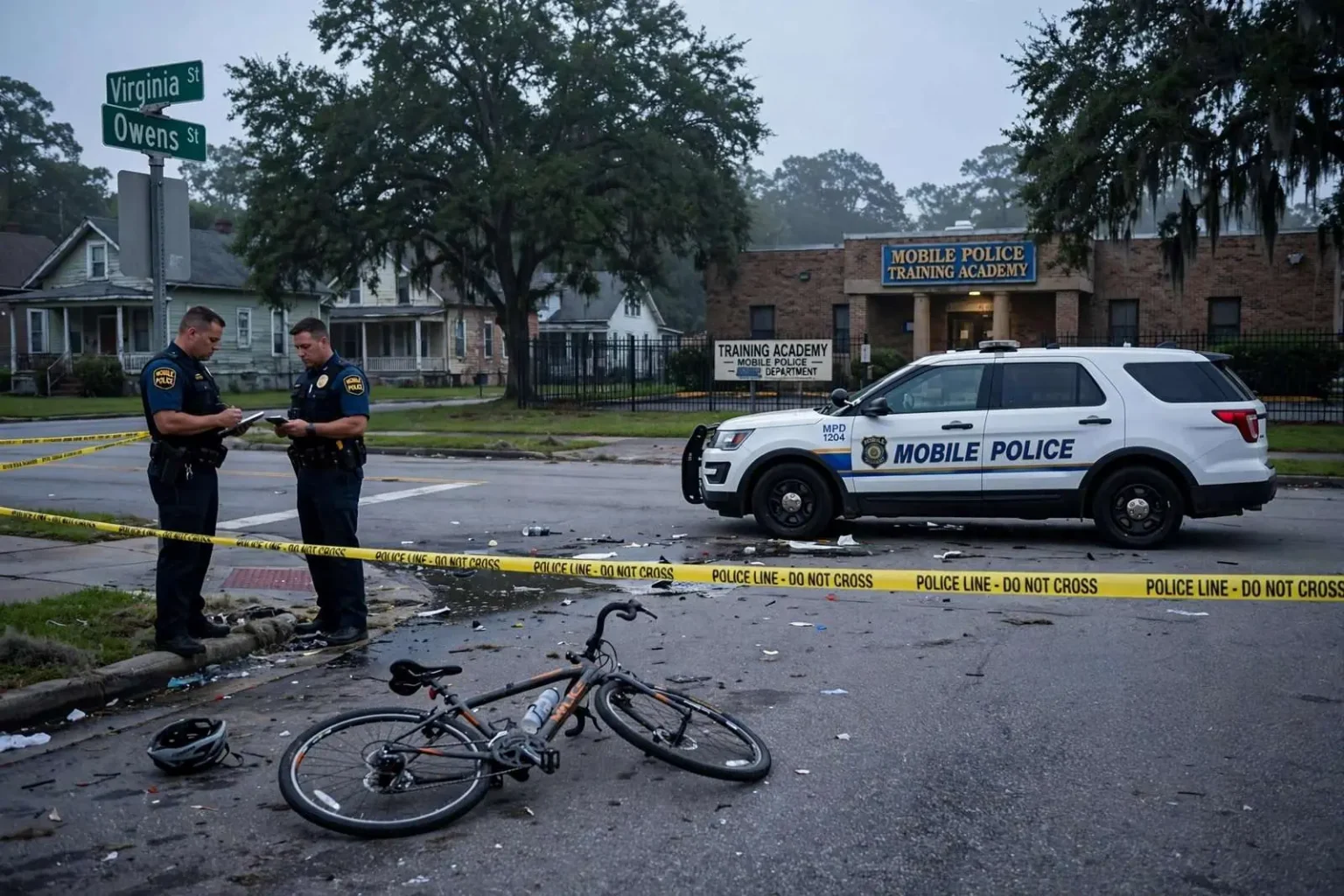
A 40-year-old man was recovering after a vehicle struck him while he was riding a bicycle in Midtown Mobile early Monday. The collision left the cyclist hospitalized but with injuries that were not considered life-threatening, and it added another entry to the running tally of bicycle-vehicle crashes that Mobile police work each year.
The collision happened at Virginia and Owens streets, near the Mobile Police Training Academy. The intersection sits in a residential stretch of Midtown where neighborhood streets cross in a grid, and the presence of the training academy nearby put the crash within sight of the department’s own campus.
Police said the cyclist was taken to a hospital with injuries that were not life-threatening. Officers responded to the scene early in the morning, and the man’s being alert enough to be treated and transported with non-life-threatening injuries marked the crash among the less severe of the bicycle collisions the city sees.
Authorities had not identified the vehicle involved or said whether any charges would be filed as the investigation continued. Anyone who witnessed the crash was encouraged to contact Mobile police, as investigators worked to piece together how the collision occurred and whether either party had contributed to it.
The Intersection and Its Surroundings
Virginia and Owens streets sit in Midtown Mobile, the band of historic neighborhoods between Spring Hill Avenue and Government Street that stretches west from downtown. The area is a mix of early-20th-century homes, churches, and small commercial nodes, with a street grid that carries steady local traffic and connects residents toward Midtown’s shops and schools.
The Mobile Police Training Academy nearby is the department’s training campus, where recruits and veteran officers complete in-service instruction. Its presence makes the surrounding blocks familiar ground for officers, and crashes in the immediate area tend to draw prompt responses from patrol units working close by.
Midtown’s grid also makes it a corridor for cyclists. Flat streets, short blocks, and destinations within easy riding distance put bicycles on these roads daily, both for transportation and for exercise — a fact that shapes the traffic picture at intersections like Virginia and Owens, where drivers and cyclists share the pavement every morning.
How Police Investigate a Bicycle Crash
A collision between a vehicle and a cyclist triggers an investigation that follows a standard sequence. Officers document the scene — vehicle and bicycle positions, skid marks, debris fields, and the damage to each — before the roadway is cleared, because those physical clues are the backbone of the reconstruction that follows.
Witness statements carry special weight in bicycle crashes. Unlike two-vehicle collisions, where drivers often give matching accounts, a cyclist may be unable to describe what happened, and the vehicle’s driver is one party to the event rather than a neutral observer. Neighbors, passersby, and drivers who saw the moments before impact are the sources that fill the gap, which is why police appealed for witnesses.
Investigators also look at the factors that determine fault in these cases: lighting and visibility at the hour of the crash, whether the cyclist had lights or reflective gear, which party had the right of way, and whether speed or impairment played a role. Early-morning crashes add the visibility question to every review, since dawn light and low angles make cyclists harder to see.
Charges, when they come, depend on what the evidence shows. A crash can close as a no-fault accident, or it can produce citations ranging from failure to yield to more serious counts if impairment or recklessness emerges. Until the investigation is complete, police generally decline to say which direction a case is heading.
Cyclists and Traffic on Mobile Streets
Mobile’s street network presents familiar challenges for cyclists. The city’s core was built long before modern bicycle infrastructure, and most streets carry mixed traffic without dedicated lanes. Cyclists riding legally are entitled to their place on the roadway, but the reality of sharing narrow lanes with cars is a daily negotiation, particularly on commuter routes through Midtown and downtown.
Advocacy for better conditions has grown along with cycling itself. Local riding groups, the city’s bike-share efforts, and the popularity of routes along Mobile Bay have all raised the visibility of cycling in the city, and with it the recurring conversation about how drivers and riders share streets that were never designed for both.
Police across the region use crashes like this one to repeat the standard advice to both sides. Drivers are urged to give cyclists room when passing, to check mirrors and blind spots at intersections, and to treat a bicycle as a vehicle with a right to the lane. Riders are urged to ride with traffic, use lights after dark, wear helmets, and make themselves visible — the simple steps that most often determine whether a collision becomes a fatality.
The Early-Morning Factor
The timing of the crash — early Monday — is a detail that matters in both the investigation and the broader safety picture. Early-morning hours combine low light with the start of commuter traffic, and they are the hours when visibility failures are most likely to put a driver and a cyclist in the same place at the same time with neither aware of the other.
For riders, the early hours put a premium on lighting. A white headlamp and a red rear lamp do more than any other single item to make a cyclist visible at dawn, and reflective clothing multiplies the effect. For drivers, the equivalent habit is slowing down and scanning intersections rather than assuming an empty road — the assumption that fails most often in the crashes that happen in that quiet stretch before sunrise.
Investigators had not said what time the collision occurred, what the lighting conditions were, or which direction each party was traveling. Those details, along with the identity of the vehicle involved, were the open questions as the case moved forward.
When a Crash Becomes a Case
For the cyclist, the immediate aftermath involves treatment, and injuries classified as non-life-threatening still can mean fractures, road rash, and weeks of recovery. Hospital staff treat the medical side while the police investigation runs its course, and the man’s condition — stable enough that his injuries were not considered life-threatening — was the one piece of good news in the morning’s report.
The driver of the vehicle, once identified, faces the standard process that follows a serious-injury collision: an interview, an examination of the vehicle, and potentially charges depending on what investigators conclude. Insurance questions follow the official findings, since fault in a bicycle crash determines who bears the costs of medical bills and damages.
The witness appeal remained open as the investigation continued. Police asked anyone who saw the crash or has information about it to contact Mobile police, and department investigators follow up on those calls in the days after a collision. In cases with no camera coverage and an injured cyclist, a single solid witness account is often the difference between a closed file and a solved case.
A Familiar Scenario for the Department
For Mobile police, the crash landed close to home — literally within the shadow of the training academy where the department’s officers learn their trade. Responding units knew the streets, and the investigation proceeded with the resources of a department working its own neighborhood.
Crashes between vehicles and cyclists recur across Mobile every year, and each one is logged into the collision data that traffic-safety planners use to identify problem intersections and times. Patterns in that data — corridors with repeated crashes, hours of peak risk — feed into decisions about enforcement, signage, and street design across the city.
As of the initial report, the 40-year-old cyclist was hospitalized in stable condition, the vehicle involved had not been identified publicly, and no charges had been filed. The investigation into the early-Monday collision at Virginia and Owens streets continued, with police asking anyone with information to come forward as the review of the crash moved ahead.
Bicycle Safety Resources in the Region
Riders in Mobile have access to a growing set of safety resources as cycling’s profile in the city has risen. Local bike shops fit lights and helmets, riding clubs lead group rides that model safe road behavior, and city and state safety campaigns periodically remind drivers and cyclists alike of the rules that govern their sharing of the road.
Alabama law treats bicycles as vehicles, which means riders have the same rights — and the same duties — as drivers. A cyclist is required to observe signals and signs, to ride in the same direction as traffic, and to use lights after dark, just as drivers are required to pass safely and yield where the law demands it. Most bicycle crashes that investigators work trace back to one party or the other departing from that framework.
The safe-passing rule is the one emphasized most often after crashes like this one. Drivers passing a cyclist are expected to leave generous clearance and to treat the maneuver as they would passing a slow-moving vehicle, not as squeezing past an obstacle. On neighborhood streets like those around Virginia and Owens, where lanes are narrow and sight lines are short, that margin is what keeps a routine morning ride from becoming a hospital case.
What Comes Next in the Case
The open items in the investigation are the ones police routinely resolve over days rather than hours: identifying and interviewing the vehicle’s driver, canvassing for additional witnesses and any doorbell or security cameras facing the intersection, and reconstructing the crash from the physical evidence. Findings typically conclude with either a determination of no violation or citations appropriate to what the evidence shows.
Updates in cases like this generally come through the department’s public-information channels, and interested residents follow them as the intersection returns to its normal rhythm. By the next morning, Virginia and Owens were carrying their usual traffic again, with little visible trace of the collision beyond the investigation itself.
The crash stood as another entry in the city’s ongoing record of vehicle-bicycle collisions — a 40-year-old rider hospitalized but expected to recover, an intersection near the police training academy returned to normal, and an open question about the vehicle involved that Mobile police continued to work with the public’s help.