
Bishop State Hands Out 280-Plus Food Boxes to Students and Neighbors
Bishop State Community College and Feeding the Gulf Coast distributed over 280 boxes of food and toiletries to Mobile students and neighbors.
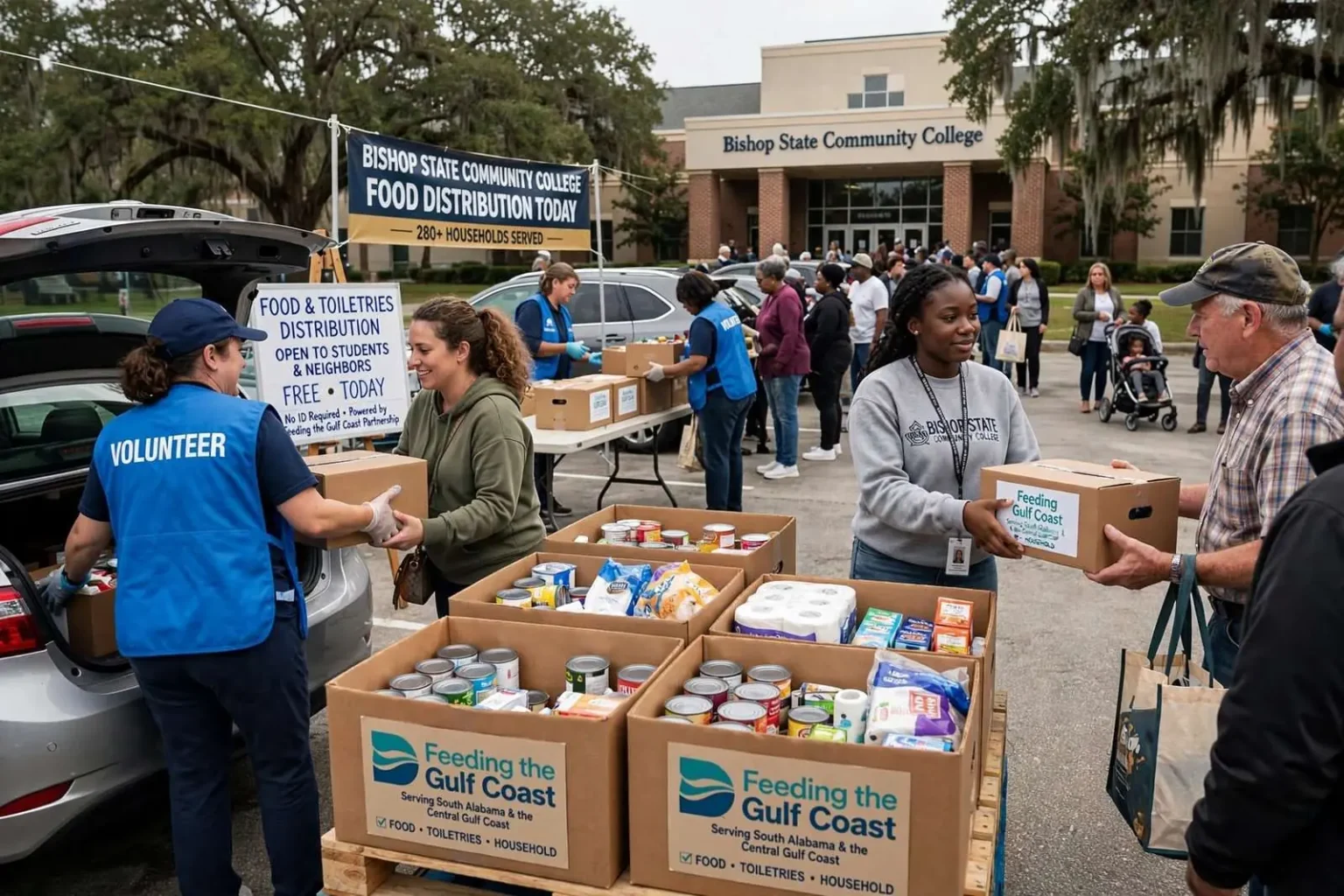
Volunteers at Bishop State Community College distributed more than 280 boxes of food and toiletries on campus Saturday, offering relief to both neighborhood families and students struggling to make ends meet. The distribution drew a steady line of recipients through the campus as volunteers loaded boxes into cars and carried them to neighbors who walked over from the surrounding community.
The giveaway, organized in partnership with the food bank Feeding the Gulf Coast, served community members as well as students facing food insecurity — a problem that has grown more visible as the pandemic disrupted jobs and household budgets across the Gulf Coast. Each box combined shelf-stable food items with toiletries, addressing two kinds of household need that often rise together when money gets tight.
Feeding the Gulf Coast, the regional food bank that serves south Alabama and the central Gulf Coast, supplies partner organizations like Bishop State with bulk food that reaches families through distribution events, pantries, and shelters. The college’s campus served as a distribution point, a role community colleges across the region have increasingly taken on as food need has spread beyond the traditional channels.
College officials said hunger among students often goes unnoticed, hidden behind the routines of campus life. “Many think because you’re able to eat, or go to the grocery store or run to the gas station or buy a bag of chips, honey buns — that you’re not hungry,” said Sherrica Hunt, the college’s director of institutional advancement. “Our students here are getting a quality education and nutritional food is important so they can take care of their families.”
The Hidden Problem on Campus
Food insecurity among college students has emerged in recent years as a national concern, and community colleges sit at the center of it. Students at two-year institutions are more likely than university students to be older, working, supporting children, and paying their own bills — circumstances that make an unexpected car repair or a cut in hours enough to push a household into skipping meals.
At Bishop State, which serves students across Mobile’s urban core, that reality shaped how officials talk about the giveaway. The boxes were available to students and to the neighborhood alike, reflecting the college’s view of itself as a community institution rather than a place apart from the streets around it.
The pandemic intensified pressures that already existed. Job losses in hospitality, retail, and service work hit Mobile’s working households hard, and students who were juggling coursework and part-time jobs found their hours reduced or eliminated. Food distributions became one of the most direct ways institutions could respond, converting philanthropic supply into immediate household relief.
Hunt’s message to the campus community was that hunger does not always look like hunger. A student who appears to be managing — attending class, holding a job, stopping at the gas station for snacks — may be stretching calories across a week. Making food available on campus, without paperwork or stigma, is designed to reach exactly that student.
A Partnership Built for the Long Term
Saturday’s distribution was one piece of an ongoing partnership aimed at keeping food on the tables of students and neighbors alike. Partnerships between colleges and food banks work because each side brings what the other lacks: the food bank has supply chains, bulk purchasing, and logistics experience, while the college has space, volunteers, and the trust of the people it serves.
Feeding the Gulf Coast’s network reaches across the region, and distribution events like the one at Bishop State are how food moves from warehouses to kitchens. A single Saturday event can move hundreds of boxes in a few hours, and the sheer volume depends on volunteers — students, staff, and community members — who show up to pack and hand them out.
What Food Insecurity Costs a Student
Research on college food insecurity has linked it to poorer academic outcomes: students who skip meals miss classes, lose concentration, and take on debt to cover basics. Some drop out entirely, not because of academics but because hunger makes finishing impossible. That is why college administrators describe food programs not as charity but as retention strategy — a student who is fed is a student who can finish.
The boxes distributed at Bishop State included toiletries alongside food, an acknowledgment that household need does not stop at groceries. Soap, hygiene items, and personal care products are ineligible for most food assistance benefits, and families under financial strain often cut them first. Bundling them with food addresses the full scope of a tight budget.
Community colleges like Bishop State occupy a distinctive place in Alabama’s education system. Open admission, low tuition, and flexible schedules make them the entry point for thousands of students who might never have reached a four-year campus, and many of those students bring the economic pressures of adult life with them to class.
The Neighborhood Around the Campus
Bishop State’s campuses sit in Mobile’s urban core, and the college’s history is intertwined with the city’s Black community — founded in the era of segregation and grown through decades as a cornerstone of higher education for Mobile families. That history shapes its role in the neighborhood: the college is a neighbor first, and a distribution event on campus is a continuation of that relationship.
The pandemic years tested institutions like Bishop State in new ways, forcing classes online and cutting off the campus jobs and services students depended on. Food giveaways, emergency grants, and technology loans became part of the institutional response, and many of those programs have persisted as administrators saw the need did not disappear with the emergency phase.
Volunteers at Saturday’s event included college staff and students, and organizers say the give-and-take matters: a student volunteer handing a box to a neighbor is participating in the college’s mission as much as anyone in a classroom. Community engagement of this kind is written into the mission of Alabama’s community colleges, which serve as workforce trainers, cultural centers, and safety nets for their regions.
For the more than 280 households that received boxes, the immediate benefit is measured in meals and in the small relief of a stocked shelf. For the college, the distribution is a statement about who the institution serves — everyone who walks through its doors, and everyone who lives on the blocks around it.
How to Get Help or Help Others
Students and residents facing food need in the Mobile area can connect with Feeding the Gulf Coast’s partner network, which includes pantries and regular distribution events across south Alabama. The food bank’s calendar lists upcoming distributions, and community colleges in the region can direct enrolled students to campus resources as they become available.
Those who want to support the work can volunteer at distributions, contribute to the food bank, or advocate for the programs that keep college food pantries stocked. The need, officials note, does not follow an academic calendar — it persists through semesters, summers, and holidays alike.
The Saturday event also illustrates how the definition of a college’s community has widened. Two-year colleges have always served whoever walks in, and in neighborhoods like the ones around Bishop State, the campus is one of the few large public institutions within walking distance of thousands of households. When those households need help, the campus is a natural gathering point.
Hunger and the Pandemic Economy
The pandemic’s effect on food security along the Gulf Coast followed the shape of the local economy. Workers in restaurants, hotels, and retail — industries that dominate Mobile’s service sector — saw the earliest and deepest job losses, and many households that had never needed assistance found themselves in lines for the first time. Food banks reported surging demand while their volunteer bases, often made up of older and higher-risk residents, shrank.
Institutions adapted quickly. Drive-through distributions replaced walk-up lines, boxes replaced bulk pantry shopping, and colleges like Bishop State turned their parking lots into distribution sites that could serve hundreds of families in an afternoon without close contact. Those innovations have outlasted the emergency, making distributions more efficient and more accessible to working families.
For student parents, the stakes compound. A student raising children while enrolled classes faces the arithmetic of feeding a family on the margin between financial aid, wages, and bills. Administrators note that many of the students receiving boxes Saturday were doing exactly that — maintaining enrollment, attending class, and holding households together with the kind of invisible effort that never appears on a transcript.
The visibility of an event like Saturday’s serves a purpose of its own. Every distribution signals to the campus and the neighborhood that needing help is common and that asking for it carries no shame. Officials say that message, repeated event after event, is what draws out students who would otherwise quietly go hungry.
The partnership between Bishop State and Feeding the Gulf Coast continues, and organizers say future distributions will follow as supply and need allow. For a college whose mission begins with the community around it, 280 boxes on a Saturday morning is both a concrete act of relief and a promise that the work will keep going.


