
Bishop State Signs Transfer Partnership With Orange Beach-Based Columbia Southern University
Bishop State Community College in Mobile has signed a transfer partnership with Orange Beach-based Columbia Southern University for graduates seeking.
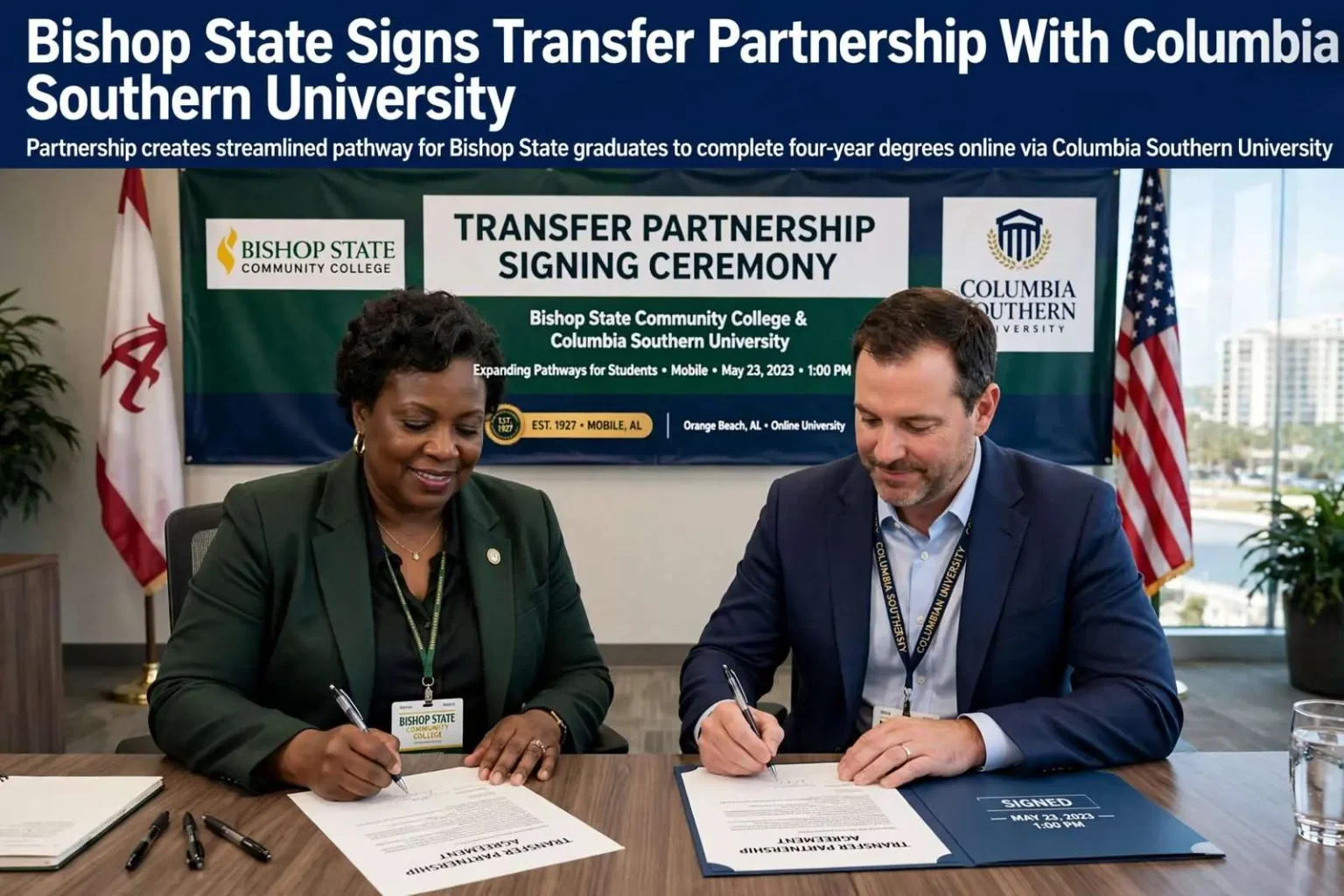
Bishop State Community College in Mobile has entered into a partnership with Columbia Southern University that is intended to smooth the path for its graduates who want to finish a four-year degree. According to a release from the college, the two schools agreed to “create a collaborative transfer process for Bishop State graduates who want to pursue a bachelor’s degree.” Administrators from both institutions were scheduled to sign the agreement on Tuesday, May 23, at 1 p.m.
Agreements of this kind have become an increasingly common tool for Alabama’s two-year colleges, which see a meaningful share of their students leave with an associate degree and no clear next step. A formal transfer partnership replaces that uncertainty with a published route: which courses count, which bachelor’s programs are open, and how a graduate moves from one campus system to the other without paperwork piling up in an admissions office somewhere. For community college students — many of them the first in their families to attend college at all — the difference between a handshake and a signed articulation agreement is often the difference between finishing a bachelor’s degree and stopping at the two-year mark.
What the Agreement Is Meant to Do
Transfer partnerships of this kind generally spell out how credits earned at a two-year college will be accepted toward a bachelor’s program, which reduces the risk that students repeat coursework or lose credit hours when they move between institutions. Lost credits cost real money and real time; every course a transfer student has to retake is a semester of tuition and financial aid stretched thinner, and credit loss is one of the most commonly cited reasons community college graduates never complete a four-year degree nationally.
The release did not detail which specific degree programs or credit-transfer terms are covered. That detail typically follows in the weeks after a signing, as registrars and academic deans map the two curricula against each other and publish equivalency tables for students and advisors. Until those tables are issued, Bishop State advisors are expected to steer interested graduates through the college’s transfer office, which handles the growing list of articulation agreements the school maintains with four-year institutions around the region.
What the agreement does establish is intent from the top of both institutions. A signing ceremony with administrators from each campus signals that transfer students are a priority rather than an afterthought — a meaningful distinction at a university that operates primarily online, where a prospective transfer student may never set foot in a campus building and needs to know from the first phone call exactly where their associate degree will land them.
Bishop State is a state-supported, two-year public historically Black college founded in Mobile in 1927. Its roots run deep in the city’s educational history: the college grew from early twentieth-century efforts to train Black teachers in segregated Alabama and evolved through decades of expansion into a comprehensive community college serving Mobile County with academic transfer programs, career-technical education, workforce training and adult education. Its campuses anchor education on the city’s south side, and its graduates feed universities across the state as well as the region’s hospitals, shipyards, schools and small businesses.
Columbia Southern University is an online university based in Orange Beach, meaning students who continue on through the agreement can do so without relocating away from the Gulf Coast. The institution’s model is built for working adults — flexible online course delivery, terms that start frequently rather than twice a year, and degree programs aimed at fields such as business administration, occupational safety and health, fire science, criminal justice and information technology. That flexibility is precisely what many community college graduates need: students who finished a two-year degree while working part-time jobs or raising children can keep the job and add the bachelor’s coursework on their own schedule.
The pairing keeps both ends of the pipeline inside south Alabama: students begin at a Mobile campus and can finish through a Baldwin County-headquartered online institution. For a region that has watched generations of its college-aged residents leave for Auburn, Tuscaloosa or out of state — often without returning — an agreement that lets a student earn every credit of a four-year education without leaving the coastal counties has value beyond any single enrollment. Degrees earned by people who stay tend to be spent in the communities where those people live, in the form of teachers, nurses, managers and small-business owners who never left.
The timing also reflects the direction of higher education along the Gulf Coast. Baldwin County is one of the fastest-growing counties in Alabama, and Orange Beach’s homegrown university has grown alongside it, serving students across the country and around the world from its offices just off the coast Highway 161 corridor. Mobile’s community college, meanwhile, has worked for years to raise transfer and completion rates among a student body that skews older, more working-class and more likely to need flexible options than the traditional residential student. A transfer pipeline between the two is a natural fit for both.
Why Transfer Agreements Matter Locally
Community colleges nationally enroll roughly a third of American undergraduates, but completion rates for students who intend to earn a bachelor’s degree remain stubbornly low — the transfer process itself is where most of the loss happens. Students lose credits, discover their courses do not match a receiving program’s requirements, or simply get lost in the logistics of applying to a new institution while finishing the old one. Structured agreements exist to remove exactly those failure points: a student who knows from day one which courses transfer, into which program, at which university, can plan a full four-year education at community college prices for the first half.
The price difference is the other half of the equation. Tuition and fees at an Alabama community college run far below what a four-year university charges for the same freshman and sophomore courses, and many Bishop State students depend on federal Pell Grants that stretch further at two-year tuition rates. Starting locally and transferring after the associate degree is, for a large share of the college’s students, the only realistic route to a bachelor’s credential — which is why every new articulation agreement represents not just a partnership but a widened doorway.
For Mobile and the broader Gulf Coast economy, the practical significance is workforce-oriented. The region’s largest employers — healthcare systems, the port, shipbuilding and repair yards, aerospace suppliers along the Mobile Bay corridor, and the tourism industry across Baldwin County — increasingly list bachelor’s-level credentials among their promotion and hiring requirements. A registered nurse with an associate degree who wants to move into management, a firefighter studying fire science, a paralegal eyeing a business administration degree: these are the exact profiles an online transfer partner serving working adults is designed to accommodate. Every credit that survives the transfer is a local employee who climbs a rung without leaving the job.
The agreement also adds to a broader pattern for Bishop State, which has spent recent years building its transfer and workforce relationships with institutions across the region as part of its mission as Mobile’s community college. Each signing gives the college’s advisors one more destination to present to students at orientation, when decisions about course selection are made and when a two-year plan can be mapped with the four-year finish already in view.
For students, the advice from transfer specialists at institutions like these is consistent: declare the intent to transfer early, meet with an advisor at both institutions, and keep copies of transcripts and syllabi from the first semester onward. Students who plan their community college coursework around a named receiving program almost always fare better in the transfer process than those who decide after graduation. With the agreement now signed, Bishop State graduates who want to pursue a bachelor’s degree through Columbia Southern can begin that planning with both institutions formally at the table.
The Tuesday signing at 1 p.m. put two administrators’ signatures on what is, in the end, a fairly simple promise: that a student who does the work at one Gulf Coast institution will not have to do it again at another. In a region where the cost of college weighs on family decisions and where staying close to home matters as much as any ranking, that promise is worth the ceremony it received. The associate degree holders who walk across Bishop State’s stage each spring now have one more clearly marked road toward the four-year credential that so many of them came to college to earn — and it runs entirely through south Alabama.
The signing also comes as two-year colleges across Alabama lean harder into transfer partnerships as a completion strategy. State higher-education officials have spent a decade pushing the message that Alabama’s workforce needs more degree holders, and the two-year colleges — spread across every corner of the state — are where a large share of the state’s potential graduates get their start. Colleges that maintain strong transfer pipelines see more of their students finish bachelor’s degrees; universities that maintain strong receiving pipelines fill upper-division seats with proven students who already know how to do college work. Both sides have an incentive to make the handoff clean, and formal agreements are how that incentive becomes practice.


