Black Joe Lewis & The Honeybears Return to Alabama Music Box in Mobile (Sept. 7, 2012)
Black Joe Lewis and The Honeybears brought their blues-and-funk-fired rock to the Alabama Music Box in downtown Mobile on Friday, September 7, 2012. The...
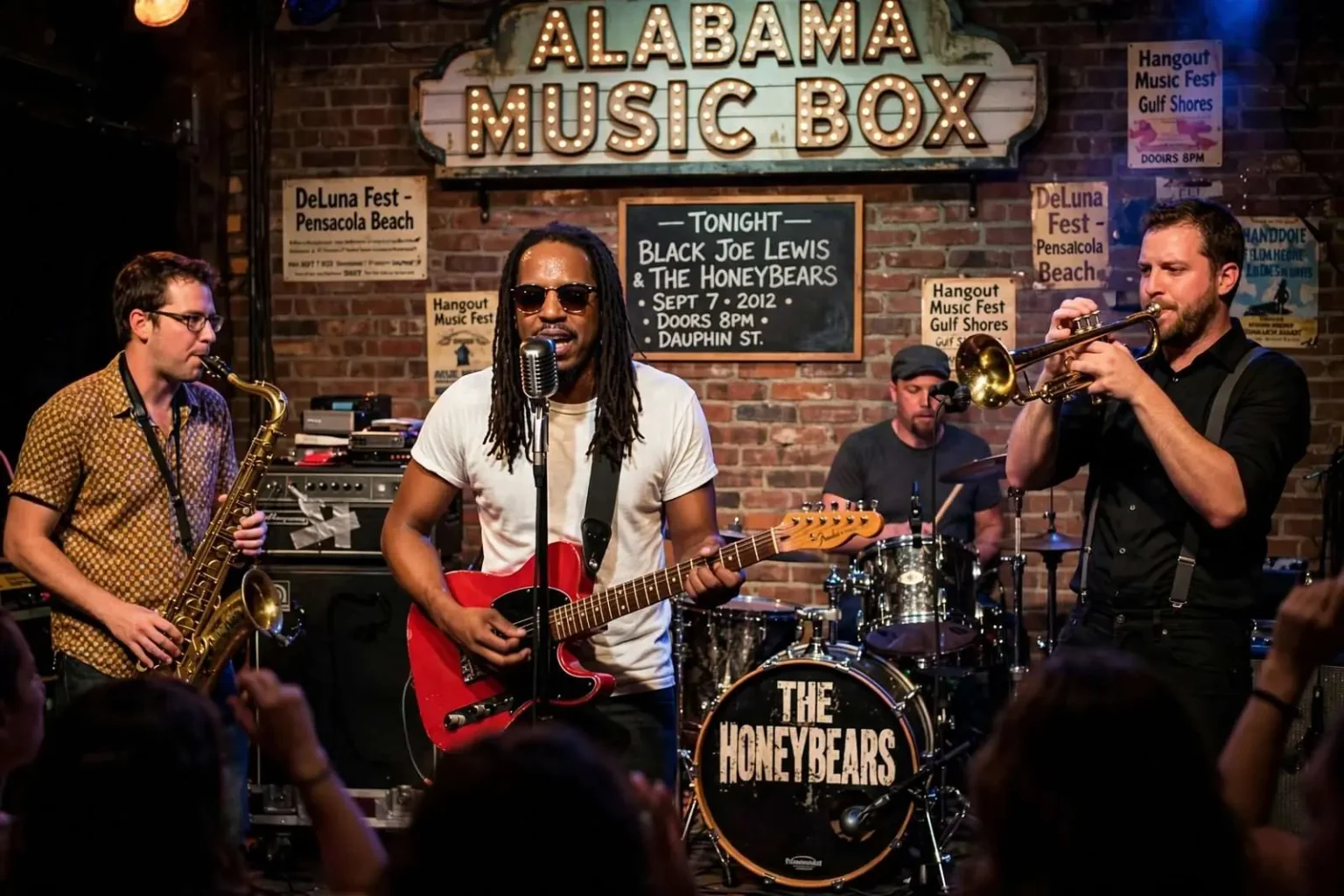
Black Joe Lewis & The Honeybears brought their blues-and-funk-fired rock to the Alabama Music Box in downtown Mobile on Friday, September 7, 2012. The Austin, Texas band arrived in the Port City with a national reputation and a Gulf Coast resume: the group had already appeared at both DeLuna Fest in Pensacola Beach and the Hangout Music Fest in Gulf Shores, making the Dauphin Street club a return to familiar territory for a band whose live shows had become their calling card.
The band’s reputation was built on sweat-soaked performances anchored by gritty guitar work and a brassy horn section. Frontman Black Joe Lewis, a guitarist and singer who came up playing Austin clubs, led a group that deliberately reached back to the raw, direct sound of classic soul and rhythm and blues, filtering it through a modern garage-rock urgency. Audiences who had seen them at the beach festivals knew what a Mobile crowd was in for: a show that moved fast, played loud, and left little space between the band and the audience.
The group’s catalog included the single “Mustang Ranch,” one of the songs that had carried them beyond the Austin scene, and the 2012 tour followed appearances on national television that had introduced the band to viewers well outside their home market. By the time the Honeybears took the stage at the Alabama Music Box, they were touring as an established act rather than an opening-act curiosity, with albums and festival slots behind them.
The band and its sound
Black Joe Lewis formed his band in Austin in the late 2000s, drawing on the city’s legendary music community and on influences that ran from Texas blues to Memphis soul to the horn-driven funk of the 1960s. The addition of a horn section gave the group a sound larger than a typical guitar band, and their records and shows blended shouted vocals, stinging guitar lines and punchy brass in a way that recalled the great soul revues while sounding unmistakably contemporary.
Critics and fans alike gravitated to the band’s energy on stage rather than any studio polish. Their albums earned national attention, with early releases drawing praise for their unfiltered approach and earning the band slots on bills far bigger than club stages. Appearances at major festivals, including the two Gulf Coast events that brought them to the region, built the live reputation that a September 2012 club date in Mobile traded on.
The 2012 tour stop in Mobile followed national television appearances that had widened the band’s audience considerably. For touring acts of that scale, the Gulf Coast circuit between New Orleans and the Florida panhandle offered a string of rooms that appreciated loud, roots-driven music, and the Alabama Music Box had positioned itself at the center of that circuit for bands passing through the region.
The Alabama Music Box and Dauphin Street
The Alabama Music Box, on Dauphin Street in downtown Mobile, was a key stop on the city’s live-music calendar and a frequent home for touring acts passing through the Gulf Coast. The venue’s location placed it in the heart of the Dauphin Street entertainment district, the stretch of downtown blocks where Mobile’s nightlife concentrates, blocks that fill on weekend nights with crowds moving among bars, restaurants and music rooms.
For a band like the Honeybears, the club offered what touring musicians value most: an attentive room, a stage big enough for a horn section, and a downtown location that drew casual music fans alongside dedicated followers. Mobile audiences had long supported blues, soul and roots acts, a taste that reflected the city’s own deep musical traditions, and a Friday night slot in September put the band in front of the district’s peak weekend crowd.
The venue’s role in the regional circuit mattered as well. Bands traveling between New Orleans and the beach festival towns needed rooms worth playing in the middle stretch, and the Music Box built its booking identity on exactly that traffic. A September 2012 visit from an Austin band with festival credentials and national television exposure was the kind of booking that defined the club’s place in the city’s music life.
The Gulf Coast festival connection
The band’s history with the Gulf Coast gave the Mobile show extra resonance. DeLuna Fest, held on Pensacola Beach, and the Hangout Music Fest, in Gulf Shores, had both put the Honeybears in front of large regional audiences in the years before the club date, and those festival appearances introduced Alabama and Florida panhandle fans to the band’s live show on the biggest stages the coast offers.
Festival slots function as a kind of regional audition. A band that delivers at an afternoon festival set collects new listeners who will turn out weeks or months later when the tour reaches their city, and the September 7, 2012 booking at the Alabama Music Box sat squarely in that pattern. Local fans who had seen the band braving the sun and wind on a beach stage could now watch them at close range on Dauphin Street.
The geography of the Gulf Coast circuit made such returns natural. Austin bands touring east toward Florida pass directly through the region, and the string of cities, from New Orleans through Mobile and Pensacola to the beaches, forms a coherent week of bookings. A band with two coastal festival appearances on its resume was a natural fit for a Mobile club that wanted established touring acts on Friday nights.
Mobile’s live music scene in 2012
The date also catches Mobile’s music scene at a particular moment. Downtown’s revival along Dauphin Street had made the entertainment district the center of the city’s nightlife, with venues large and small booking original music several nights a week. The city’s own musical heritage, from its contributions to soul and rhythm and blues to the distinctive Gulf Coast sound that grew up around Mobile Bay, gave audiences there a discerning ear for bands working in those traditions.
Black Joe Lewis & The Honeybears, playing blues-and-funk-fired rock with a full horn section, were the kind of act that resonated with that audience. Their music honored the same lineage of soul and rhythm and blues that Mobile listeners grew up hearing, and their unpolished, high-energy delivery suited a club crowd rather than a seated theater. A Friday night in September, with the district at its busiest, gave the band the fullest possible room.
For local music fans, the show was an example of what the Dauphin Street circuit had made possible by 2012: nationally touring bands with festival credentials and television appearances playing an intimate club ticket, on a street where a listener could park once and stay out all night. The visit of an Austin band with a single like “Mustang Ranch” to its name was the ordinary business of that scene operating at its best.
The show in retrospect
Seen from the present, the September 7, 2012 date preserves a snapshot of three things at once: a band from Austin at the height of its touring momentum, a Mobile venue serving as the Gulf Coast’s way station for national acts, and a downtown entertainment district drawing crowds on the strength of live music. Each of those elements has continued to evolve since, but the account records how they came together on that Friday night.
The elements the report preserved remain the heart of the story: the band’s identity as an Austin group with blues-and-funk-fired rock, their sweat-soaked reputation built on gritty guitar and a brassy horn section, the single “Mustang Ranch,” the tour’s arrival after national television appearances, their history at DeLuna Fest and Hangout Fest, and the Alabama Music Box’s standing on Dauphin Street as a key stop for touring acts on the Gulf Coast.
For readers who were there, the date recalls a loud, close-quarters night in downtown Mobile; for those who missed it, the record stands as an example of the live-music traffic that moved through the Port City in the early 2010s, when a Friday on Dauphin Street could bring an Austin soul-funk band with a festival resume to a stage a few steps from the street.
Austin to the Gulf: the band’s road
The route from Austin’s clubs to a Dauphin Street stage is one that touring bands have traveled for decades, and the Honeybears’ version of it illustrates how a young group builds a national following. Austin’s music community gave the band its start and its development, a city where a guitarist can absorb blues, soul, country and rock within a few blocks, and where a horn-powered ensemble could find its voice in front of demanding local crowds before facing the road.
From that base, the band expanded outward through regional touring, festival bookings and steadily wider national exposure. Each layer of the climb was visible in the Mobile stop of September 2012: festival appearances at DeLuna and the Hangout demonstrated the regional following, the national television appearances demonstrated the wider one, and the club date itself demonstrated the working band’s routine of carrying that reputation from city to city one night at a time.
The single “Mustang Ranch” served as the band’s calling card in that expansion. Radio play and word of mouth around a signature song give touring acts a foothold in every market, and crowds along the Gulf Coast who knew the song from the band’s festival sets could hear it again in a club setting, where the horn section and gritty guitar lines hit at close range.
What a horn band means on a club stage
A horn section changes the physics of a club show. The sound fills the room differently than a four-piece guitar band, the arrangements shift between shouting brass and stripped-down grooves, and the visual presence of horn players adds a revue-like energy that clubs rarely see on a standard Friday night. For the Alabama Music Box crowd in September 2012, that difference was part of the draw.
The band’s blues-and-funk foundation gave the horns something substantial to work with. Rather than decorating songs with occasional stabs, the Honeybears’ arrangements grew out of the soul and rhythm-and-blues tradition in which the horn section is a lead voice, trading phrases with the guitar and driving the choruses. Audiences raised on Gulf Coast soul heard the lineage immediately, and the band’s garage-rock edge kept the delivery current.
Shows of that kind tend to be remembered as physical experiences, which is how the band’s reputation for sweat-soaked performances earned its phrase. A September Friday in Mobile, with the summer heat still holding and the Dauphin Street district crowded outside, was an environment the band’s style was built for, and the historical record of the date preserves that fit between a hot-room band and a hot-room town.
The lasting record of the night
The preserved account of the September 7, 2012 show records the essentials: the band, the venue, the street, the date, the festival history, the single, and the national television appearances that preceded the tour. It stands as local documentation of a touring act’s visit, the kind of entry that fills in the map of the Gulf Coast’s live-music history one club date at a time.
Such records matter to the cities they describe. Mobile’s claim on the regional music circuit rests on accumulations of nights like this one, when national and regional touring acts chose a Dauphin Street stage as the place to play on a Friday. The Alabama Music Box’s role as a frequent home for those acts is part of what the 2012 date documents.
And for the band’s history, the Mobile stop sits among the dates that followed their festival breakthroughs and television exposure, carrying their blues-and-funk-fired rock through the clubs of the Gulf Coast. The night remains on the record: Austin’s Black Joe Lewis & The Honeybears, on Dauphin Street in downtown Mobile, Friday, September 7, 2012.