
Boat Strike Suspected in Manatee Death Near Orange Beach
A 1,200-pound manatee died from a boat strike near Orange Beach, and a second was injured in the same mating herd, prompting DISL to renew calls for boater awareness.
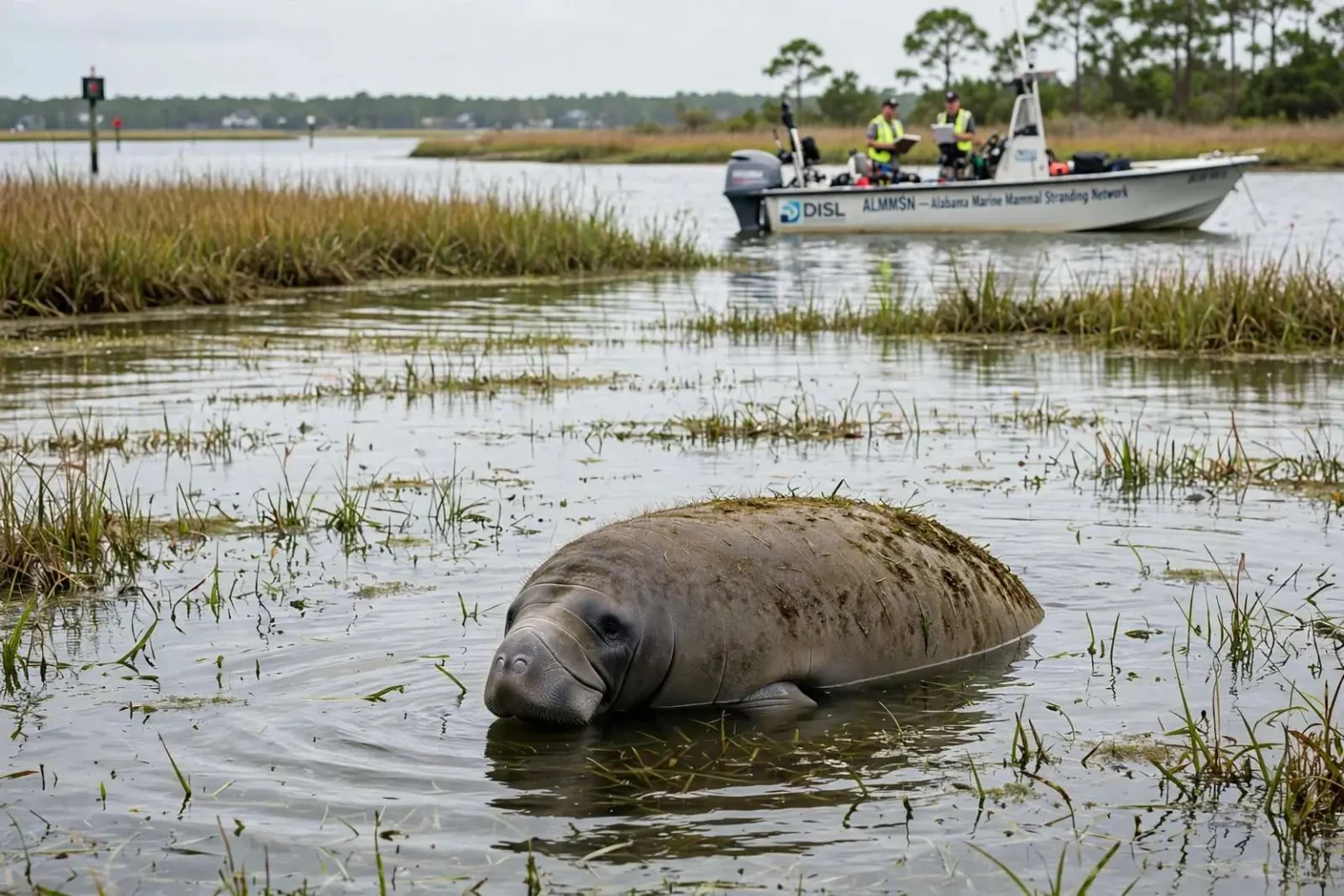
ORANGE BEACH, Ala. — A manatee found dead in Orange Beach over the weekend is suspected to have been killed by a boat strike, and a second manatee from the same herd was seriously injured in a related encounter, according to the Dauphin Island Sea Lab (DISL). The back-to-back injuries have prompted researchers to renew their call for boater awareness on Alabama’s waterways.
A resident reported the animal to DISL’s Manatee Sighting Network on Sunday, Aug. 16. It was recovered by the Alabama Marine Mammal Stranding Network (ALMMSN), with support from the Alabama Department of Conservation and Natural Resources, on the southern shore of Wolf Bay, south of the Intracoastal Waterway.
The location was telling. Wolf Bay, connected to the Intracoastal Waterway and the open waters of Perdido Bay, is exactly the kind of habitat manatees seek when they wander into Alabama during the warm months — shallow, vegetated water with ample seagrass and access to deeper travel corridors. It is also, by design, exactly the kind of water that draws recreational boats, which is what makes the overlap between manatee habitat and boat traffic the recurring problem researchers keep returning to.
What the necropsy found
A necropsy at the DISL Marine Mammal Research Center revealed signs of acute trauma consistent with a watercraft strike. The roughly 1,200-pound manatee had deep propeller lacerations across its back and right side that officials believe caused its death.
“It was very clear that it had been hit by a vessel,” said Mackenzie Russell, DISL’s Stranding Programs Manager. “Other signs of internal injury and blood loss point to a boat strike as the cause of death. Every animal that is killed, especially in some sort of human-caused tragedy like this, it really is tough.”
A necropsy — the animal equivalent of an autopsy — is the only reliable way to establish cause of death in a marine mammal, and propeller wounds leave signatures that are difficult to misread: parallel lacerations spaced at the intervals of the blades, depth and angle that indicate the speed and size of the vessel. In this case, the examiners found both the external wounds and the internal evidence of blood loss and organ trauma that a vessel impact produces.
The dead manatee was not alone. Both manatees struck were part of what researchers call a mating herd, and the second animal, reported injured the day before the carcass was found, survived with serious wounds.
Both manatees struck during a mating herd
Officials believe both manatees were struck while part of what’s known as a mating herd, in which multiple male manatees crowd around and compete for a single female. Russell said it may look chaotic in the water, but it’s a normal part of manatee life.
“It’s very loud. It’s a lot of splashing,” Russell said, describing the scene. “Up to 12 — you know, 2,000-pound animals — sloshing around and acting crazy.”
Mating herds form when a female manatee enters estrus and draws a group of males that can number in the dozens, all competing for the chance to breed. The herd churns through the water for days, rolling and jostling at the surface, often in shallow near-shore areas where the animals are highly visible — and, for boaters passing through, easily mistaken for a sandbar wake or simply not seen at all.
Dr. Ruth Carmichael, Director of DISL/MSN and ALMMSN, said a manatee injured by a boat was reported to the Manatee Sighting Network the day before the dead manatee was found, and both boat-struck animals were part of the same mating herd in the Intracoastal Waterway.
“When mating, manatees form herds that have difficulty evading fast-moving vessels,” Carmichael said. “Each manatee death is significant to the population, and the loss of an otherwise healthy reproductive animal is truly unfortunate.”
That is the biological problem in a single sentence. Manatees reproduce slowly — a female produces a single calf on a multi-year cycle — so every adult female lost removes not just one animal but all the calves she would have had. A healthy adult struck at the peak of her reproductive life represents a compounding loss for a population that is struggling to hold its ground.
Russell echoed that concern. “Those mating herds are a vulnerable time for them,” she said. “Their ability to move out of the way is drastically reduced. We had two affected animals in the same mating herd by vessels — that’s a pretty big deal. Losing one reproductively active animal in a population is a really big deal, especially for manatees, when their population is still threatened.”
A rising trend
Boat-related manatee deaths are increasing in Alabama. This case marks the sixth confirmed boat strike death in Alabama waters since 2015, before which no watercraft-related manatee deaths had been recorded in the state. Researchers have also documented a corresponding rise in manatee sightings and strandings in recent years.
Those two curves — sightings up, watercraft deaths up — are almost certainly connected. Florida’s manatee population has grown over recent decades, and as the animals’ numbers expand they range farther north in the warm months, pushing past the Florida Panhandle into Alabama’s rivers, bays and backwaters. Mobile Bay, the Mobile-Tensaw Delta, Wolf Bay, Perdido Bay and the Intracoastal Waterway have all become regular summer habitat for wandering manatees. More animals in Alabama water means more encounters with Alabama boaters, and the collision record has followed.
Manatees are slow-moving, air-breathing mammals that surface to breathe every few minutes while traveling. They cannot dive deep or dart away quickly, and they have no natural predator in Alabama waters — which is why nearly every traumatic manatee death in the state traces back to a boat propeller or hull. In shallow bays where a resting manatee can lie in inches of water, a propeller that draws three feet is a hazard the animal has no way to perceive or avoid.
The seasonal pattern matters as well. Manatees arrive in Alabama waters in late spring, concentrate through the summer, and begin returning to Florida as Gulf water cools in the fall. That means the highest-risk weeks for Alabama boaters are the warm months when traffic is heaviest — precisely when mating herds are most likely to form in shallow, popular boating areas.
Boaters urged to slow down and give manatees space
DISL/MSN is urging boaters throughout Baldwin County and the northern Gulf Coast to slow down, stay alert and give manatees plenty of room, particularly in rivers, bays and deltas where shallow water and abundant vegetation attract them.
“We ask for at least 100 to 150 feet,” Russell said of the distance boaters should keep once a manatee is spotted.
Officials also recommend wearing polarized sunglasses to help spot manatees below the surface and designating someone on board to keep watch for the animals nearby. Polarized lenses cut the glare that ordinarily turns the water’s surface into a mirror, revealing the circular ripples — the “footprint” — that a surfacing manatee leaves, along with the snout and the broad, paddle-shaped back just beneath the surface.
“Just be aware,” Russell said. “Be aware that we have manatees in our area. They do form mating herds. Give them distance; be prepared. Drive your boat safely.”
The advice carries particular weight at the waterway features where this case unfolded. The Intracoastal Waterway near Orange Beach carries a steady stream of cruisers, fishing boats and personal watercraft between Perdido Pass and points east, while Wolf Bay’s shallows draw anglers and sightseers. A mating herd occupying either area can cover an acre or more of churning water, and the animals in it are focused on each other, not on the boats around them.
Boater safety tips
- Keep at least 100 to 150 feet from manatees when possible, and designate a spotter on your boat.
- Wear polarized sunglasses to help spot manatees beneath the surface.
- Report injured or distressed manatees immediately to the Alabama Marine Mammal Stranding Network: 1-877-WHALE-HELP (1-877-942-5343).
- Report all manatee sightings, especially injured ones, to DISL’s Manatee Sighting Network at 1-866-493-5803.
Those hotlines are not administrative afterthoughts — they are the mechanism that makes every other response possible. The Orange Beach case began with a resident’s phone call to the Manatee Sighting Network, and the difference between a reported sighting and an unreported one can be the difference between a rescued animal and a carcass. Sightings reports also build the dataset researchers use to understand where manatees go in Alabama waters, which in turn informs where boater-awareness efforts are directed.
ALMMSN, the stranding response network, operates with trained responders and volunteers who can reach a live animal quickly enough to attempt rescue or assess an injury, and who can recover a carcass quickly enough that a necropsy yields reliable answers. Both functions depend on the public reporting quickly rather than assuming someone else already has.
For a threatened population, every manatee matters.
That closing sentiment from researchers is more than rhetoric. Manatees remain listed as threatened under the Endangered Species Act, and the species’ recovery depends on reducing human-caused deaths everywhere the animals range — not just in Florida’s famous wintering grounds. Alabama’s waters are a small but growing piece of that range, and the state’s boating community is now, whether it planned to be or not, part of the species’ safety net.
The Orange Beach episode — one animal dead, one injured, both from the same herd, both struck by vessels in the same stretch of water on the same weekend — illustrates how quickly an ordinary boating day can intersect with an already vulnerable species. Researchers say the formula for preventing the next one is simple and entirely in boaters’ hands: slow down in manatee habitat, keep watch, keep distance, and pick up the phone when a sighting involves an animal in trouble.