Bob Riley and Ricky Mathews Make the Case for Mobile on Bloomberg Radio
Bob Riley and Ricky Mathews discussed EADS, the oil spill and regionalism on Bloomberg Radio, as Riley blasted Feinberg over slow BP claims payments.
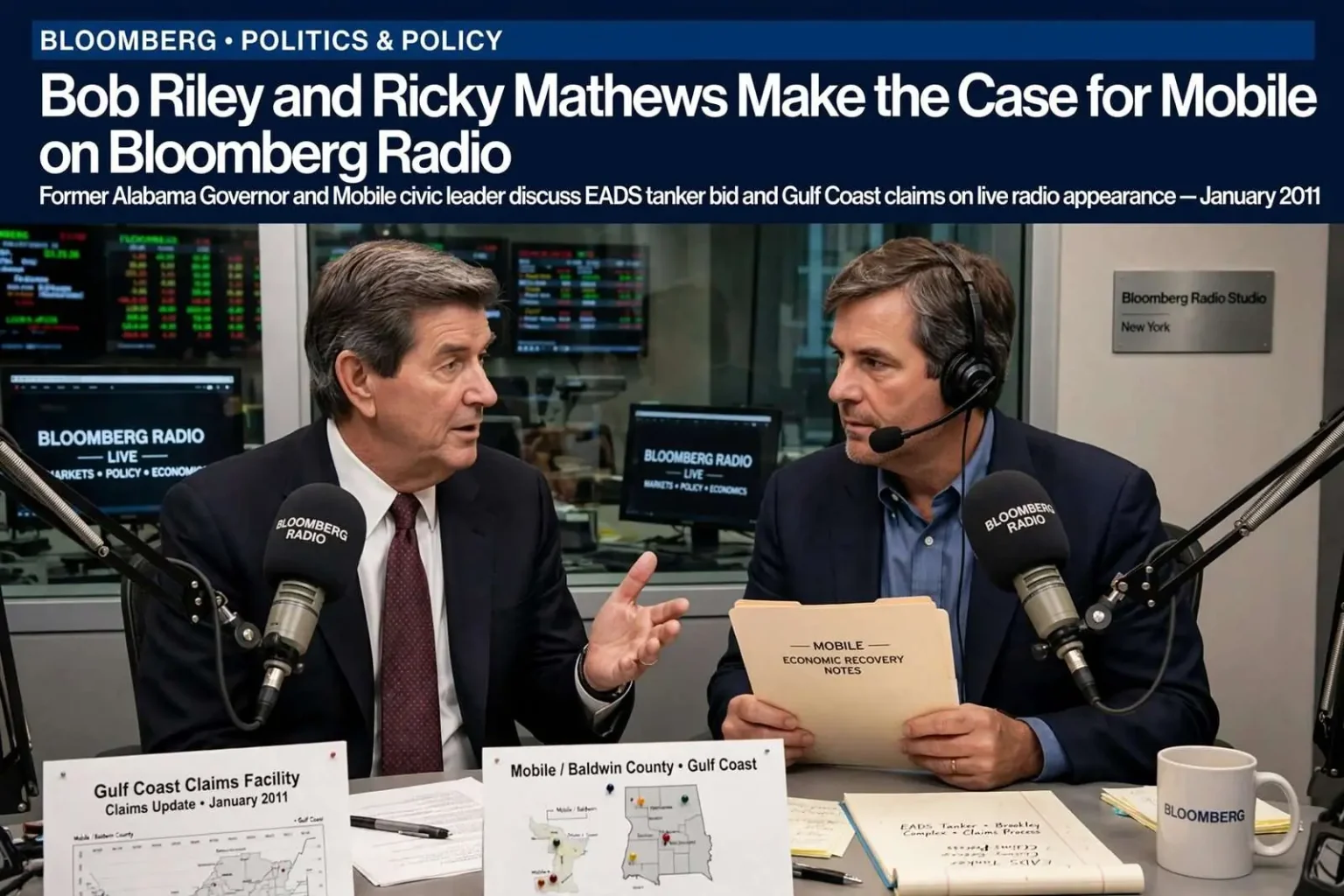
Former Alabama governor Bob Riley and Mobile civic leader Ricky Mathews carried Mobile’s economic story to a national audience in early January 2011, appearing together on Bloomberg Radio for a wide-ranging conversation about the EADS aerial refueling tanker contract, the slow-motion aftermath of the Deepwater Horizon oil spill, and the case for regional cooperation along the Gulf Coast. The joint appearance was notable on its own terms. It is one thing for a region’s frustrations to be aired in city council chambers or statehouse budget hearings, and quite another for them to be laid out on a national business network whose listeners include investors, executives and policymakers who shape decisions made hundreds of miles from the Alabama coastline.
The appearance underscored how tightly the region’s two biggest economic fights had become intertwined by the start of 2011. Mobile was still awaiting word in its high-stakes competition with Boeing for the EADS tanker assembly line, a project Riley had personally championed for years and one that promised to reshape the industrial landscape of the entire central Gulf Coast. At the same time, businesses from Bayou La Batre to Gulf Shores and across Baldwin County were still struggling with the claims process run by the Gulf Coast Claims Facility, the program created to compensate losses from the BP oil spill. Two crises, two different federal and corporate processes, one shared regional stakes.
The Tanker Fight That Put Mobile on the Map
The aerial refueling tanker competition was, by the time of the radio appearance, the most consequential economic development contest in Mobile’s modern history. The Pentagon’s effort to replace its aging fleet of aerial refueling tankers had stretched across multiple bidding cycles and years of political wrangling, and Mobile had positioned itself at the center of it. EADS, the European aerospace parent company of Airbus, had proposed building the new tanker at the Brookley complex near downtown Mobile, a site with a long aviation history that the city had worked to reinvent as an aerospace and industrial hub.
Riley had been the project’s most persistent public advocate, traveling frequently to press the case that Alabama offered the right mix of workforce, infrastructure and cost for one of the largest defense manufacturing investments in the country. His argument to national audiences was straightforward: the tanker work would create thousands of direct jobs and anchor an aerospace cluster that could outlast the production run itself. Supporters noted that the project would ripple well beyond Mobile’s city limits, drawing suppliers and skilled workers from across the Gulf Coast region and giving Baldwin County communities and neighboring areas a durable connection to the aerospace economy.
The stakes explain why the radio appearance mattered. With the competition still unresolved, every public platform available to the region’s advocates was a chance to keep Mobile’s bid visible in front of the decision-makers and opinion-shapers who followed defense procurement. Boeing, bidding with a competing airframe, had its own well-organized supporters in Washington and elsewhere, and the contest had become as much a contest of public narratives as of technical specifications. Riley and Mathews used the Bloomberg Radio segment to make sure the Alabama side of that narrative was heard plainly: Mobile was ready, the workforce was real, and the region had bet heavily on the outcome.
While the tanker question hung in the air, the other half of the conversation dealt with a wound that was already nine months old. The Deepwater Horizon disaster of April 2010 had sent oil toward the Alabama coast for much of the summer, shutting down fishing grounds, emptying beaches during peak season and disrupting the supply chains that restaurants, charter boats, hotels and seafood processors depend on. By January 2011 the visible oil was largely gone from Alabama’s beaches, but the financial damage was still being adjudicated claim by claim through the Gulf Coast Claims Facility, the claims program that had taken over compensation duties from BP’s earlier emergency payment process.
For business owners along the coast, the claims facility had become the single most important institution in their economic lives, and one of the most frustrating. Documentation requirements were demanding, payment timelines were unpredictable, and the gap between what a business had lost and what the facility offered as compensation became a running source of complaints from Mobile County to the Baldwin County beaches. It was against that backdrop that Riley used his national platform to say what many coastal business owners had been saying privately for months.
Riley Blasts Feinberg Over Claims Payments
Riley sharply criticized Gulf Coast Claims Facility administrator Kenneth Feinberg, arguing that businesses along the Alabama coast were being systematically shortchanged. According to Riley, Feinberg had underpaid documented claims and was leaving some business owners with roughly ten cents for every dollar of actual economic losses. That arithmetic, in Riley’s telling, was not an abstraction: it was the difference between a coastal restaurant or charter operation making it through the winter and locking its doors for good.
The former governor went further, questioning the structural arrangement behind the claims process itself. Feinberg’s law firm was receiving $850,000 a month from BP to administer the claims facility, a figure that critics had seized on as a potential conflict of interest. Riley contended that Feinberg had not adequately explained to business owners how payment decisions were being made, leaving claimants to guess why similar losses produced such different outcomes. In Riley’s view, the opacity was itself a harm, because businesses that could not understand the methodology could not plan, borrow or rebuild with any confidence.
He accused the claims administrator of abusing the authority delegated to him by the Obama administration while small enterprises on the coast neared financial ruin. The criticism was pointed in a way that officials speaking on background rarely are, and it landed on a national business network precisely where pressure on BP and the claims process could be applied most visibly. Riley’s argument was that a compensation program born from a catastrophe should not become a second catastrophe of its own, and that the standard of proof for paying a documented claim should not be so high that honest businesses were paid pennies on the dollar while their creditors waited.
For Mobile and Baldwin County business owners still waiting on compensation, Riley’s remarks did two things at once. They validated the frustration that had been building along the coast since the summer, and they put that frustration before an audience that included people with the power to influence how the claims process was run. The remarks added pressure on the claims facility at a moment when every dollar mattered to the coast’s recovery, as winter turned into a lean season for tourism-dependent operations that had already lost their best months of the year.
The third thread of the conversation, regional cooperation, tied the other two together. Riley and Mathews argued that the Gulf Coast’s communities succeed or fail together, a point that the tanker competition and the oil spill had each demonstrated in different ways. A tanker decision in Mobile would shape hiring and investment from Pascagoula to Pensacola, and the recovery from the spill depended as much on coordinated advocacy in Washington as on the weather. The two men made the case that when the region speaks with one voice, whether about defense work or about claims administration, it carries more weight than any single city or county speaking alone.
That message has a particular history along the central Gulf Coast. Mobile and Baldwin County have long shared a single media market, an intertwined workforce and a coastal economy that stretches across county lines, and the same is true of neighboring communities in Mississippi and Florida. Disasters have a way of erasing jurisdictional boundaries. After the spill, charter captains, seafood processors and motel owners from several states found themselves in the same lines at the same claims offices, and local officials learned quickly that the loudest and most unified regional voice was the one that got answered.
The Timing of a Governor’s Last Weeks
The appearance also carried a personal significance for Riley, whose second term as governor was entering its final weeks in January 2011. Few elected officials in Alabama had tied their tenure so closely to a single economic project, and Riley had invested enormous personal and political capital in bringing the tanker line to Mobile. Speaking on a national network in the closing days of his administration gave him a platform to defend that investment one more time and to frame the competition on his own terms, free of the constraints that press secretaries and negotiation deadlines usually impose.
For Mathews, the segment offered a chance to represent Mobile’s civic and business leadership directly to a national audience. Local civic leaders rarely get that kind of microphone, and the appearance signaled that Mobile’s business community intended to keep pressing its case through every available channel until the tanker decision arrived. The combination of a governor who had championed the project and a civic leader who lived with its consequences gave the broadcast a credibility that neither could have managed alone.
What the Region Was Waiting On
By early 2011 the tanker competition had already consumed years of effort, and the community around the Brookley complex had organized itself around the possibility of winning it. Workforce training programs, supplier networks and infrastructure plans had all been built with the award in mind, and losing the competition would mean dismantling expectations that a whole region had invested in. Winning it would mean the beginning of a different kind of economy for Mobile, one anchored in advanced manufacturing and aerospace rather than the port, paper and shipbuilding traditions that had defined the city for generations.
Against that uncertainty, the claims fight was about something more immediate: keeping the businesses that already existed alive long enough to see the recovery through. Riley’s ten-cents-on-the-dollar characterization captured a grievance that had spread across the coast, and his willingness to name the problem on a national broadcast turned a local complaint into a matter of public record that officials in Washington and at BP could not easily ignore. Whether the pressure produced faster or fairer payments in the weeks that followed, the January appearance served as a reminder that the Gulf Coast’s recovery was being watched, and argued for, on a national stage.
Together, the two appearances at the start of 2011 said something durable about the region. Mobile’s future was being contested in boardrooms in Chicago and in claims offices in Daphne and Gulf Shores, and the people arguing for it understood that the two fights were really one: a coast trying to protect what it had built and to build something bigger in its place.