Bomb Threat Forces Evacuation of AL.com’s Downtown Mobile Headquarters; Eight Mile Man Arrested
A phoned-in bomb threat forced AL.com staffers out of their Royal Street building as sheriff's deputies charged an Eight Mile man with making the threat.
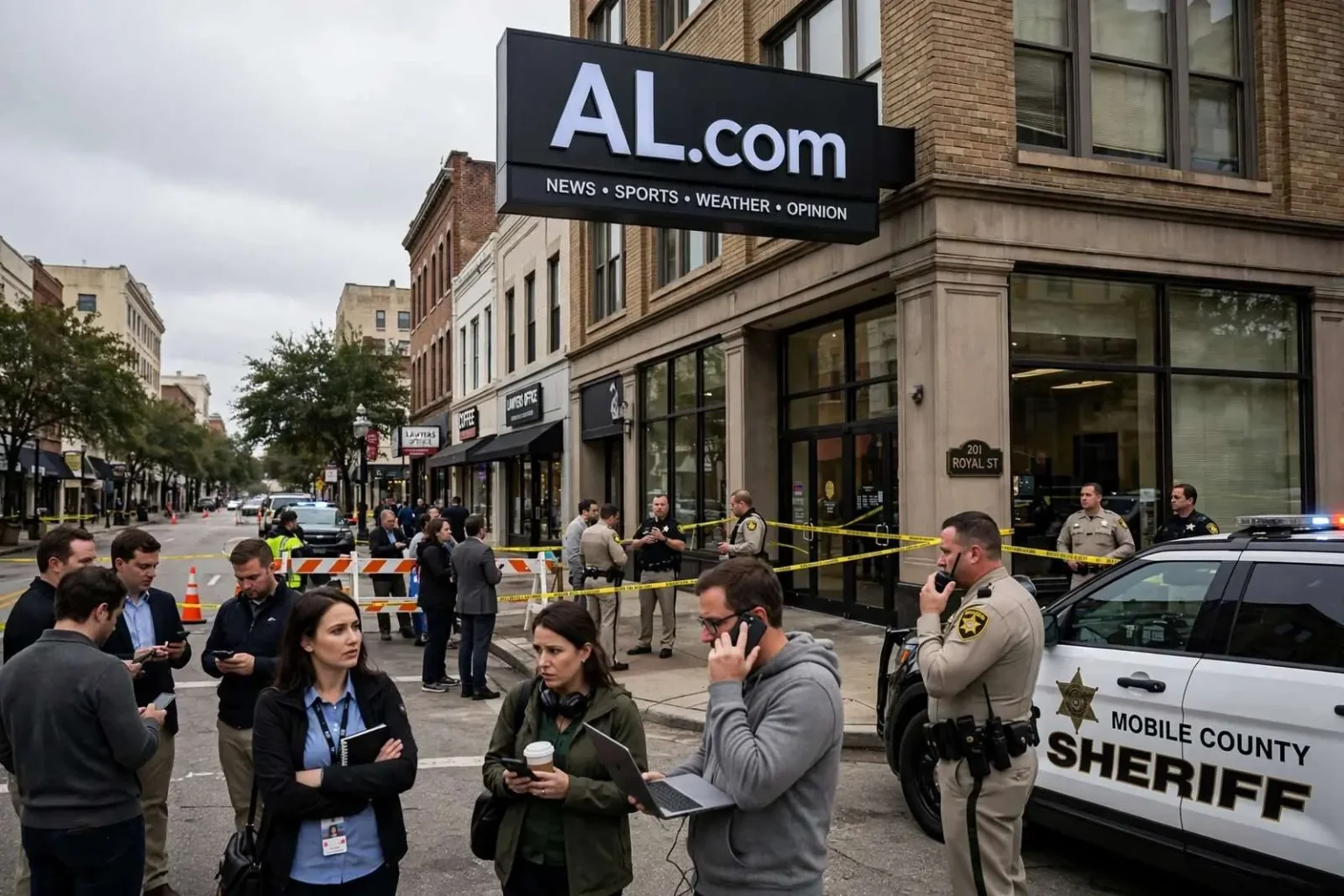
Staffers at the Royal Street headquarters of the state’s largest news website were sent scrambling into the street Monday morning after a phoned-in bomb threat prompted a full evacuation of the downtown Mobile building, turning an ordinary workday at the newsroom into a hours-long exercise in patience, rumor control and mobile reporting.
According to the Mobile County Sheriff’s Office, deputies arrested Anthony Joiner of 5065 Sweetbriar Lane in Eight Mile, charging him with making the threat as well as possession of marijuana and drug paraphernalia. The arrest came the same day, a rapid resolution to a case that could easily have stretched across days of uncertainty in a building full of journalists trained to ask exactly the questions investigators prefer to hold back.
Investigators have not laid out exactly why Joiner is believed responsible, but people familiar with the matter said the call is thought to have grown out of an argument in the publication’s online comment section — a motive, if confirmed, that would place the incident among the growing list of cases where online disputes spill into threats against real people in real buildings.
Hours Outside the Building
The evacuation unfolded around 11 a.m., according to employees who spoke on condition of anonymity. Staffers described the familiar rhythm of an office interrupted: the alert, the walk down Royal Street, and then the peculiar limbo of a newsroom staff standing on a downtown sidewalk with phones in hand and work to do but no desks at which to do it.
At 12:17 p.m., staff received an email from site operator Tom Bates downplaying any immediate danger while directing everyone to keep working from outside the office for a few hours. “As we continue to look into a phone call we received this morning, we are acting out of an abundance of caution in asking you to work from outside the office for a few hours,” Bates wrote, assuring staffers there was nothing direct or specific at play.
The message struck the tone leadership would maintain through the afternoon — calm, minimal and heavy on reassurance — but it also left a newsroom full of reporters with little to report. Employees were finally cleared to return shortly before 5 p.m., ending an evacuation that consumed most of the business day without, in the end, producing any evidence of a device.
At least one staffer voiced frustration that leadership had shared little about the nature of the threat or whether any particular individual was targeted, a complaint that reflects the peculiar position news employees occupy: trained to demand transparency from institutions, they spent the afternoon on the receiving end of a holding statement.
The Arrest in Eight Mile
The break in the case came quickly. Deputies with the Mobile County Sheriff’s Office traced the threat and took Anthony Joiner into custody at his Eight Mile address, where the marijuana and paraphernalia charges were added to the threat count. Eight Mile, the unincorporated community north of Prichard along U.S. 45, sits within the sheriff’s patrol jurisdiction, and the case now moves through the same Mobile County courts that handle the county’s threat prosecutions.
Court records show Joiner previously faced a 2015 arrest for harassing communications, a prior that investigators will weigh as the case proceeds. Threat charges in Alabama range from misdemeanors to felonies depending on the specificity of the threat and the disruption caused, and prosecutors will assess which tier fits a phoned-in bomb threat that emptied a downtown building for most of a day.
Law enforcement officials have treated comment-section disputes as a rising source of threat cases nationwide, and the pattern has a particular edge when the target is a news organization, whose staff publish their names and whose work regularly provokes strong reactions. Whether prosecutors here frame the case that way will depend on the evidence connecting the call to the online argument that investigators believe spawned it.
The Building on Royal Street
The Royal Street headquarters occupies a block of downtown Mobile within sight of the district’s restaurants, offices and government buildings, and a bomb threat there draws a response that reaches beyond one company. Police tape, closed sidewalks and streaming news coverage on a Monday lunch hour guarantee that half of downtown knows about the incident before the threatened building’s own staff do.
Bomb threats against media organizations have become a recognized hazard of the business, and newsrooms have steadily updated their evacuation and continuity procedures in response. Monday’s outcome — a full evacuation, a leadership holding statement, a same-day arrest and a return to work by evening — is, by the standards of such incidents, the good version: disruptive, unsettling, but contained.
The sheriff’s office has not released a detailed account of how the call was traced, and the case file will become public only as it moves through court. What is already clear is the sequence: a phone call, a building emptied, an arrest in Eight Mile, and a newsroom back at its desks before the day’s final edition.
Media Notes: New Editor at Mobile Bay Magazine
In other local media news, Maggie Bagwell Lacey was named executive editor of Mobile Bay Magazine in June, taking over from Lawren Wood Largue. The change at the top of the area’s premier lifestyle publication puts a native daughter in charge of chronicling the coast she grew up on.
The Point Clear native and McGill graduate — who holds a bachelor’s degree from Vanderbilt — started at MBM in October as food editor after earlier stints managing Fairhope’s Windmill Market, designing shoes in the New York fashion industry and working in marketing on the regional scene. That path — from the Eastern Shore to the fashion industry and back — mirrors the magazine’s own orientation: sophisticated in its sensibility, rooted in the communities it covers.
Mobile Bay Magazine occupies a distinctive place in the region’s media landscape, covering the society, food, culture and waterfront life of Mobile and Baldwin counties with a photography-forward, long-form approach that daily outlets cannot match. Its executive editor shapes the monthly features, the society coverage and the dining writing that anchor the publication’s identity, making the appointment a significant one in local media circles.
Lacey’s move from food editor to executive editor inside a year signals the magazine’s confidence in her institutional knowledge of both the Eastern Shore community and the publication’s audience. Her predecessor, Lawren Wood Largue, steered the magazine through the years when its print and digital operations were reshaped alongside the rest of the industry.
The pairing of the two stories — a downtown newsroom emptied by a threat and a magazine naming a new editor — says something about the state of local media on the Gulf Coast: the work continues, the people change, and the institutions, however tested, keep publishing. By the time Mobile Bay Magazine’s next issue reached readers, the newsroom on Royal Street was already back at work, and the man accused of emptying it was already in custody awaiting his day in Mobile County court.
What Happens Next in the Case
Joiner’s charges now move through the early stages of the Mobile County criminal process: booking, an initial appearance where bail is set, and then the filing of formal charges. The threat charge will be the focus — Alabama prosecutors treat bomb threats as serious offenses because of the disruption and fear they cause, regardless of whether any device ever existed — while the marijuana and paraphernalia counts are the kind of companion charges that routinely ride along with an arrest made at a residence.
His 2015 arrest for harassing communications will appear in prosecutors’ files as they weigh how to charge the case, and prior similar conduct often pushes threat prosecutions toward the felony end of the spectrum. Investigators’ belief that the call grew out of a comment-section argument, if it survives scrutiny, gives the case a narrative that has become familiar to judges and juries in recent years: an online quarrel escalating into a real-world threat that emptied a building and cost a company a full day of work.
Neither the sheriff’s office nor the news organization has said whether the staff was specifically threatened, and that question — whether the call named individuals or simply the building — could matter both to the charging decision and to the newsroom’s own security posture going forward.
Threats Against Newsrooms as a Growing Pattern
Monday’s evacuation fits a pattern that media industry groups have documented with growing alarm: bomb threats, harassment campaigns and online mobs aimed at news organizations, often sparked by coverage or by comments sections, which give disgruntled readers a direct line to the subject of their anger. Newsrooms across the country have responded with lockdown drills, security assessments and coordination with local police — and with a deliberateness about what to publish when the threatened outlet is their own.
That last point was on display in Mobile on Monday. The state’s largest news website spent the afternoon covering a bomb threat at its own headquarters with the restraint of an organization aware of both its safety obligations to staff and its reluctance to amplify whoever made the call. The sheriff’s office arrest announcement provided the confirmable facts; everything else stayed in the file.
For the staffers who spent the day on the sidewalk, the episode ended without injury and with an arrest — the outcome everyone hopes for when a threat arrives. The frustration some voiced about leadership’s silence is the residue of an afternoon spent on the wrong side of a story, waiting for information from an institution whose habit is to hold it. Both impulses — caution and transparency — are part of the same professional DNA, and Monday forced them into an uncomfortable balance on Royal Street.