
Bond Not Set for Man Charged With Kidnapping, Raping Woman After Mobile Carjacking
Bond was not set for Edward Pettway, charged with kidnapping and raping a woman after an armed carjacking at Bayou Bend Apartments.
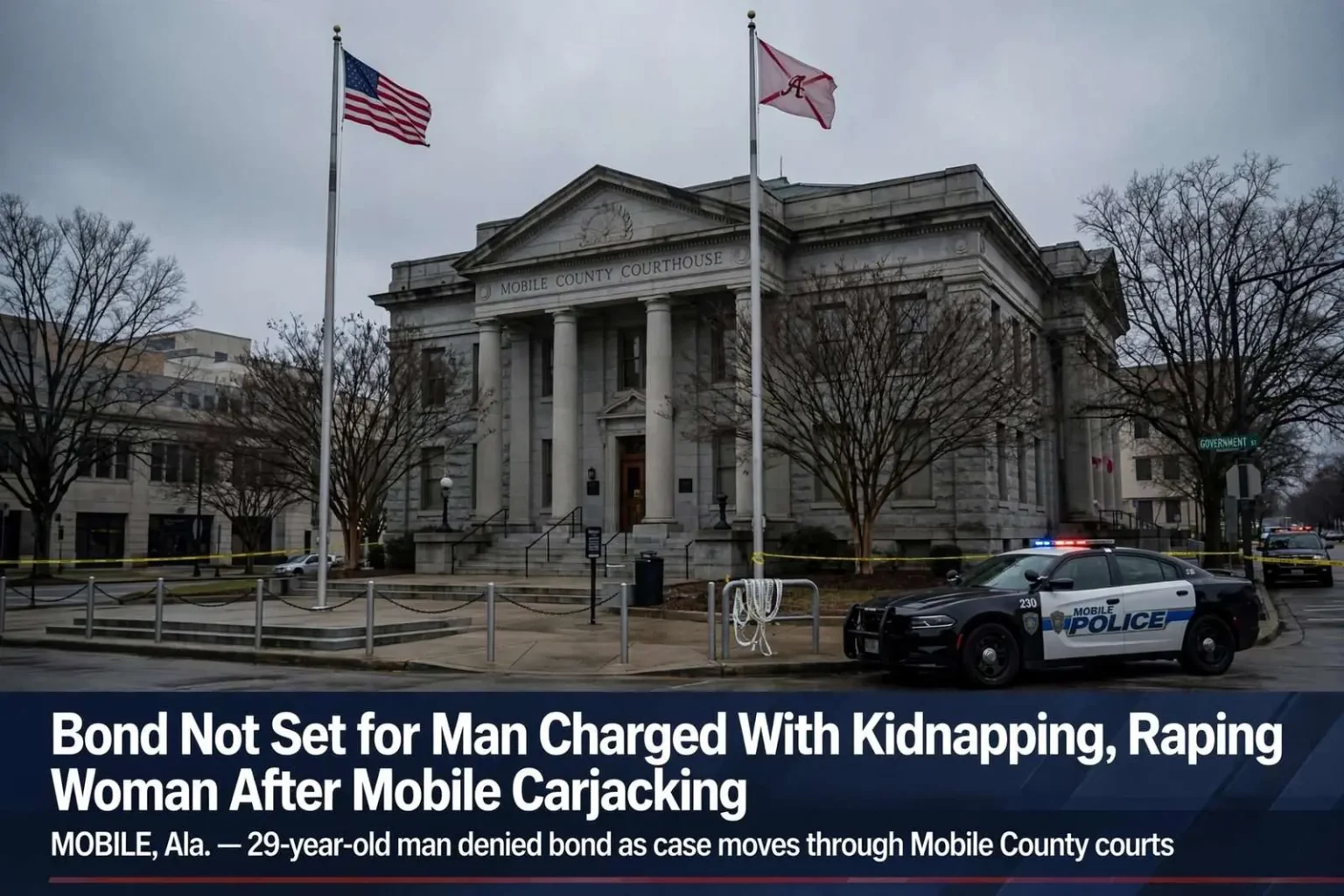
MOBILE, Ala. — Bond was not set for a 29-year-old man charged with kidnapping and raping a woman in Mobile, after his attorney asked a judge for more time to review the allegations against him. The decision leaves Edward Pettway in custody as the case moves through Mobile County’s courts.
Pettway appeared for a scheduled bond hearing Monday morning, but the hearing ended without bond being set. His lawyer requested additional time to further research the case, a routine request at early hearings where defense counsel has not yet received all of the evidence prosecutors intend to rely on. The judge’s acceptance of the request means the bond question returns to the courtroom at a later date.
For now, the practical effect is straightforward: Pettway, 29, remains jailed without bond while his case advances. He remains charged with rape and kidnapping as prosecutors move forward with the case, charges that stem from what Mobile police describe as a violent early-morning attack that began as an armed carjacking.
What Police Say Happened
According to the Mobile Police Department, the alleged assault occurred around 3 a.m. on January 31 and began as an armed robbery. Detectives said Pettway, armed with a gun, stole a car from a man at the Bayou Bend Apartments on Brill Road, an apartment community in west Mobile.
The man’s girlfriend was inside the vehicle at the time. Police said Pettway sexually assaulted the woman before she was able to escape — a sequence that transformed a property crime into a case carrying the county’s most serious charges, and one that investigators have handled accordingly since the night it occurred.
Robbery, rape and kidnapping charges each carry their own weight under Alabama law, and the combination reflects what investigators say unfolded over the course of the incident. The allegations remain accusations at this stage of the process: Pettway is presumed innocent, and it will fall to prosecutors to prove the charges beyond a reasonable doubt in court.
Why Bond Can Go Unset
To anyone unfamiliar with criminal procedure, “no bond set” can sound unusual — but it is a recognized stage in serious felony cases. In Alabama, a defendant arrested without a warrant in certain felony cases appears before a judge for an initial hearing, where the court addresses counsel, the charges and, eventually, the conditions of release. When the defense asks for more time, judges commonly defer the bond decision to a later hearing rather than rule on incomplete information.
The delay serves both sides. Defense attorneys use the time to review police reports, witness statements and evidence, so they can argue for a bond amount and conditions grounded in the actual record rather than guesswork. Prosecutors, meanwhile, prepare to articulate why a defendant should face a high bond or none at all, weighing the seriousness of the allegations, the strength of the evidence and any considerations about flight risk or public safety.
In cases involving violent felony charges — rape, kidnapping, armed robbery — the bond calculus is heavily influenced by the nature of the accusations. Alabama law allows judges broad discretion in setting bond for serious offenses, and in the most serious cases the state can seek to hold a defendant without bond entirely, subject to constitutional limits and the specific procedures that apply.
The Presumption of Innocence in Practice
Courtroom coverage of cases like this one requires care with language, and the distinction is more than etiquette. An arrest and charges are the state’s position; they are not a finding of fact. Pettway is presumed innocent unless and until prosecutors prove the charges in court, and his attorney’s request for time to study the case is an exercise of the same rights any defendant holds.
That process moves on a schedule set by the court. Early appearances address counsel and bond; probable-cause proceedings test whether the charges are supported; discovery then hands the defense the evidence the state intends to use. Only after those stages does a case reach trial, and many are resolved along the way through plea negotiations that reflect the strength of the evidence on both sides.
What Monday’s hearing determined was procedural, not ultimate: the bond question waits, the charges stand, and the defendant remains in custody in the meantime. For the alleged victim and the families on both sides, the slower rhythm of the courts contrasts sharply with the speed of the night the case began — but each step is designed to protect the integrity of the outcome.
The Case as Investigators Built It
The timeline investigators describe is narrow: an armed carjacking at an apartment complex on Brill Road around 3 a.m., a woman taken in the stolen vehicle, a sexual assault, and an escape. Cases that compress that much alleged violence into a single incident are typically worked by multiple units at once — robbery detectives on the carjacking, special victims investigators on the assault, all coordinated under the supervision of the department’s command staff.
Evidence in such cases comes from several directions. The victim’s account, physical evidence collected after the assault, the vehicle itself, scene processing at the apartment complex and any surveillance footage from the surrounding area all contribute to the case file. By the time a suspect appears for a bond hearing, detectives have generally presented their findings to the district attorney’s office, which made the decision to charge.
Bayou Bend Apartments sits along Brill Road in west Mobile, a corridor of apartment communities and residential streets. The location factored into the response — patrol units flooded the area after the initial report, and the search that followed the carjacking report became the backbone of the investigation that led to an arrest.
What Happens Next in the Case
With bond deferred, the case returns to court for the hearing that was postponed. There, the judge can set bond — with an amount and conditions such as no contact with the alleged victim — or, in cases where the law permits, consider the state’s arguments for holding the defendant without bond.
The charges themselves will proceed on parallel tracks. Rape and kidnapping are serious felonies under Alabama law, and each is punishable by lengthy prison terms upon conviction. Prosecutors will carry the case through the grand jury or preliminary-hearing process, where a determination is made that probable cause supports the charges, before the case moves toward trial in Mobile County Circuit Court.
Along the way, the defense will continue its own work: reviewing the state’s evidence, interviewing witnesses, examining the legal basis for each charge and raising any suppression issues that the facts support. Early hearings like Monday’s are where that record begins to take shape, and the attorney’s request for time signals that the defense intends to engage the case thoroughly rather than rush to a bond argument it is not ready to make.
The Larger Context: Carjackings and Violence in Mobile
Mobile police treat carjackings among the most serious property crimes precisely because of how often they escalate into violence. A vehicle theft that occurs with the owner present involves a confrontation, and when a weapon is displayed — as police say happened at Bayou Bend — the potential for harm rises sharply. Detectives investigating such cases typically work them alongside robbery squads, since the same offender is often connected to multiple incidents.
Residents of apartment communities along corridors like Brill Road often ask what they can do after a violent incident nearby. Police agencies generally repeat the same fundamentals: be aware of surroundings when arriving or leaving after dark, keep phones charged and accessible, share arrival times with roommates or family, and report suspicious activity immediately rather than assuming someone else has. Witness reports in the first minutes after a crime are consistently the most productive leads investigators receive.
The case also illustrates a pattern that victim advocates emphasize: people inside a vehicle during a carjacking are at extreme risk, and the theft of a car with an occupant inside routinely becomes a kidnapping case under Alabama law, because taking the vehicle means taking the person in it. That legal reality is why the charges in this case stack the way they do.
For the woman who escaped, the aftermath involves medical care, counseling and the strain of participating in the prosecution of the man accused of attacking her. Advocates note that the support system around a victim — from Sexual Assault Nurse Examiner programs to victim services officers with the district attorney’s office — plays a critical role in seeing such cases through to resolution.
Pettway, 29, remains charged with rape and kidnapping as the case moves forward. Bond was not set Monday; when the hearing is rescheduled, the court will revisit the question with the benefit of the additional preparation his attorney requested.


