
Bond Set at $210K Each for Pair Charged in Christmas Eve Shooting Death of Mobile Teen
India Nelson and Rory Smith face murder charges in the shooting death of 15-year-old Jakory Smith at Carondolet Apartments in Mobile.
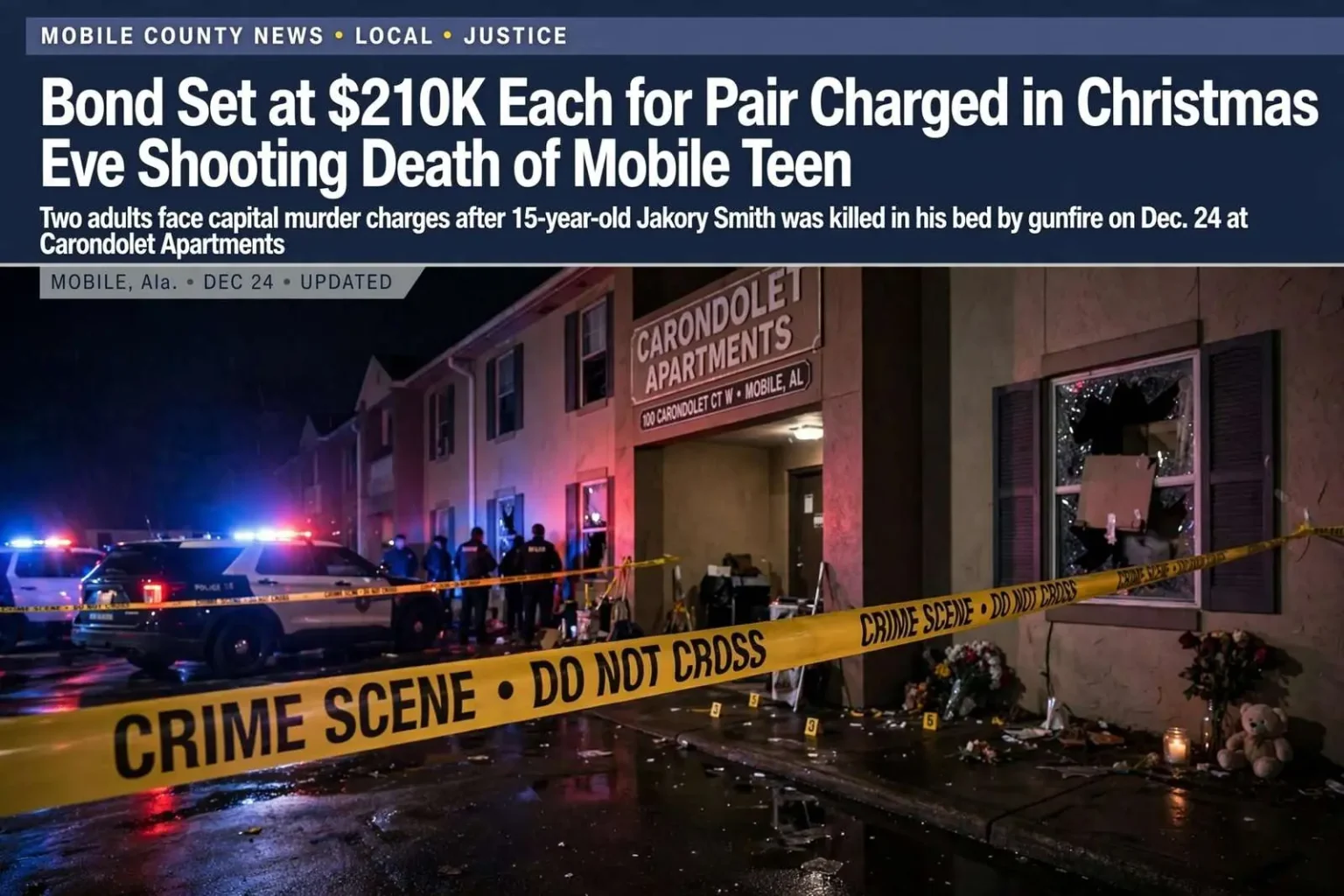
Bond has been set at $210,000 each for the two adults charged in the shooting death of a 15-year-old Mobile boy killed in his bed the night before Christmas, a case that has moved through the Mobile County court system in stages marked by grief, upgraded charges and a grand jury’s decision to treat the killing as capital murder.
India Nelson, 25, and Rory Smith, 30, were arrested after police say they were responsible for the death of Jakory Smith. The teenager’s death in the early hours of December 24 — a bullet fired from outside an apartment tearing through a window and striking him as he slept — drew wide attention across Mobile, where the randomness of the loss and the timing on the night before Christmas left a lasting mark on the community.
Officers responding to a report of shots fired around 2:27 a.m. on December 24 at the Carondolet Apartments in the 100 block of Carondolet Court West found the teenager wounded. He was rushed to a local hospital, where he died from his injuries. The apartment complex sits in a residential stretch of west Mobile, and the predawn gunfire brought officers to the scene within minutes of the first calls.
Prosecutors: Argument Between Suspects Turned Deadly
Prosecutors described the killing as senseless, telling the court the gunfire erupted out of a domestic dispute between Nelson and Rory Smith. Jakory Smith, who was not part of that dispute, was struck while he slept. That account — a fight between two adults spilling into gunfire that found a sleeping child — became the backbone of the state’s case from the earliest hearings.
The boy’s mother, Marie Salter Millerden, spoke about losing her son the night before Christmas. “It wasn’t Christmas for me,” she said. “All I could think about was my baby … my baby has no life in him.” Her words, delivered as the case moved through its first court appearances, gave the proceedings a human weight that statistics about gunfire and apartment complexes rarely carry.
Court records indicate both defendants have prior violent histories, a factor that weighs into bond decisions and, later, sentencing exposure. The case proceeds through the Mobile County court system with both held on the murder charges, though the case’s posture would change dramatically once a grand jury reviewed the evidence.
Charges Upgraded to Capital Murder
The stakes in the case rose sharply when a Mobile County grand jury indicted both defendants on capital murder — an upgrade from the original murder counts, which also carried charges of discharging a gun into an occupied dwelling and criminal mischief. Capital murder charges in Alabama carry a penalty range that includes life without parole, and they signal prosecutors’ view that the killing met one of the state’s aggravating definitions — here, a death occurring in the course of another felony, with the gunfire directed into an occupied dwelling.
A bullet fired from outside tore through the window of the apartment and struck Jakory Smith as he slept in his bed. That detail has anchored the case since the first days: the boy had no connection to the argument investigators say triggered the shooting, and the round that killed him traveled through an exterior wall of a home where he was doing nothing more dangerous than sleeping the night before a holiday.
The indictment changed the legal landscape for both defendants. Nelson had made bond on the original charges, but the indictment changed that: her bond was revoked upon the capital murder charge and a judge signed a warrant for her arrest. She later turned herself in to authorities, a surrender that her attorneys arranged in the days after the warrant issued.
Rory Smith, who faces the same upgraded capital murder count, remains in custody at Mobile Metro Jail as the case moves forward. His bond had not afforded him release under the original charges, and the capital indictment foreclosed any near-term prospect of regaining it.
How Capital Murder Cases Move in Mobile County
Capital murder prosecutions in Alabama are the slowest and most complex cases in the state’s courts. After indictment, the case moves through months of discovery, motion practice and competency evaluations before any trial date is set. Defense attorneys in death-eligible cases must meet heightened qualification requirements, and prosecutors must decide early whether they will seek the death penalty or accept a sentence of life without parole upon conviction — a decision that shapes every later stage of the process.
In Mobile County, capital cases routinely take years from indictment to trial, and appeals stretch the timeline further. The county’s dockets have carried a steady stream of capital indictments in recent years, and cases involving child victims have historically drawn the closest scrutiny from both prosecutors and the judges who must manage them.
The upgraded charges also change the detention picture for the defendants. Bond on a capital murder charge is rarely granted in Alabama, and where it is set, it typically requires a hearing before a circuit judge with evidence presented about the strength of the state’s case and the defendant’s history. Nelson’s return to custody after turning herself in reflected that new reality: whatever bond schedule applied to the original charges no longer governed once the grand jury acted.
The Apartment, the Night, and What Followed
The Carondolet Apartments, in the 100 block of Carondolet Court West, became the focus of the investigation within hours of the shooting. Detectives canvassed the complex for witnesses, collected shell casings and traced the trajectory of the round that entered the apartment through the window. The finding that the gunfire arose from a dispute between the two defendants — rather than a targeted attack on the household — emerged from that canvass and from the defendants’ own statements as the investigation proceeded.
The timeline mattered to prosecutors from the start. Shots fired at 2:27 a.m. on December 24 meant the apartment’s residents were asleep, and the state has treated the sleeping victim not as an incidental detail but as the heart of why the case warrants capital treatment. Alabama’s capital murder statute covers killings committed in the course of certain felonies, and discharging a firearm into an occupied dwelling — the companion charge from the original arrest — provided the underlying felony that elevated the homicide.
For the family, the legal milestones have arrived in an order that reopens the loss at each step: the first bond hearings, the mother’s statement to the court, the grand jury’s decision, and the revocation of Nelson’s bond. Community members who followed the case have noted the cruelty of the calendar — a 15-year-old killed in his bed hours before Christmas morning, a mother describing a holiday that never happened.
What Lies Ahead in the Case
With both defendants in custody and facing capital murder indictments, the case now heads into the long pretrial phase that defines capital litigation. Prosecutors will make their penalty decision after reviewing the completed case file and the defendants’ histories, which court records indicate include prior violent conduct. Defense motions — from change of venue requests to challenges to the capital designation itself — will fill the months before any trial.
Jakory Smith’s family, meanwhile, continues to attend the hearings. The $210,000 bonds set early in the case, the revoked bond after the indictment, and Rory Smith’s continuing detention at Mobile Metro Jail are the procedural facts of the file; the case’s human core remains what it was on the morning of December 24 — a sleeping teenager, a bullet through a window, and a family facing every holiday that follows without him.
Bond Decisions Under the Spotlight
The $210,000 bond figure set for each defendant drew attention at the time because it arrived before the case’s biggest escalation. Judges setting bond in murder cases weigh the severity of the offense, the defendant’s criminal record, community ties and flight risk, and the identical amounts for Nelson and Smith reflected the court’s initial view that both stood equally accused of the same crime. The original counts — murder, discharging a gun into an occupied dwelling and criminal mischief — allowed bond as a matter of course, unlike the capital charge that followed.
When the grand jury returned its capital indictment, the procedural ground shifted. Nelson’s release ended not because she violated any condition but because the new charge itself removed the basis for her earlier bond, and the judge’s warrant made her status official. Her decision to turn herself in spared authorities a manhunt and, her representatives noted at the time, preserved some measure of cooperation as the case advanced.
Rory Smith’s path through the same system was simpler only in that he never got out. His detention at Mobile Metro Jail continued through the indictment without interruption, meaning the two defendants have spent most of the case’s life in different custody postures despite facing the same charge.
A Case That Reflected a Wider Problem
Gunfire striking children inside their homes has been a recurring tragedy in Mobile and across Alabama in recent years, and prosecutors have responded by charging such shootings as capital murder whenever the evidence supports an underlying felony. The message from district attorneys statewide has been consistent: a bullet through a window that kills a sleeping child will be treated as among the most serious crimes on the docket, whatever the shooters’ intentions.
The Carondolet Court case fits that pattern precisely. The argument between the defendants, the rounds fired at an occupied apartment and the death of a bystander child combined the elements — discharge into an occupied dwelling, a killing in the course of a dangerous felony — that Alabama law reserves for its harshest charges. Legal observers noted at the time of the indictment that the grand jury’s decision made the likely outcomes either a lengthy capital trial or a negotiated plea to a sentence of life without parole.
For now, the file continues to grow while the family waits. Each hearing advances the case a step, and each anniversary of the date on the indictment — the night before Christmas — marks another year since a 15-year-old went to sleep in his bed on Carondolet Court West and never woke up.


