
Bond Set at $30,000 for Driver Charged in Crash That Killed Mobile School Bus Driver
Bond was set at $30,000 for Brandon Barner, charged with homicide by vehicle in the I-65 crash that killed bus driver Kimberleigh Welch.
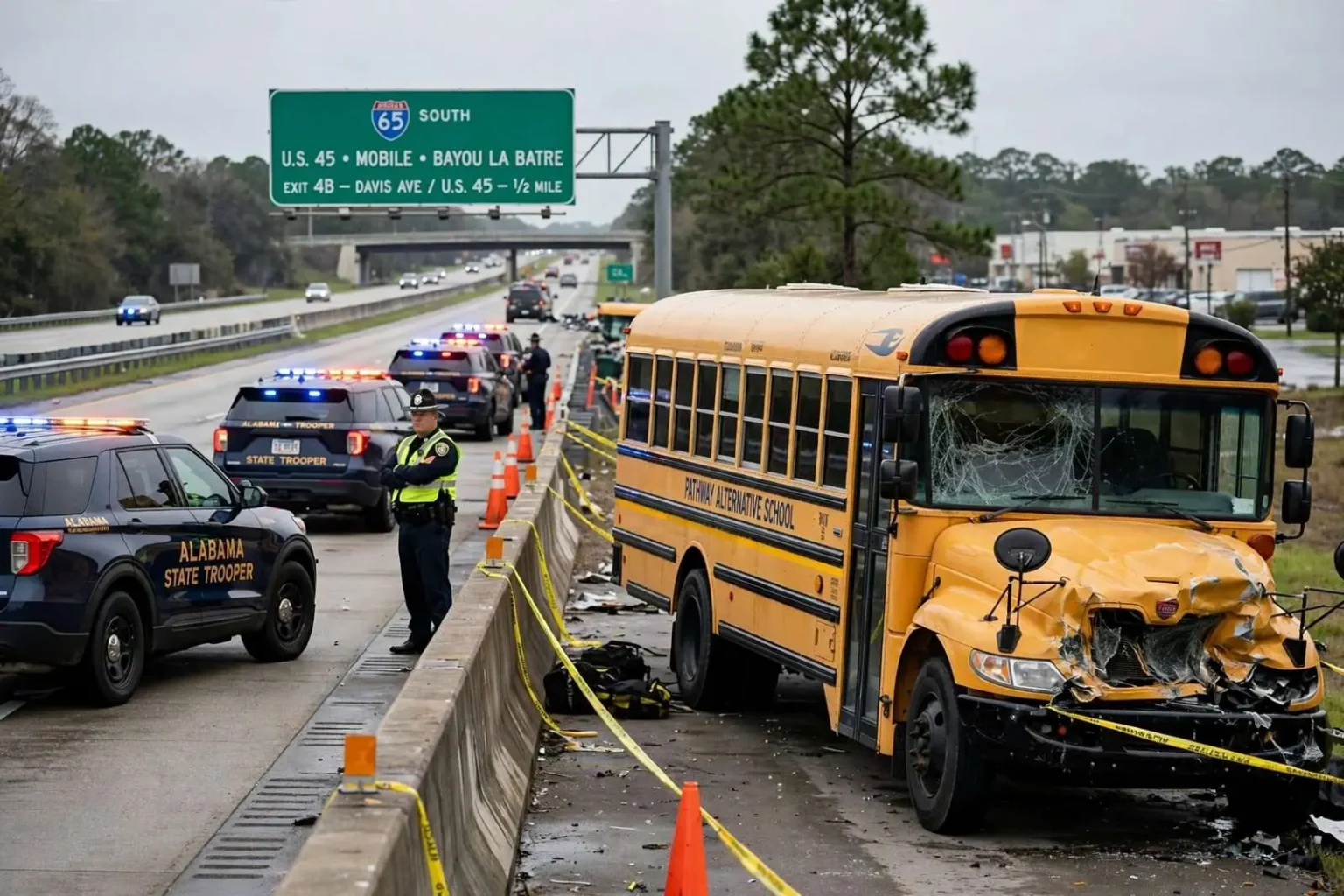
MOBILE — A judge set bond at $30,000 for the Florida man charged in the Interstate 65 crash that killed a Mobile school bus driver, and by Friday afternoon the defendant had been released from Metro Jail. Jail records show Brandon Barner bonded out just after 3 p.m. Friday, less than a day after the bond hearing that set the terms of his release while the case moves toward the courts.
Barner is charged with homicide by vehicle in the death of 32-year-old Kimberleigh Welch, the bus driver whose death stunned the school community she served. The charge — vehicle homicide — is Alabama’s mechanism for holding drivers criminally responsible when their unlawful driving kills another person, and it does not require proof that a driver intended harm, only that their unlawful act behind the wheel caused a death. A $30,000 bond is a mid-range figure for the offense, reflecting both the seriousness of a fatal crash and the fact that Barner was not considered a flight risk or a danger beyond the case itself.
His release on bond means Barner will await his next court date at home rather than in custody, subject to whatever conditions the court attached to the bond. He was expected back in court Oct. 13 for arraignment, the hearing at which a defendant formally enters a plea and the case begins its path through the docket.
What troopers say happened
According to Alabama State Troopers, Barner was driving south on I-65 near the off-ramp to U.S. 45 when his car struck the bus Welch was driving, causing it to overturn. The crash scene, on one of the busiest stretches of interstate on Mobile’s west side, tied up traffic while troopers worked the investigation and emergency crews extracted and treated the injured. Investigators documented the positions of the vehicles, skid evidence, damage patterns, and witness accounts — the standard work of reconstructing a fatal collision before any charging decision is made.
Welch was taken to University Hospital, where she died from her injuries. A third vehicle was also involved in the crash; its driver was not hurt. The involvement of three vehicles underscored how quickly a momentary error on an interstate can cascade: a strike in one lane can push a vehicle across several, involving drivers who had no role in the initial mistake.
The timing and location of the crash added to its impact. The U.S. 45 exit serves a busy corridor of schools, businesses, and neighborhoods on Mobile’s western side, and the early-morning timing meant the bus was operating on a schedule that put it on the interstate at the height of commuter traffic. State troopers closed and later reopened lanes as the investigation proceeded, and the sight of an overturned school bus on I-65 drew attention across the city within hours.
A driver remembered
Welch, a mother of four, had just dropped students off at Pathway Alternative School before the crash. That detail — the students already delivered, the empty bus on the return leg — was the small mercy in a devastating morning, and it was the one everyone in the school community noted. The children she was responsible for each day were not aboard when the bus went over.
She was remembered as a hard worker who loved the students she drove to school each day. Colleagues and parents described a driver who knew the children by name, waited for the slow ones, and treated the route as more than transportation. School bus drivers occupy a particular place in a school system: they are the first school employee a child sees in the morning and the last one at night, and the trust parents place in them is absolute. Welch’s death was felt at Pathway Alternative School and across the district’s transportation operation, where drivers returned to their routes in the days that followed knowing exactly what had been lost.
The man behind the wheel
Barner, of Panama City Beach, was passing through Mobile on his way to an alumni function at Jackson State University in Clinton, Mississippi, at the time of the crash. The detail became one of the case’s defining ironies: a routine road trip between two points in the region, with no connection to Mobile, ending in a fatal wreck on the interstate and a criminal charge. Drivers from across the Gulf Coast pass through Mobile’s interstate network daily — I-65 running north from the coast toward Montgomery, I-10 crossing east to west — and the volume of through traffic means that when something goes wrong on a Mobile interstate, the person responsible is just as likely to be a traveler as a resident.
For Barner, the road from Panama City Beach to Clinton, Mississippi, now runs through the Mobile County court system. The charge he faces, homicide by vehicle, can carry significant prison time under Alabama law, and the range of outcomes — from probation to years in prison — will depend on the facts prosecutors can prove and the circumstances the defense presents. Cases built on interstate crashes often turn on technical evidence: data from the vehicles themselves, reconstruction analysis, and the precise sequence of lane changes and speeds in the seconds before impact.
How vehicle homicide cases work
Alabama’s homicide by vehicle statute covers deaths caused by drivers who violate traffic laws in ways that create a substantial risk, from impaired driving to reckless speed to, as prosecutors allege here, an unsafe maneuver on the interstate. Prosecutors must connect a specific unlawful act to the death — not merely show that a crash occurred. That burden is why fatal-crash investigations take weeks: toxicology results, vehicle data downloads, and reconstruction reports all feed the file before a district attorney finalizes charges or a defense begins to test them.
The bond process that put Barner back on the street Friday is the routine machinery of that system. A judge weighs the charge, the defendant’s ties to the community, his criminal history, and the risk of failure to appear, then sets an amount intended to guarantee his presence at future hearings. Bonding out just after 3 p.m. — within hours of the hearing — indicated that a bondsman or family members posted the required percentage quickly, which is common in cases where the defendant has family support and no prior record. It does not speak to guilt or innocence; it only means the case will proceed with the defendant free until convicted or acquitted.
What comes next
The Oct. 13 arraignment will be the first public step in a case that will likely take months to resolve. Between now and then, investigators will complete their work, prosecutors will review the file, and the defense will receive the evidence the state intends to use. For Welch’s family, the court process will unfold alongside a private grief made public by the circumstances of her death — a mother of four, a worker her school community loved, killed on a commute she had made safely countless times.
The corridor where it happened
The stretch of Interstate 65 near the U.S. 45 off-ramp is one of the most heavily traveled segments of highway in southwest Alabama, carrying commuter traffic, port-bound trucks, and the constant stream of travelers moving between the Gulf Coast and points north. Interchanges like the U.S. 45 exit concentrate risk: merging vehicles, lane reductions, and drivers making late decisions about exits produce the sideswipes and rear-end collisions that troopers document daily. When a school bus is part of that mix, the stakes rise, because a vehicle that size cannot maneuver out of trouble the way a sedan can.
School transportation officials in Alabama operate under strict safety rules — regular inspections, licensed drivers, and routes planned around traffic — but no rule can protect a bus once another vehicle strikes it at interstate speed. The fact that Welch had already completed her student drop-offs and was running an empty leg of her route meant the crash’s toll, while devastating, stopped short of injuring the children she served. Transportation directors across the region noted the outcome with a shudder: minutes earlier, and the same crash would have unfolded with a full load aboard.
Remembering a driver by what she did
In the days after the crash, the picture of Welch that emerged from her school community was consistent: reliable, warm, and devoted to the students on her route. School bus drivers frequently serve the same children for years, and the relationships that form in the front seat of a bus — the morning greetings, the conversations on long rides, the driver who waits when a child is running late — are among the quiet bonds that hold a school system together. Those are the losses that registers most deeply when a driver dies, and they are what colleagues pointed to as they mourned.
She was a mother of four raising her own family while helping raise, for an hour each morning and afternoon, the children of dozens of others. The scale of that loss — four children losing their mother, a route full of students losing a familiar face, a school losing a worker it depended on — is what made the crash resonate beyond the interstate where it happened.
The courts will now determine what the law requires of the man charged in her death. The Oct. 13 arraignment will begin that process, and the case will move at the pace of the docket. What will not wait is the lesson the crash left behind for every driver who passes through Mobile’s interstates: the vehicles around you are carrying someone’s children, someone’s parent, someone’s whole day — and the seconds a driver spends tired, distracted, or rushed are the ones no one gets back.


