Boxing Champion Christy Martin to Headline Baldwin County Drug Court Fundraiser in Daphne
Former boxing champion and domestic violence survivor Christy Martin will headline the Baldwin County Drug Court Foundation's annual fundraiser on Oct. 15 at the Daphne Civic Center.
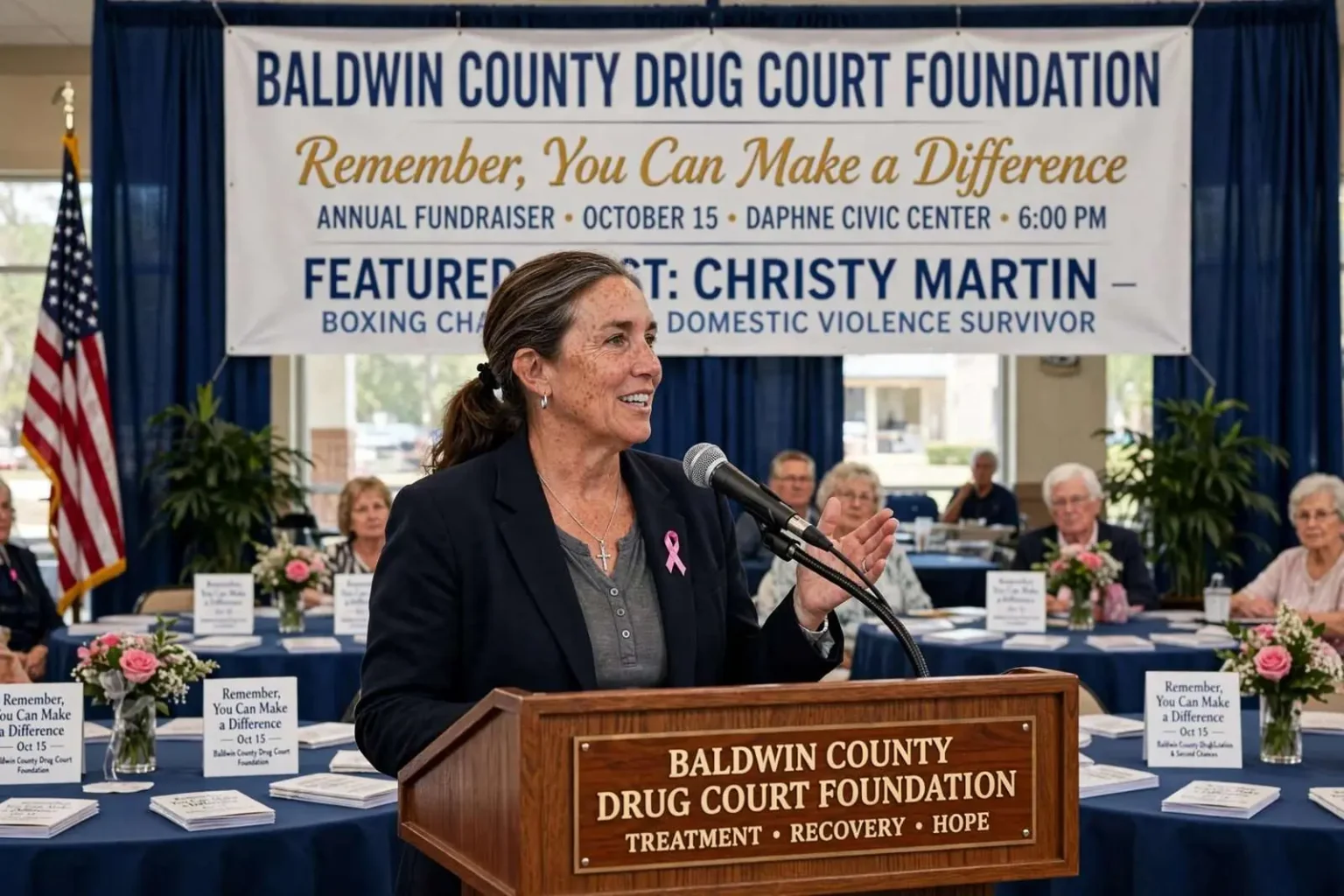
Former boxing champion and domestic violence survivor Christy Martin will be the featured guest at the Baldwin County Drug Court Foundation’s annual “Remember, You Can Make a Difference” fundraiser on Oct. 15 at the Daphne Civic Center. Martin, widely regarded as one of the most successful female boxers in the sport’s history, will headline the public event, which supports the foundation’s educational and rehabilitative efforts in Baldwin County.
The fundraiser is the foundation’s principal annual gathering, and the choice of a featured guest whose public story centers on survival, recovery and second chances tracks closely with the mission of the drug court program the foundation supports. Drug courts operate on a treatment-first model: instead of moving nonviolent offenders straight through the criminal docket and into jail, they combine judicial supervision with counseling, testing, education and employment support, with the judge checking progress at regular review hearings. Participants who complete the program can have charges reduced or dismissed; those who do not stay with it return to conventional prosecution.
Alabama embraced that model broadly in the 2000s, and programs now operate across the state’s judicial circuits. Baldwin County, which sits in the 28th Judicial Circuit, has run its drug court for years, and the foundation exists to raise money that taxpayer funding does not cover — treatment scholarships, educational materials, rehabilitation services and support for participants working to rebuild their lives. The foundation’s name for the event, “Remember, You Can Make a Difference,” reflects that fundraising purpose: contributions from local residents and businesses translate directly into services for people in recovery.
Why Martin fits the room
Martin’s biography gives the evening a speaker whose story runs through exactly the themes the drug court model is built on. She emerged in the 1990s as the most prominent woman in American boxing, fighting with a relentless, crowd-pleasing style that earned her the nickname “The Coal Miner’s Daughter” and a place on cards promoted at a time when the sport’s biggest promoters had never featured women at all. Her March 1996 fight against Deirdre Gogarty on the undercard of a heavyweight championship event in Las Vegas is widely credited with forcing mainstream audiences to take women’s boxing seriously; the bout was bloody, dramatic and impossible to dismiss, and it opened doors that had been closed for decades.
Her career record of 49 wins, 7 losses and 3 draws, with more than 30 knockouts, made her one of the most successful female boxers in the sport’s history, and her induction into the International Boxing Hall of Fame in 2020 formalized what fans had long argued — that she belongs among the most important figures the sport has produced, male or female.
But the second act of her story is the one that connects most directly to a drug court audience. In November 2010, Martin was attacked inside her own home in Florida — stabbed and shot by her then-husband, who left her for dead. She survived, and the years that followed involved surgery, recovery, the criminal prosecution of her attacker and an ongoing public conversation about domestic violence, trauma and addiction. Martin has spoken candidly about the wounds of that period, including struggles with substance abuse, and about the long, unglamorous work of rebuilding a life after violence. Her survival and recovery turned her into a sought-after speaker for organizations working at the intersection of criminal justice, addiction and domestic abuse.
For Baldwin County residents who attend, the evening is both a fundraiser and a reminder of how the county’s justice system has shifted. Residents across Mobile County and Baldwin County rely on a network of municipal police departments, the Mobile County Sheriff’s Office, the Baldwin County Sheriff’s Office, and state troopers to handle day-to-day calls, and major cases are typically handled by the investigative divisions of those agencies, often working in coordination with one another. What happens after an arrest, though, increasingly runs through specialty courts — drug court, mental health court, veterans court — that treat the underlying problem rather than only the offense.
The setting: Daphne and Baldwin County
The venue itself sits in one of Alabama’s most consequential counties. Baldwin County lies directly east across Mobile Bay and is the largest county by area in Alabama. Its communities include the Eastern Shore cities of Fairhope, Daphne, and Spanish Fort, along with the Gulf-front municipalities of Gulf Shores and Orange Beach. The county has been among the fastest-growing in the state for two decades, driven by retirees, second-home owners, and tourism along the white-sand beaches.
Daphne sits on the eastern shore of Mobile Bay just south of Spanish Fort. It grew rapidly in the 1990s and 2000s as a suburban community serving commuters working in Mobile and at the industrial sites along the bay’s eastern edge. The Daphne Civic Center, the city’s primary event venue, hosts everything from trade shows to school banquets, and it is a familiar gathering place for Eastern Shore nonprofits. Rapid growth has brought the county both prosperity and pressure — rising demand for courts, treatment services, schools and public safety — which is the backdrop against which the drug court foundation does its work.
Mobile and Baldwin County together form a single regional economy, with commuters, students, and shoppers moving daily across the bay, and with shared concerns about transportation, schools, public safety, and growth that play out in both counties’ public meetings and local news coverage. The two county court systems face many of the same drivers of caseload: substance abuse, domestic violence and the repeat offenses that follow when those problems go untreated. That is the practical logic of a drug court — intervene early, supervise closely, and spend public money on treatment instead of jail cells — and it is the logic the foundation asks donors to support each October.
News from across south Alabama frequently highlights the ways in which local decisions in city halls, county commissions, school board meetings, and state offices in Montgomery interact with daily life for residents from Saraland to the Eastern Shore and from downtown Mobile to the Gulf beaches. The regional economy runs through the Port of Mobile, the Brookley aeronautics complex, and the industrial corridor along the Mobile River, which connect stories about steel, shipbuilding, aerospace, and shipping into a single regional narrative.
Local school systems, including Mobile County Public Schools and the Baldwin County Public Schools system, are among the largest employers in the region and are a focus of ongoing community attention, particularly around school construction, teacher staffing, and student performance. Hurricane and severe-weather preparedness is a recurring topic for residents across the coast, with annual public drills, sandbag distributions, and updates from local emergency management agencies as the Atlantic hurricane season progresses each year — and it is worth remembering that October, the month of this fundraiser, sits near the statistical peak of that season.
What the night supports
Proceeds from the “Remember, You Can Make a Difference” fundraiser go toward the foundation’s educational and rehabilitative efforts in Baldwin County. In practice, that means helping participants in drug court access the services that give the program its success rate — counseling slots, educational classes, and rehabilitation support — as well as backing the community education that helps residents understand what treatment-based justice actually looks like.
Drug courts nationally have been studied extensively since the first program opened in Miami in 1989, and the consistent finding across jurisdictions is that supervised treatment programs outperform jail-first approaches at reducing repeat offending while costing taxpayers substantially less per participant. The savings show up in fewer beds occupied in county jails, fewer probation revocations and fewer children entering foster care when a parent stabilizes in recovery. Those are the outcomes Baldwin County’s judges, treatment providers and foundation volunteers point to when they make the case for community support each year.
The foundation’s annual dinner also functions as a reunion of sorts for program graduates. Participants who complete drug court are invited back to see the next class through, and their presence in the room — working jobs, raising families, staying clean years after graduation — is the kind of proof no brochure can match. Speakers who have lived the program are typically paired with the headliner, so the audience hears both the national story from the stage and the local story from the podium.
For Martin, the appearance continues a post-boxing career built around telling her story in public. For the foundation, her presence on a stage in Daphne gives the mission a face: someone whose life was nearly taken by violence, whose path ran through addiction and the courts, and who rebuilt. Tickets and sponsorship information for the Oct. 15 event are available through the foundation, and organizers encourage early reservations, since the annual dinner draws a full house of Eastern Shore supporters. Attendees will hear from Martin, from court staff and from program graduates whose own recoveries are the most concrete evidence the foundation can offer that the money raised that night makes a difference.