
Boyfriend Charged With Murder in Shooting Death of Selwondra Pugh on Magnolia Road
Jason Cooley faces a murder charge in the shooting death of his girlfriend, Selwondra Pugh, at a Magnolia Road home in Mobile.
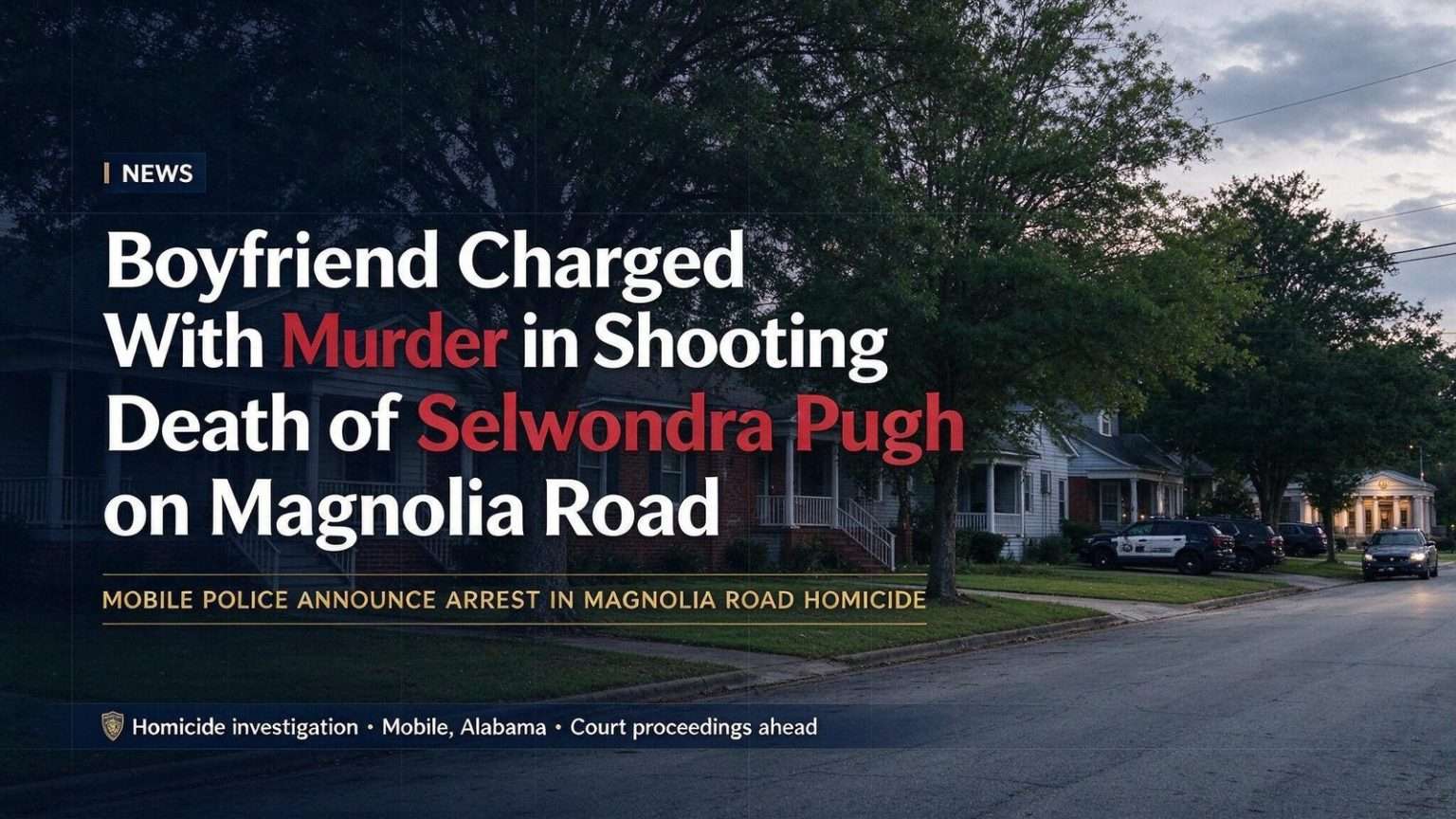
Mobile Police have charged a 42-year-old man with murdering his girlfriend after she was shot at a Magnolia Road home this week, a case that moved from a late-night shooting to an arrest in a matter of hours.
Jason Cooley was taken into custody early Tuesday and booked into Mobile Metro Jail shortly after 3 a.m. on a murder charge in the death of Selwondra Pugh, also 42. The booking in the early hours of Tuesday followed the shooting Monday night, giving police barely a day between the gunfire and the arrest.
The shooting
Police said Pugh was shot three times in the stomach around 9 p.m. Monday at a home in the 400 block of Magnolia Road. The location sits in Mobile’s inner-city neighborhoods, a residential stretch where Magnolia Road runs through blocks of houses a short distance from downtown. Officers responded to reports of the shooting and found Pugh wounded inside or near the home.
She was rushed to a hospital, where she died from her injuries. Despite emergency treatment, the three gunshot wounds to the abdomen proved fatal, and police moved quickly from a shooting investigation to a homicide case.
The arrest
Jason Cooley, Pugh’s boyfriend, was charged with her murder. The arrest came quickly by the standards of homicide investigations, which typically unfold over days or weeks of evidence gathering. In domestic-violence killings, investigators often reach the suspect quickly because the relationship itself defines the circle of inquiry: who was in the home, what the history of the relationship was, and what witnesses in the household or neighborhood saw and heard in the moments around the shooting.
Cooley was booked into Mobile Metro Jail, the detention facility that serves Mobile County’s municipal and county arrests, shortly after 3 a.m. Tuesday. A murder charge in Alabama carries the state’s most severe penalties, and the case will proceed through Mobile County’s court system, where prosecutors will present the evidence police assembled in the first hours and days.
Remembering Selwondra Pugh
Friends knew Pugh as Shay. The nickname carried through the mourning that followed her death, as friends and family gathered to grieve a woman they remembered in personal terms rather than case numbers. She leaves behind three daughters, and the loss ripples through a family now facing life without their mother.
Those who knew her described the kind of grief familiar to every community that loses someone to domestic violence: disbelief that the person they saw regularly is gone, anger at the circumstances, and concern for the children left behind. Support networks of family, churches and friends in Mobile’s neighborhoods typically rally around such households in the weeks after a loss like this one.
Domestic violence and lethal risk
The case fits a pattern that advocates and researchers have documented for decades: when intimate-partner violence turns lethal, the victim is most often a woman killed by a current or former partner, frequently with a firearm, frequently at home. National data consistently show that a substantial share of female homicide victims are killed by intimate partners, and that access to a gun multiplies the lethality of domestic abuse dramatically.
Mobile Police, like departments nationally, handle domestic-violence calls as high-risk encounters for precisely this reason. Officers responding to such calls document injuries, assess escalation history and connect victims with protective orders and advocacy resources. The gap between the help available and the danger remains, and each lethal case renews the community’s conversation about what more can be done.
What happens next
With Cooley in custody on a murder charge, the case moves into the judicial process. An initial appearance before a judge comes first, followed by the grand jury’s review of the evidence for indictment. Prosecutors in Mobile County handle homicide cases with the full resources of the District Attorney’s Office, and defense counsel will represent Cooley through the proceedings. Cases arising from domestic incidents turn heavily on witness accounts, forensic evidence and the documented history between the parties.
The 400 block of Magnolia Road returns to its routines, but the loss of Selwondra Pugh — Shay, a mother of three daughters — remains with the family and friends who knew her. The quick arrest cannot restore what was taken, and the case now proceeds through the courts toward whatever accountability the evidence supports.
The speed of the arrest in this case reflects how Mobile Police approach suspected intimate-partner homicides. When a shooting victim dies and the evidence points to a partner or family member, investigators move immediately: securing the scene, interviewing everyone present or nearby, obtaining search warrants for the home, and locating the suspect before any flight from the jurisdiction. An arrest within hours of the death indicates that detectives found the account of events consistent enough to charge, and that the suspect made no successful evasion.
The booking process at Mobile Metro Jail itself captures a piece of the case’s record. The facility on Center Street processes arrests from across Mobile County, and the intake time — shortly after 3 a.m. Tuesday — marks the official transfer from police custody to the county system. From there, bond considerations, initial appearances and the appointment or retention of defense counsel follow on the court’s schedule.
How homicide prosecutions unfold in Mobile County
A murder charge of this kind proceeds through several predictable stages. The suspect appears before a district judge within days for an initial hearing, where the charge is read and counsel matters are addressed. The evidence then goes to a Mobile County grand jury, which hears the prosecution’s presentation and votes on an indictment. If indicted, the case is assigned to a circuit court docket, where pretrial motions, discovery and plea negotiations precede any trial.
Prosecutors weigh the evidence assembled by detectives: the scene findings from the 400 block of Magnolia Road, the forensic examination of the victim, witness statements from the neighborhood, and any physical or digital evidence connecting the defendant to the shooting. Domestic killings often involve witnesses within the household, including children, which adds painful complexity to the process that advocates and courts must navigate carefully.
The wider toll in the community
Each domestic-violence death in Mobile County adds to a toll that local advocates track with grim attention. Shelters, crisis lines and court advocacy programs in the area serve hundreds of clients in a typical year, and the demand for protective orders continues steady. The gap between the services available and the need persists, particularly for victims who remain in shared homes with the person harming them — the setting in which so many lethal encounters, like this one, occur.
Research on intimate-partner homicide consistently identifies warning signs in the period before a killing: escalating violence, threats with weapons, separation attempts and prior calls to police. Advocates use that knowledge to press for risk-assessment screening at every domestic call, so that the cases most likely to turn lethal receive immediate intervention. Whether any such warning signs preceded Pugh’s death is a question the investigation’s fuller record may address.
Three daughters, one loss
The most lasting consequence of the shooting belongs to Pugh’s three daughters, who now grow up without their mother. Children who lose a parent to violence carry the loss through every stage of life, and family members typically step into caregiving roles amid their own grief. Community organizations and churches in Mobile often coordinate support for such households, from funeral assistance to ongoing family counseling.
Friends who mourned Shay in the days after her death remembered her in the terms of everyday life — the person she was to her family, her humor, her presence in the neighborhood — rather than the circumstances of her death. That distinction matters in how a community processes these losses: the case file records a crime, but the people who knew her record a life.
The case against Jason Cooley now belongs to the courts. The charges, the evidence and the testimony will move through Mobile County’s justice system in the months ahead, and the outcome will be a matter of public record. What the community is left holding, meanwhile, is the loss itself: a 42-year-old mother of three, shot at her home on Magnolia Road, mourned by everyone who knew her as Shay.
For residents along Magnolia Road, the week’s events leave a familiar mark. A house in the 400 block became the center of police activity, then a courtroom narrative, and the neighborhood absorbs the event the way residential streets do — with increased patrols for a time, with conversations on porches, and with the quiet that follows a loss among people who knew the family. Officers encourage anyone who witnessed anything in the moments around the shooting, however small the detail, to bring it to detectives or leave it through the department’s anonymous tip channels, since even fragmentary accounts can confirm a timeline built from evidence.
The case also lands among the grim statistics Mobile Police report year to year, where each homicide carries both a number and a name. In this one, the name the friends and family hold onto is Selwondra Pugh — Shay — and the record will show a 42-year-old woman shot three times at her home on a Monday night, whose boyfriend was charged before the week was out.


