

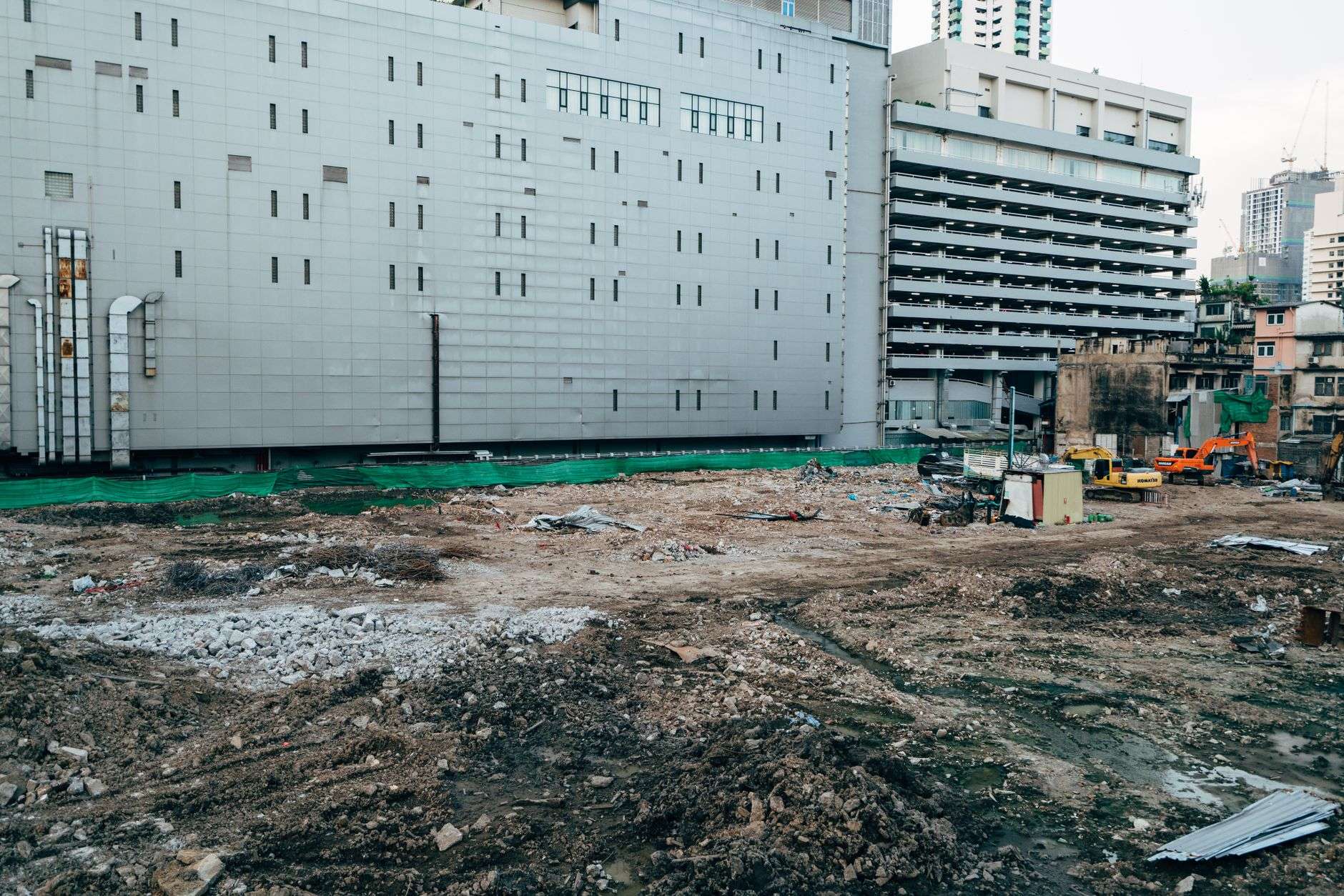
MOBILE, Ala. — Demolition work began Friday on Mobile’s Frank W. Boykin Towers, a defunct low-income housing project on land that now belongs to the Mobile Airport Authority.
As bulldozers worked elsewhere on the property, a long-reach trackhoe reached up eight stories to rip apart the walls at one end of the 122-unit tower.
250 Acres North of I-10
The building sits on more than 250 acres of land that the Mobile Airport Authority purchased from the Mobile Housing Authority and the federal Department of Housing and Urban Development in 2024. The property is north of Interstate 10 at Michigan Avenue, near the Mobile Aeroplex at Brookley.
At the MAA’s regular monthly meeting on Wednesday, acting executive director J. Adam Hays referred to the property as “North Brookley.” He told the MAA board that demolition of the Boykin Towers was imminent and that demolition and cleanup work on the surrounding neighborhoods would follow.
The Mobile Airport Authority said in 2024 that it would develop a master plan so that the property could “serve the MAA’s mission and help fund its operations well into the future.”
Birdville: A World War II Neighborhood
Hundreds of small homes around the Boykin Towers date back to the World War II era, when the neighborhood was developed for workers employed by military operations at Brookley Field.
The neighborhood was formally known as Thomas James Place, but because many of its streets were named for birds, it became known as Birdville.
Brookley Field was one of the largest military installations on the Gulf Coast during and after World War II, and Mobile’s population surged during the war years as workers arrived for defense and shipbuilding jobs. Housing built for that workforce — modest, quickly constructed and located close to the base — is the origin of the neighborhood now being cleared.
That history is the reason a housing development and an airport property sit on the same ground. The neighborhood existed because of the airfield in the first place.
How the Property Came to Be Vacant
After military operations ceased at Brookley, the area was used as low-income housing and additional structures such as Boykin Towers were built.
By the 2010s, the Mobile Housing Authority was facing increasing difficulty in maintaining it and other aging properties to HUD standards. It struggled to secure permission and funding to demolish and redevelop them.
That combination is a well-documented pattern in public housing across the country. Properties built in the mid-20th century reach the end of their practical service life, the cost of bringing them to current standards exceeds their value, and the federal approvals and funding required to demolish and replace them move slowly. The result is often a property that deteriorates for years while the process runs.
By 2020, the Boykin Towers had been closed. Around the towers on Friday, neighborhood streets were blocked off and many of the small homes were showing major signs of neglect.
What Comes Next
Hays told the board that demolition and cleanup work on the surrounding neighborhoods would follow the tower’s removal.
The MAA has not released details of a final development plan for the North Brookley property. Its 2024 statement — that a master plan would let the land serve the authority’s mission and help fund its operations — indicates the property is being positioned both for aviation-related use and as a revenue source.
The timing coincides with substantial activity elsewhere on the campus. The new Mobile International Airport at Brookley is expected to open in early 2027, and roadway work including a planned roundabout at Michigan Avenue and Broad Street is underway to handle the traffic that move will bring.
A Piece of Mobile’s Wartime Landscape
The clearing of Birdville removes one of the more tangible remnants of Mobile’s World War II expansion. The homes were built for a specific purpose at a specific moment, served as housing for roughly eight decades afterward, and are now being removed to make room for whatever the airport authority decides the land should become.