
Boys & Girls Clubs Open Five Mobile County Sites to Watch Kids During Virtual Learning Week
Five Boys & Girls Clubs branches across Mobile County opened during virtual learning week, giving working parents free childcare and supervision.
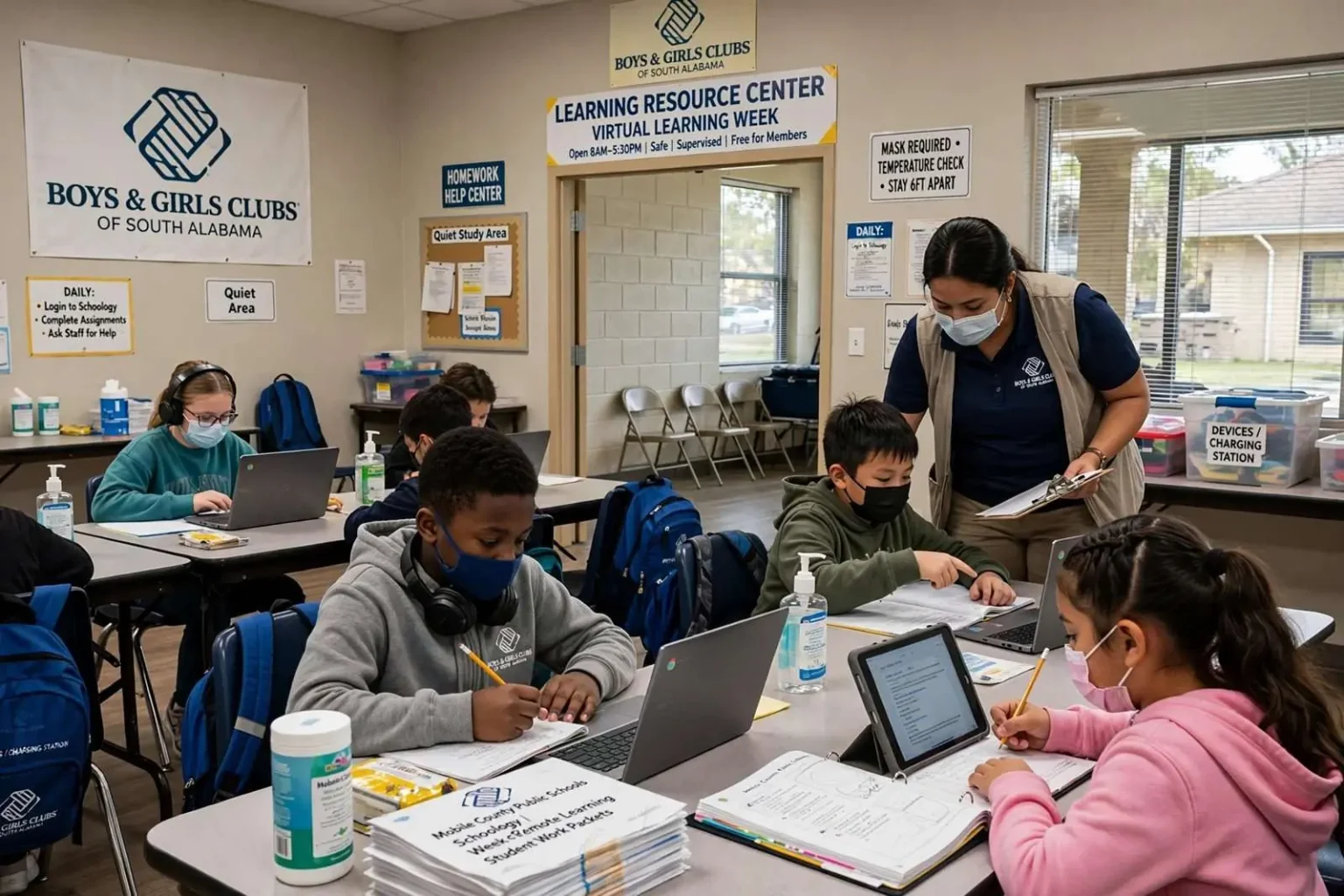
As Mobile County schools shifted to a week of remote instruction amid a staffing crunch and climbing COVID-19 numbers, the Boys & Girls Clubs stepped in with a practical answer for working families: open the clubs. The move addressed one of the quiet crises of the pandemic era — the gap between a school calendar that can flip to remote learning overnight and a work schedule that cannot — by turning five neighborhood clubhouses into supervised learning centers for the week.
Five branch locations across the county welcomed students during the virtual learning week, giving parents who could not stay home from work a supervised place for their children to complete schoolwork. For thousands of Mobile County households, the announcement answered the question that dominates every school-closure notice: not whether the lessons will happen, but who will be with the kids while they do.
Where Kids Could Go
The participating sites were the Bernard Malkove Branch on Cody Road, the Kiwanis Branch on Rice Street, the Semmes Branch on Wulff Road, the East Optimist Branch on Plaza Drive, and the Sonny Callahan Branch on Carol Plantation Road. Each operated from 8 a.m. to 5:30 p.m., Monday through Friday of the virtual week — a span that mirrors a full workday, covering the hours when parents of school-age children most need coverage. The five sites spread across the county from west Mobile to Semmes and the deep south of the county, giving families in different corners of the area a realistic driving distance.
Access was free for existing club members, while non-members paid a $30 membership registration fee to use the Learning Resource Centers. The fee structure kept the barrier to entry low — a one-time membership cost rather than a weekly childcare bill — while folding new families into the club system, where many would keep coming back for after-school and summer programming long after the virtual week ended.
Club leaders said they did not know exactly how many families would show up, but the need was clear: many parents in Mobile County simply have no way to stay home with their children when classrooms go quiet. The county’s workforce — heavy on healthcare, retail, shipping and hospitality jobs that cannot be done from a kitchen table — leaves little room for a parent to work remotely during a remote-learning week, and the clubs positioned themselves as the safety net for exactly those families.
The timing of the club openings also mattered. A single notice of a school closure gives families only days to rearrange childcare, and options for full-day supervision — grandmothers, neighbors, daycares with school-age openings — run out quickly when an entire district closes at once. By announcing the five sites with hours and fees up front, the clubs gave parents a concrete answer inside the same news cycle as the closure itself.
Each of the five branches brought its own neighborhood into the plan. The Malkove Branch on Cody Road serves west Mobile’s long-established suburbs; the Semmes Branch anchors one of the county’s fastest-growing communities on the western edge; the Kiwanis and East Optimist branches cover older in-city neighborhoods; and the Sonny Callahan Branch serves families in the Tillman’s Corner area in the county’s deep south. Together they put a supervised site within reasonable reach of most of the county’s population.
Safety Rules and Remote Classrooms
Club officials described the centers as safe spaces for remote learning, with mask requirements, temperature checks, and students bringing their own lunches. The protocols matched the standard of the moment — the same rules students would have followed in a school building — and the bring-your-own-lunch policy avoided the complication of communal meal service. Staff screened students at the door each morning, spaced workstations apart and kept groups consistent through the week to limit mixing between households.
Inside the clubhouses, the model looked like a study hall supervised by people who know the neighborhoods’ children by name. Staff members helped students log in, stay on schedule and work through assignments — a layer of adult support that matters enormously for younger students and for households without reliable internet, devices or a parent available to troubleshoot. For families on the wrong side of the digital divide, a supervised site with connectivity and working computers is often the difference between a week of learning and a week of falling behind.
The school district’s remote format itself had changed since the early pandemic. Rather than live-streamed classes, teachers posted lessons and assignments in Schoology for students to complete on their own schedules, while elementary students received paper packets sent home. The asynchronous approach reflected hard lessons from the spring of 2020: live video classes proved difficult for families juggling shared devices and work schedules, and teachers struggled to reach students who could not log on at a fixed hour. Self-paced work in Schoology, paired with paper packets for the youngest learners, was the compromise the district settled on.
That format also shaped what the clubs needed to provide. With no live classes to attend, students needed a quiet place, a device, internet access and an adult nearby to keep them moving through the day’s assignments — all of which a Learning Resource Center could supply at scale. The self-paced model meant students arriving at different times could still complete the same work, and club staff could spread attention across grade levels rather than racing a bell schedule.
The staff-to-student ratio became the quiet variable in the whole arrangement. Club staff are youth-development workers, not teachers, but they are practiced at managing mixed-age groups, keeping students on task and spotting the child who is stuck, hungry or struggling — skills that translate directly to a day of asynchronous assignments. Teachers, meanwhile, monitored Schoology from home, answering questions and grading remotely while the clubs handled the physical supervision.
A District Under Pressure
The virtual week came as the school district wrestled with two forces at once: a staffing crunch that made in-person operation impossible and case numbers climbing fast enough to worry health officials. Mobile County Public Schools, one of the largest districts in Alabama, serves tens of thousands of students across a county stretching from Citronelle to Dauphin Island, and a single week of remote instruction ripples through every workplace in the region. The district’s decision to go remote for a week reflected the arithmetic of the moment — too many teachers and staff out to safely staff classrooms — and the clubs’ response reflected the same reality on the family side.
The Boys & Girls Clubs of South Alabama has built its mission around exactly this kind of gap-filling. The organization’s clubhouses provide after-school care, summer programming and youth development for thousands of children across the county each year, many from working families who depend on the clubs to make their schedules function. When schools close, the clubs’ role expands from after-school supplement to full-day support — a shift the organization has made repeatedly since the pandemic began.
The Learning Resource Center model became something of a template during the pandemic’s stop-and-start school year. Across the country, youth organizations, YMCAs and community centers converted their floors into supervised e-learning sites, and the Boys & Girls Clubs’ national organization pushed local affiliates to do the same. Mobile’s five-branch week fit that pattern — improvised in the details, but informed by what the organization had learned in earlier closures about spacing, screening and keeping students actually working.
For the families who used it, the week offered more than childcare. Students kept a routine, stayed connected to their assignments and spent the week with adults who could help when the work got hard — while parents kept their jobs and their paychecks. And when the virtual week ended and classrooms reopened, the clubs went back to their regular rhythm, having shown once again that in a crisis, the institutions that know a community’s families best are often the ones that respond fastest.
The $30 registration also bought something the week alone couldn’t: continuity. Families who registered as members kept access to the clubs’ year-round programming — homework help, athletics, teen programs and summer camps — meaning the virtual-week arrangement doubled as an on-ramp to the organization’s regular services for households that had never used them. For the clubs, that pipeline is the point: the more families the system reaches during a crisis, the more children it can serve when the crisis passes.
As the week went on, the arrangement settled into a rhythm familiar to anyone who spent the pandemic era inside a school building: morning screenings, spaced-out workstations, headphones on, devices charging, and staff circulating between tables the way teachers once walked rows of desks. It was not a classroom, and it did not pretend to be. But for one strange week in a year of them, it was close enough — and for the parents clocking in across Mobile County, close enough was exactly what they needed.


