
BP Donates $50,000 to Sponsor 2010 BayFest After Gulf Oil Spill
BP is sponsoring Mobile's BayFest with a $50,000 donation as the oil company works to rebuild goodwill after the Gulf oil spill.
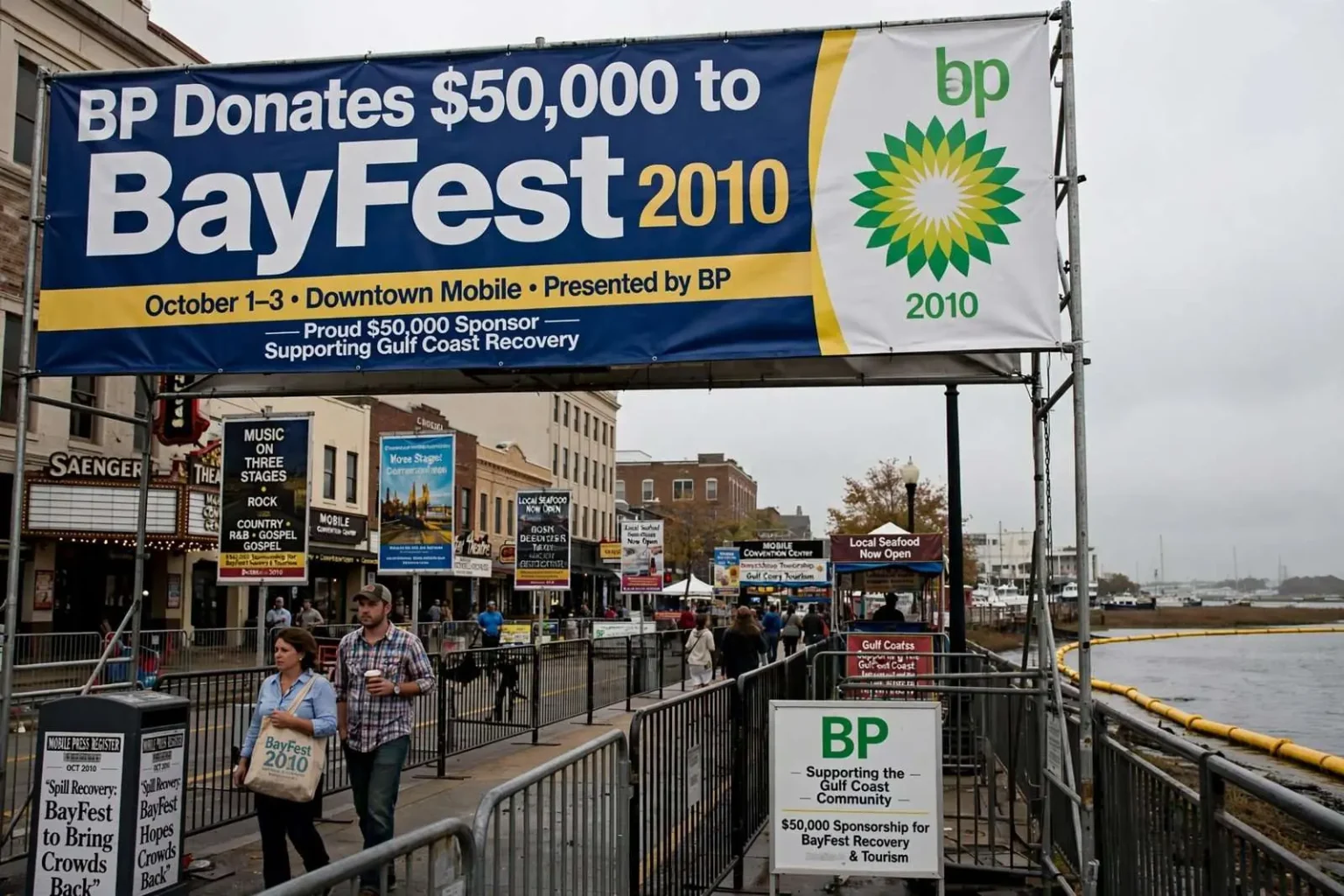
BP is putting up $50,000 to sponsor Mobile’s annual BayFest music festival, according to a local television station’s report, as the oil company looks to smooth over relations with a Gulf Coast tourism and hospitality industry battered by the Deepwater Horizon oil spill. The donation ties one of the region’s biggest annual celebrations to one of the most unpopular companies on the coast — and it showed, in the fall of 2010, how BP was spending its way back toward something like goodwill in the communities its disaster had damaged.
The spill, which began in April 2010 after an explosion on BP’s Deepwater Horizon drilling rig in the Gulf of Mexico, sent millions of barrels of oil into Gulf waters over several months. Eleven workers died in the April 20 explosion, and the well that followed — a mile down on the seafloor, leaking for eighty-seven days before it was capped in July — became the largest marine oil spill in history. The images of the summer were of oiled marshes, boom lines and tarballs on white sand, and they played on screens across the country for months.
Coastal Alabama businesses reported steep drops in tourism and event attendance for much of the summer as visitors stayed away from beaches and waterfront festivals amid spill fears, even in areas like Mobile Bay that saw comparatively little direct oiling. The perception did the damage as much as the oil itself: families who had booked Gulf Shores vacations canceled them, fishing charters sat at the dock, and restaurant owners along the coast described their slowest summers in memory. Mobile, protected inside the bay and largely upstream of the visible oiling, suffered a confidence problem more than an oil problem — but visitors do not distinguish between a bayfront park and a beachfront, and the whole coast shared the slump.
A Bid to Restore Goodwill
BP’s sponsorship of BayFest, one of the region’s largest annual music festivals, comes as the company has faced pressure to fund Gulf Coast recovery efforts following the spill. The company set up a multibillion-dollar claims fund for affected businesses and individuals, and local sponsorships like the BayFest donation were part of a broader effort to demonstrate support for the region’s economy heading into the fall event season.
The $20 billion claims fund, negotiated with the White House in June 2010, was the centerpiece of BP’s compensation effort, designed to pay businesses and individuals whose livelihoods the spill damaged. But the sponsorship checks — for festivals, seafood promotions, chamber events and the like — served a different purpose: they put BP’s name back into the community calendar in a helping role, at events residents already loved. For festival organizers, the money was welcome regardless of the donor’s motives; a $50,000 sponsorship is a meaningful share of a music festival’s budget, and 2010 was shaping up as a hard year to sell sponsorships on the Gulf Coast, with companies across the region tightening event budgets.
BayFest draws tens of thousands of visitors to downtown Mobile each year for a multi-day, multi-stage music lineup, making it a significant driver of local hotel, restaurant and retail business during what organizers hoped would be a rebound weekend after a difficult summer for the coast. The festival’s stages spread across the downtown streets, its crowds fill hotels from the convention district to the interstate exits, and its October dates — coming after the summer’s bruising season — had always served as a kind of downtown’s victory lap. In 2010, the question hanging over the whole weekend was whether the coast’s visitors would come back at all, and BayFest was positioned as the first big test.
For BP, the calculus behind a $50,000 festival sponsorship was transparent. The company’s brand on the Gulf Coast was toxic by August 2010 — protests had greeted its executives, its name was shorthand for the summer’s losses, and every gas station bearing its sunflower logo had become a small lightning rod. Sponsorship money was one of the few tools available to demonstrate commitment without waiting for claims checks to clear. Festivals, chambers of commerce and tourism boards across the coast accepted BP money in that season with varying degrees of comfort, and the debate over whether BP’s money was welcome became a recurring local controversy from Louisiana to the Panhandle.
The BayFest donation carried a particular local logic. Mobile Bay’s seafood and tourism industries had suffered collateral damage from the spill’s reputational drag even where oil never came ashore, and Mobile’s hospitality industry — hotels, downtown restaurants, the convention business — depended on the same Gulf-brand confidence that had collapsed in the summer. A check to the city’s signature music festival was BP acknowledging that its responsibility ran beyond the oiled shoreline to the region’s whole event economy.
Festival organizers, for their part, faced a hard market. Corporate sponsorships fund the multi-stage infrastructure that a festival like BayFest requires — staging, sound, security, cleanup — and 2010’s economic climate, with the spill layered on top of the recession, made sponsor dollars scarcer across the board. A $50,000 sponsor arriving in that market was not going to be turned away over its initials.
What the Money Meant Downtown
The timing of the sponsorship, announced as the festival approached, put BP’s name into the middle of a conversation the Gulf Coast was having with itself that fall: how fast to forgive, and on what terms. Some residents argued the company owed the coast far more than sponsorships and that accepting its money normalized the damage; others took the practical view that BP’s money, spent locally, was the fastest mechanism available to return value to the communities affected — better in a downtown stage rental than in a settlement fund’s paperwork. Local coverage of festival sponsorships in that season invariably noted the tension.
BayFest itself had grown into one of the largest events on the central Gulf Coast, with a multi-day lineup spanning rock, country, R&B and gospel stages spread through downtown’s streets and parks. The festival’s economic footprint — hotel nights, restaurant tabs, bar receipts across a three-day weekend — made its October date a meaningful line in the downtown business calendar, and after a summer of spill-driven cancellations along the coast, every autumn event carried extra weight as a signal that the region was open for business.
BP’s $50,000 did not repair the summer. It was, in scale, a rounding error against the multibillion-dollar claims process that would stretch for years — through the GCCF claims facility, the 2012 settlement and the 2015 settlement that ultimately reached into the billions more. But as a gesture aimed at a specific weekend in downtown Mobile, it performed a specific function: it helped fund a festival, it kept ticket prices where organizers wanted them, and it put BP’s name on the side of an event the region loves, at the moment the region was deciding how it felt about the company whose rig had darkened its summer. Whether that bought goodwill was an open question in October 2010; that it was meant to was not.
The Deepwater Horizon disaster’s shadow over the 2010 festival season is worth setting out plainly, because it explains why a sponsorship announcement was even newsworthy. After the rig exploded on April 20, oil flowed from the Macondo well until July 15, when a cap finally stopped the flow, and the well was not permanently sealed until September. During those months, an estimated several million barrels entered the Gulf, closing fishing grounds across the north-central Gulf, prompting months of beach closures in Florida and Alabama, and generating round-the-clock national coverage that told prospective visitors the coast was Oiled — with a capital O — whether or not oil ever reached a given stretch of sand.
Alabama’s beaches took visible hits — tarballs and weathered mousse reached Orange Beach and Gulf Shores at various points through the summer — and the state’s tourism machine spent the season fighting cancellations with advertising designed to show clean sand. Baldwin County’s beach towns, which live and die on summer occupancy, reported the worst season in memory, and the damage extended up the bay: charter captains in Mobile Bay and along the Causeway saw trips evaporate, seafood houses watched wholesale prices spike as Gulf catches shrank, and the ripple ran all the way to inland businesses that had never seen a barrel of oil.
Mobile’s position in that economy was distinctive. The city sits at the head of Mobile Bay, protected from most direct oiling by geography and the barrier islands to its south, but its downtown hospitality economy sells the same Gulf Coast promise as the beach towns: come to the water, spend the weekend, bring the family. When the beaches take a reputational wound, downtown festivals feel it even in a city where the water stayed clean. That is the context in which BayFest’s October weekend became a referendum: if the crowds came downtown in force, the coast’s event season could be declared alive; if they stayed home, the damage would be measured in one more season of red ink.
BP’s sponsorship also fit a pattern the company was executing across the Gulf in the fall of 2010. Beyond the claims fund, BP poured money into tourism promotion campaigns for the affected states, seafood marketing programs to counter the perception that Gulf catches were unsafe, and a steady stream of community sponsorships — festivals, fairs, schools and chambers — that kept the company’s name attached to recovery rather than disaster. Public relations firms managed the effort; local organizers cashed the checks. The arrangement was uneasy on both ends, but it moved millions of dollars into Gulf Coast event budgets during the exact season when those budgets were bleeding, and BayFest’s $50,000 was one entry in that ledger.
The longer arc, of course, ran far beyond one festival weekend. The spill’s legal aftermath — claims facilities, criminal and civil settlements, the Restore the Gulf restoration money that eventually flowed from the penalties — shaped the coast for a decade. But in October 2010, the immediate question was simpler: would downtown Mobile’s streets fill for BayFest the way they always had, and would the coast’s fall season begin its recovery there? BP’s $50,000 sponsorship was a bet, by the company and by the festival alike, that the answer was yes — and the crowds that came downtown that October were the beginning of the answer.


