Brewton Council Approves Development Deal, Liquor License Transfer and Audit Agreements
The Brewton City Council approved a development agreement with Brewton Holdings, a liquor license transfer and multiple audit and appointment items during its Monday meeting.
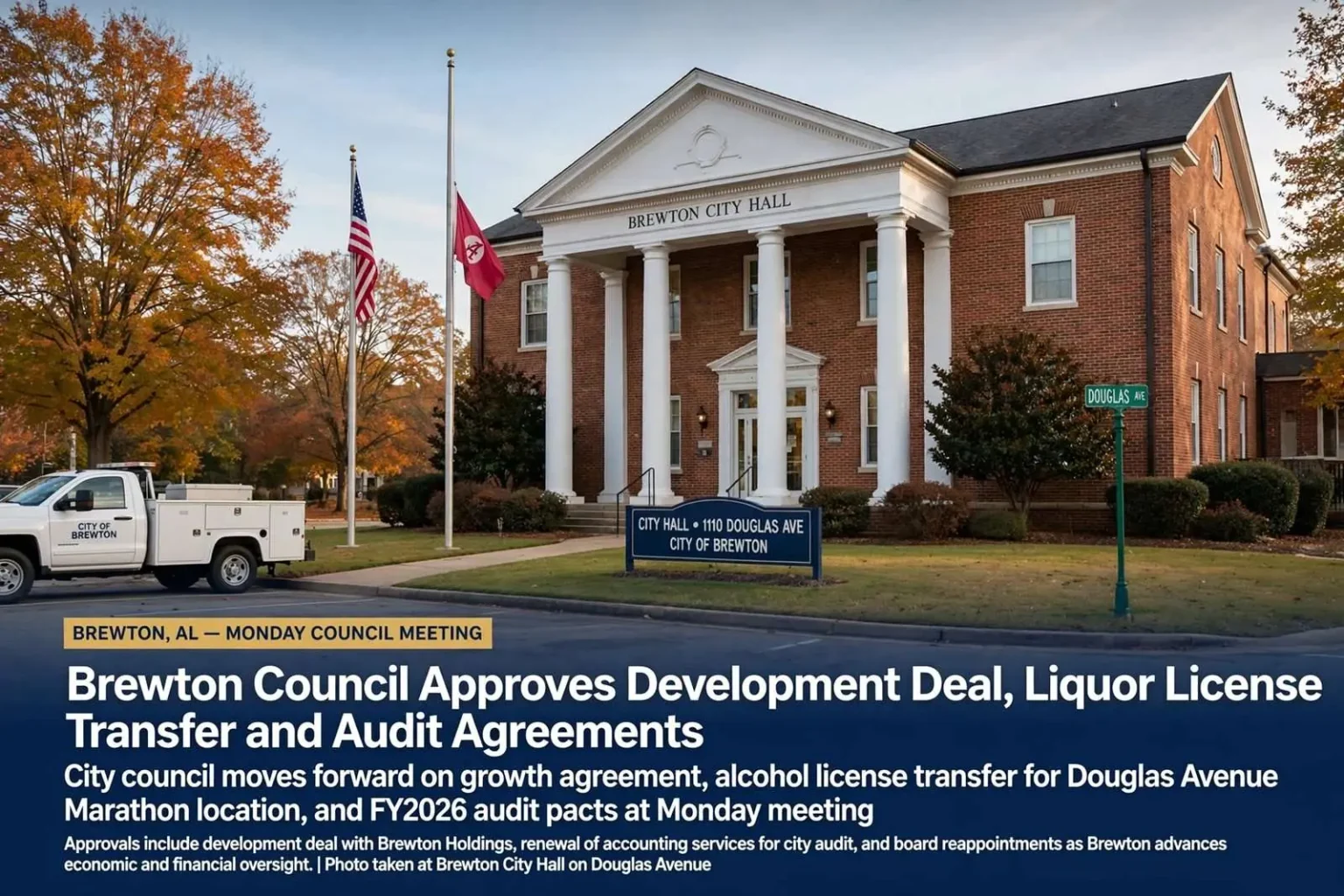
Brewton city councilors moved quickly through a packed agenda Monday, approving several agreements tied to local business growth and routine city services. The council approved a project development agreement between the city of Brewton and Brewton Holdings, Inc. The agreement clears the way for the company to pursue growth in the community as it renovates an existing location to accommodate the business and services planned by the owner.
Development agreements of this kind are a standard tool in Alabama municipal government, laying out the responsibilities of a city and a private company before renovation or construction begins. For a city of Brewton’s size, each commercial renovation carries outsized weight: an existing building brought back into productive use means construction spending, permanent jobs, added sales tax revenue and a visible sign along a main corridor that the local economy is moving.
Councilors also approved a liquor license application for new owners of the Marathon gas station location on Douglas Avenue. The business already held a liquor license, but a change in ownership required a fresh application. No opposition was raised during a public hearing held ahead of Monday’s meeting, and the council approved the license change without objection.
The transfer process exists to keep the city in control of who sells alcohol inside its limits. Alabama’s alcoholic beverage control framework requires each license holder to be vetted, and a change of ownership — even at a location where a license has been in place for years — resets that review. The public hearing attached to the application gives residents a formal opportunity to support or object before the council votes, and the absence of opposition signaled that the change of hands at the Douglas Avenue station raised no concerns among neighbors.
Other Council Business
In other action, the council approved an accounting services agreement with BMSS, LLC to prepare the city’s Fiscal Year 2026 annual audit. City Clerk Brooke Hartin said the same auditors will be handling the work, noting only the name of the accounting firm has changed; the audit will again be conducted with much of the same staff the city has worked with for roughly 20 years.
Continuity of that kind matters more in municipal auditing than it might appear. An audit firm that has examined a city’s books for two decades knows where the risks live, understands the history behind each account and can spot anomalies faster than a newcomer starting from scratch. The name change on the agreement reflects the corporate side of the accounting industry — firms merge, rebrand and reorganize — while the working relationship on the ground remains intact.
The annual audit itself is the city’s independent financial checkup. A certified public accounting firm examines Brewton’s revenues, expenditures, funds and internal controls for the fiscal year, then issues an opinion on whether the financial statements fairly present the city’s position. Alabama municipalities are required to undergo annual audits, and the results go to state oversight bodies, bondholders and citizens who want to know how their tax dollars are managed. A clean audit supports the city’s credit standing and its ability to fund projects on favorable terms.
The council also approved an engagement agreement with Warren Averett, LLC. Engagement agreements formalize the scope, timeline and fees of professional services before work begins, protecting both the city and the firm by defining exactly what is being purchased. With two accounting-related agreements on one agenda, the council effectively lined up its financial oversight for the fiscal year ahead in a single meeting.
Board Appointments and the Development Authority
The council accepted a mayoral appointment of a committee tasked with recommending a new appointment to the Brewton Development Authority, with a recommendation expected at the council’s next meeting. The two-step process — a committee screens candidates, then the council acts on the recommendation — gives board seats a measure of vetting before they reach the full council for a vote.
The Brewton Development Authority plays a central role in the city’s economic development machinery. Industrial development authorities in Alabama cities can acquire property, issue bonds and provide incentives that recruit and retain employers, operating with a longer horizon and specialized focus than a city council’s general agenda allows. Whoever fills the open seat will help steer decisions that shape Brewton’s competitiveness for new business in the years ahead, which is why the council is following the committee’s process carefully rather than filling the post on the spot.
The council approved a committee recommendation to reappoint Liz Garrett to the Brewton Library Board. The committee was headed by David Jennings, and the council’s approval was unanimous, giving Garrett another term on the board.
Library boards carry more responsibility than their quiet reputation suggests. The Brewton Public Library serves residents of all ages with lending collections, children’s programming, computer access and community meeting space, and its board oversees policy, budget guidance and the long-term direction of the institution. Reappointments reward continuity — board members who know the library’s operations can see strategic decisions through — and the unanimous vote indicated the committee’s recommendation met no resistance in the chamber.
The City Behind the Agenda
Brewton, the seat of Escambia County in south Alabama, operates under a mayor-council form of government in which the council sets policy, approves contracts and confirms appointments while the mayor’s administration carries them out. Monday’s agenda — a development agreement, a license transfer, audit engagements and board appointments — offers a representative sample of what small-city councils actually do: the work is rarely glamorous, but each item touches residents’ daily lives, from the roads businesses renovate along to the books stocked at the public library.
The speed with which the packed agenda moved reflected the preparatory work done before the meeting. Agreements are drafted and reviewed before they reach the chamber, public hearings are noticed in advance, and committees vet appointments between meetings. A council that can process a business incentive, a liquor license and a twenty-year audit relationship in one sitting is one whose committee structure is functioning as designed.
When the Council Meets
The Brewton City Council meets each second and fourth Monday of the month at 4:30 p.m. in the council chambers at Brewton City Hall on Douglas Avenue. Meetings are open to the public.
Open meetings are the public’s window into municipal government, and Alabama’s open meetings law requires that residents be able to observe the deliberations that lead to votes like Monday’s. For citizens of Brewton, the twice-monthly schedule provides regular opportunities to watch their city’s business conducted firsthand, speak during public comment periods where offered, and follow issues from committee recommendation to final vote — as the Development Authority appointment will in the weeks ahead.
Residents who want to weigh in on future items — development agreements, license applications or board appointments — can attend in person or contact city hall before an item reaches the agenda. Monday’s meeting showed both sides of that bargain: a public hearing was held and heard, and a council that encountered no opposition moved briskly through business aimed, on balance, at growth and good housekeeping for the city it governs.
What Each Agreement Means for Residents
For residents, the practical effects of Monday’s votes will show up gradually. The Brewton Holdings renovation becomes visible first, as construction activity and then a reopened or expanded business bring services and foot traffic to its part of town. The Marathon station’s license transfer means continuity at a familiar stop on Douglas Avenue, with new ownership now formally authorized to operate as its predecessor did.
The audit agreements operate on a longer horizon. When the Fiscal Year 2026 audit is delivered, it becomes the document that banks, grant agencies and state officials consult when they evaluate the city — the paperwork that underwrites everything else a city can do. Cities with consistent, clean audits spend less to borrow, qualify for more programs and face fewer surprises when leadership changes; the council’s vote to keep its longtime audit team was, in that sense, a vote for institutional stability.
The library and Development Authority appointments shape civic life at both ends of the spectrum. The library board influences the daily experience of families, students and seniors who use the facility; the Development Authority influences whether the next employer chooses Brewton or a neighboring city. Small cities live on decisions like these, made by volunteers whose names rarely appear in headlines.
The Value of Continuity in City Hall
A recurring theme ran through Monday’s agenda: continuity. The audit relationship spans roughly two decades under a firm that has changed names but not people. A library board member won another term on a unanimous vote. A committee process, rather than an ad hoc choice, will produce the Development Authority recommendation. Cities that preserve institutional memory in these roles tend to make steadier decisions, because the people involved remember what was tried before and why.
That steadiness is an asset in a competitive environment. South Alabama’s small cities compete for the same industries, the same grant programs and the same retail investment, and the ones that win are usually those whose governments can move quickly on agreements like the one approved Monday — because the committees, audits and boards underneath were already in order.
The council’s next meeting, on the schedule announced Monday, will bring the Development Authority recommendation forward for action, giving residents the chance to watch the appointment process complete itself in public, as the city’s open-meeting practice requires.