Brewton teen charged with felony computer tampering in grade-changing scandal
An 18-year-old is charged with felony computer tampering after allegedly changing grades at W.S. Neal High School in East Brewton, Alabama.
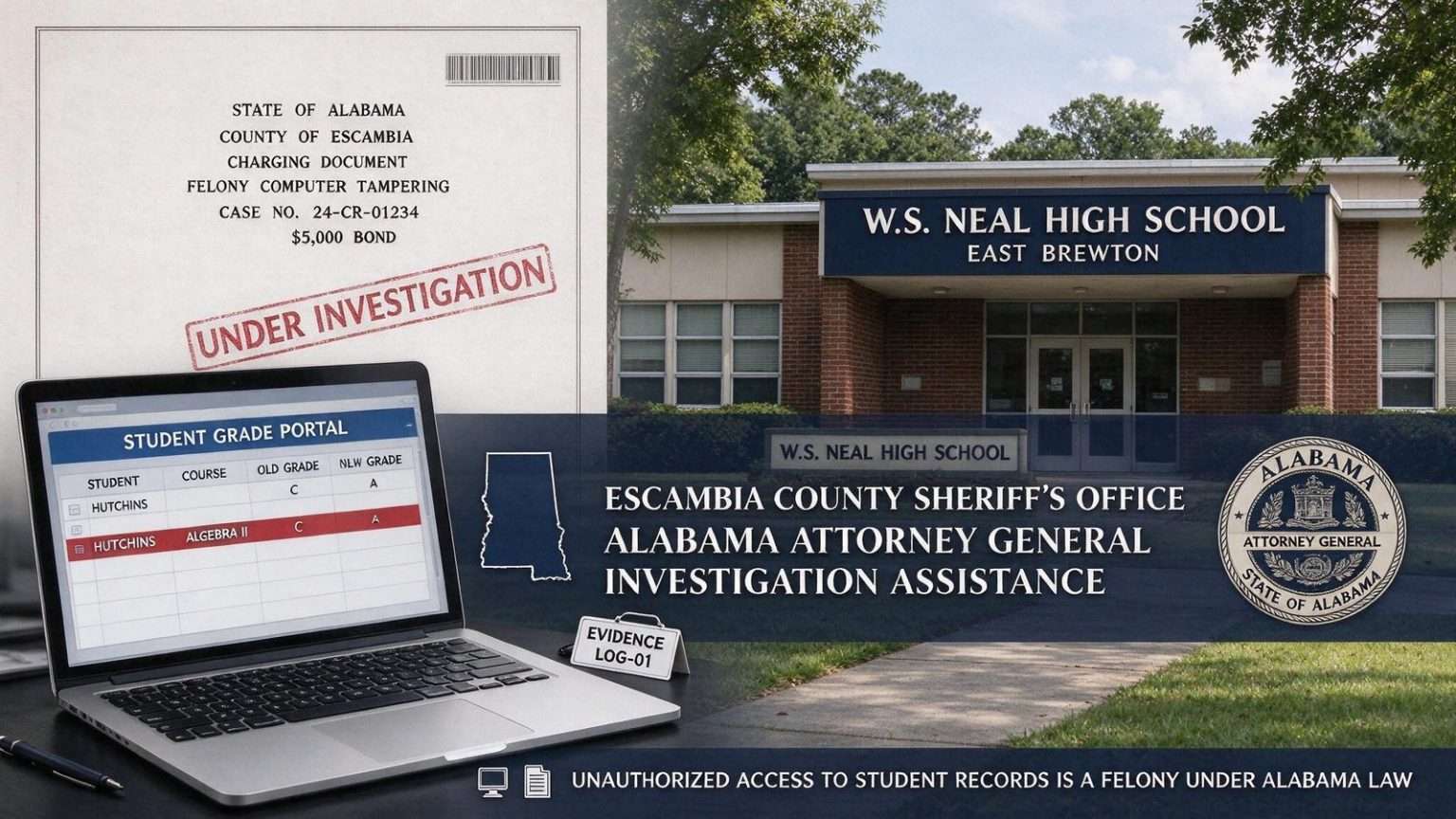
A teenager has been arrested and charged with felony computer tampering in connection with a grade-changing scheme at a Brewton-area high school. According to the Escambia County Sheriff’s Office, 18-year-old Matthew Hutchins is accused of using a computer to alter grades for himself and possibly other students at W.S. Neal High School in East Brewton. The Alabama Attorney General’s Office was brought in to assist with the investigation. The teenager was released from the Escambia County jail after posting a $5,000 bond. The case remains under investigation.
What deputies say happened
The investigation began after officials at W.S. Neal High School raised concerns about irregularities in student records. Sheriff’s investigators traced the changes to computer access at the school and identified Matthew Hutchins, an 18-year-old student, as the person accused of altering the grades. According to the Escambia County Sheriff’s Office, the tampering may have benefited other students in addition to Hutchins himself, and determining the full scope of the scheme became a central question of the ongoing inquiry.
Computer tampering is a felony under Alabama law, covering the unauthorized alteration, deletion or interference with computer data or systems. The charge reflects a legal reality that school districts confront more often than the public realizes: student information systems, grading platforms and attendance databases are computer networks, and unauthorized access to them is treated the same as intrusion into any other system, regardless of the motive behind it.
A state agency joins the case
The involvement of the Alabama Attorney General’s Office underscored the seriousness with which the case was treated. The attorney general’s office maintains specialized units that assist local law enforcement with computer crimes and public corruption matters, providing forensic expertise that a small county sheriff’s office may not have on staff. In a case built on digital evidence — server logs, access records and audit trails from a school’s grading system — that assistance can determine how complete the picture of the intrusion becomes.
For the Escambia County school system, cooperation with the investigation meant preserving records and reviewing how the tampering occurred. Questions a district must answer in such cases include whether the student exploited a shared password, an unattended computer, or a weakness in the system’s access controls, and whether the district’s practices need to change in response.
The school and its community
Brewton and East Brewton share the region’s paper-mill heritage and its close-knit character, where news of a student’s arrest travels quickly. A grade-changing scandal at the school touched not just one student’s record but the credibility of the institution’s academic records, which matter for scholarships, college admissions and the standing of every transcript the school issues.
School officials faced the delicate task of identifying which grades had been altered and restoring them, since any illegitimate change affects the fairness of class rankings and honor rolls. The statement that other students may have been implicated made that audit all the more consequential.
The charge and its consequences
Hutchins was booked into the Escambia County jail and released after posting a $5,000 bond, an amount consistent with the nonviolent nature of the alleged offense. A felony charge of computer tampering carries potential prison time under Alabama’s sentencing guidelines, though outcomes in cases involving young defendants and school-based intrusions vary widely, from diversion programs and probation to more severe penalties depending on the circumstances and the defendant’s record.
Because the case remained under investigation at the time of the arrest, the full accounting of what happened at W.S. Neal High School — how many grades were changed, whether other students were involved, and what penalties would ultimately follow — was still to come. What was already clear was the message the case sent to students across the region: altering school records is not a prank or a victimless stunt, but a felony that brings sheriff’s deputies, state investigators and a courtroom into a teenager’s life.
How school computer crimes are investigated
Cases of this kind begin with an audit trail. Student information systems record who logged in, when, and what was changed, and school technology staff can usually pinpoint the accounts and terminals involved. Sheriff’s investigators then work backward from those records to the person sitting at the keyboard. In the W.S. Neal case, that work produced the accusation against Hutchins and the possibility that additional students benefited from altered grades.
The Alabama Attorney General’s Office assistance was significant for its forensic depth. Analyzing a school’s grading network requires expertise in log interpretation, file system analysis and the mechanics of the software involved, and state computer crime specialists bring experience from cases across Alabama. Their findings typically shape whether the case ends in a plea, a trial, or a resolution short of prosecution.
What other schools have learned
Grade-changing incidents have surfaced at schools across the country for decades, and the lessons are consistent. Districts that reviewed their systems after such episodes moved to require strong individual passwords, automatic logging of grade changes, alerts when records are modified outside normal business hours, and prompt audits whenever discrepancies appear. The human element matters as much as the software: shared or guessable passwords and unattended logged-in computers remain the most common points of entry.
For students, the consequences extend beyond the criminal charge. Suspension or expulsion typically follows, and a felony record can shadow college applications, financial aid eligibility and employment long after any court case concludes. The gravity of those outcomes is precisely why prosecutors treat school intrusions as more than adolescent mischief, and why the felony charge in Escambia County was not unexpected.
Awaiting the full record
At the time of the arrest, the Escambia County Sheriff’s Office described the case as under investigation, leaving open the questions that matter most to the school and the community: how many grades were changed, how long the scheme had operated, and whether other students would face consequences. Those answers would come only as the forensic review and interviews proceeded.
What the arrest already established was the framework of the case: an 18-year-old student at W.S. Neal High School in East Brewton, a felony computer tampering charge, a $5,000 bond, and a state agency assisting local deputies. For a small Escambia County community unaccustomed to seeing its high school in the news for this reason, the case served as a pointed reminder that school records are protected by criminal law — and that the protection is enforced.
The Escambia County context
Escambia County, Alabama, sits in the state’s southeastern corner along the Florida line, a rural county where Brewton serves as the county seat and East Brewton is its smaller industrial neighbor. The sheriff’s office polices the unincorporated areas and supports municipal departments, and major cases — especially ones involving digital evidence — strain a small agency’s resources. That reality explains the practical logic of inviting the attorney general’s office into the case rather than attempting the forensic work alone.
The county’s schools operate under the Escambia County school system, with W.S. Neal High School carrying the name of a longtime local educator and serving as the centerpiece of East Brewton community life. Friday football games, honor society ceremonies and scholarship signings are the stuff of local identity, which is why a scandal touching the integrity of grades resonated beyond the students directly involved.
Bonds, bookings and the process ahead
The booking and release process that followed the arrest is standard procedure. After being taken to the Escambia County jail, Hutchins appeared before a judicial officer who set bond, and the $5,000 amount secured his release pending further proceedings. Bond in a nonviolent felony case is designed to ensure appearance at future hearings rather than to punish, and release conditions typically include requirements to remain in contact with the court.
From there, the case would move through the standard stages: review by the district attorney, a preliminary hearing or grand jury review, and potentially arraignment and trial in circuit court. Along the way, defense counsel would examine how investigators connected the computer activity to the defendant, the strength of the forensic evidence, and whether any statements or searches in the case complied with constitutional requirements.
The larger lesson for schools
The Brewton-area case joined a long line of incidents that have prompted school systems everywhere to take their digital infrastructure seriously. Grades are the currency of a student’s academic life, and their integrity underwrites everything from class rank to athletic eligibility to college admission. When that integrity is compromised — by a student, an outsider, or anyone else — the damage spreads across every honest transcript the school has issued.
For administrators at W.S. Neal High School, the investigation’s findings would determine how the school repaired its records and tightened its systems. For students watching the case unfold, it demonstrated that the digital version of changing an answer on a teacher’s gradebook is a felony investigated by the sheriff and the state attorney general — a very different proposition from the pranks of an earlier era, with consequences to match.