The Brick Pit Is the Best Barbecue on Old Shell Road. That Is Not the Same as Good.
Our critic found the pulled pork dry and the ribs tough at Mobile's best-known barbecue joint, and made an argument that the real standard lies somewhere up Interstate 65.
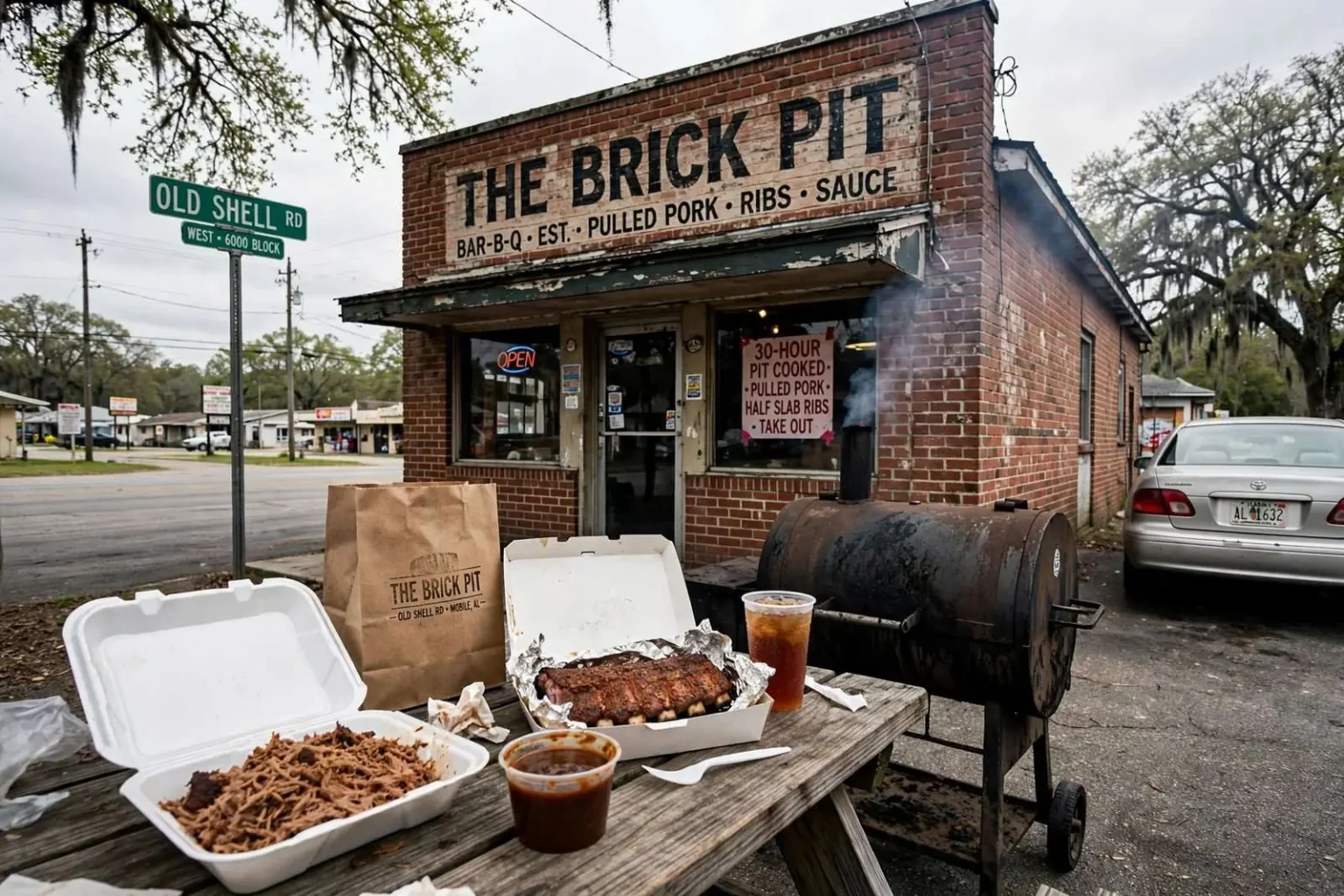
The Brick Pit is the best barbecue restaurant on Old Shell Road, our anonymous dining correspondent declared in the spring of 2008. Any diner who thinks otherwise, he added, is having a bad dream. It is a sentence that reads like praise until you notice how carefully it has been fenced in. Best on Old Shell Road is not the same as best in Mobile, or best on the Gulf Coast, or even reliably good, and the review that follows makes those distinctions with the dry patience of a man who ordered everything the pit advertises and liked almost none of it.
Old Shell Road itself is one of Mobile’s oldest and most familiar east-west corridors, running from the heart of the city west toward the suburbs, lined for much of its length with neighborhood businesses that have served the same blocks for decades. A barbecue pit with a loyal address on that road starts with an advantage most restaurants would envy: it is woven into the daily geography of thousands of Mobile drivers. What our correspondent set out to test was whether the food deserved the loyalty the location earns.
Ordering both, finishing neither
Intent on sampling the two things a barbecue restaurant must get right, our critic ordered the Sourdough Brick Bites — the pulled pork — and a half slab of ribs. The portions were ample. Either would have been a meal in itself, and he managed the Brick Bites and half the ribs, carrying the rest home to the refrigerator. No one could accuse the kitchen of stinginess; the question the review poses is whether quantity can carry a plate when the quality does not.
The pulled pork was tasty but quite dry, and somewhat tough. It had been left on the pit too long. If the meat really is cooked for up to 30 hours as advertised, our critic suggested, it might come off the fire a little earlier. He got a good quantity of both inside and outside meat, the bark and the interior that pitmasters prize as the test of a proper shoulder, and all of it, he wrote, was tough and dry. That is a notable failure for a house that makes its cooking time a selling point, since the whole promise of a long, slow fire is meat that yields without a fight.
Any diner who has stood at a Alabama counter knows the two schools of pulled pork that coexist across the state. One chops it fine and dresses it heavily, letting the sauce do the work; the other pulls it in substantial pieces and expects the smoke and the seasoning to stand on their own. The Brick Bites belong visibly to the second school, which is precisely why the dryness mattered so much in the tasting. Dressed pork can hide a hard morning at the pit. Undressed pork cannot.
The ribs
The ribs fared no better. They were, in the critic’s phrase, worthy of skipping — tough and dry as well, and hard enough to eat that he counted himself fortunate to still have all his natural teeth. For a plate that in most barbecue houses costs more than anything else on the menu, that is a serious verdict, and it is delivered without anger, almost with amusement. The half slab he could not finish went home in a box, and nothing in the review suggests he was eager to rehearse the argument the next day.
Strange as it may seem, he noted, the ribs at Sonny’s are better. That is a comparison with real weight behind it. Sonny’s is a Florida-rooted chain with locations across the Panhandle and south Alabama, the kind of place a barbecue purist passes over on the way to a standalone pit. When a reviewer tells readers that the chain down the road out-cooks the neighborhood name on its own signature dish, the message to the kitchen is unmistakable: consistency, not character, is what was missing.
The sauce
Our critic declined to pretend to expertise he does not have. He is not sophisticated enough, he said, to break down a barbecue sauce and explain precisely why it failed him. He knows only that it did. The consistency, he offered, is a little too thick. He does not care for a thin sauce either, but this one is a tad heavy — and the taste, he concluded, is just not how Alabama sauce should taste. It is not a flavor he would return for.
That last sentence is the most damning thing in the review, more so than either tough pork judgment. Alabama sits in the middle of the nation’s sauce map, and its natives are tolerant of wide differences. The vinegar-and-pepper traditions of the eastern Carolinas pass through on their way west, Memphis brings its sweet and tomato-forward pans, Texas leans toward thin, mop-style heat, and the northern part of Alabama produced the state’s own signature contribution, the mayonnaise-based white sauce that dresses smoked chicken across the Tennessee Valley. Given all of that, a Mobile diner has absorbed a broad range of flavors and can forgive almost any of them. What he cannot forgive is a sauce that tastes like none of them — heavy where it should cut, muted where it should announce itself, and, in the end, forgettable.
Flavor is the harder issue. A house sauce is the one item on a barbecue menu that cannot be sourced or rationalized, because it is the item the pit makes entirely from its own recipe. When the critic writes that it is simply not how Alabama sauce should taste, he is telling the owners that the one thing that is uniquely theirs is the one thing not working.
Where the standard actually lives
Much of the review is given over not to the Brick Pit but to the places our critic wishes he had been eating instead — a habit of the traveling diner, and a reasonably useful road map for anyone driving north out of Mobile. For pulled pork, the review’s direction of travel points up the state’s spine, toward the barbecue belts of the Black Belt region and the Tennessee Valley, where whole-hog and shoulder traditions run deeper than any single restaurant and where a pit that dries its meat does not survive the competition.
That geography lesson is worth spelling out, because it frames what the Brick Pit is up against. Alabama’s most storied barbecue culture sits hours from Mobile, centered on Decatur, Huntsville, Birmingham and the small towns in between, where pit rooms have been running continuously for generations and where the standard of tenderness is set by crowds who would simply stop coming if it slipped. A Mobile pit competes, in effect, against the memory of those places every time a well-traveled diner sits down. Our correspondent clearly carried that memory with him, and the Brick Pit did not measure up to it.
Within the city itself, the review implies, the field is thinner, and that is the trap of the opening sentence. A restaurant can be the best on its corridor and still not be worth a detour. Old Shell Road diners who want barbecue will keep pulling into the Brick Pit’s lot because it is there, and because the portions are honest and the price is fair for what lands on the tray. The correspondent’s point is narrower and sharper: for the money and the drive, there are places — some of them chains, which he seems to find almost embarrassing to admit — where the same order comes off the pit the way it should.
What the review asks of the pit
Nothing in the spring 2008 review is hostile, and that is what makes it useful reading for the restaurant and its regulars alike. The critic liked the size of the portions, worked through both meats carefully, gave the sauce his honest amateur’s assessment, and left with a takeout box rather than a grievance. His complaints are fixable in an afternoon: pull the pork off the fire sooner, let the ribs spend less time over the heat or more time wrapped, and take the sauce back to the kitchen for a conversation about balance.
Barbecue is unforgiving business in exactly the way the review demonstrates. A pit can advertise 30-hour cooking and still serve dry meat the day the schedule runs long, and no amount of signage rescues the plate. The Brick Pit’s saving graces, as the review records them, are location, portion and price — real advantages, but the kind that keep a restaurant afloat rather than make it a destination. Until the meat and the sauce catch up, the reviewer’s verdict stands as both compliment and warning: the best barbecue on Old Shell Road, and that is not the same as good.
A note on the critic’s method
Readers of the review will notice that our correspondent does what careful diners do: he orders the benchmarks, eats them side by side, and separates what a restaurant controls from what it does not. He cannot judge the dining room, the parking, or the pace of service from a single visit, and he does not try. He judges the three things that travel home in the box — pork, ribs and sauce — and he is explicit about the limits of his own palate when he reaches the sauce, refusing to invent a chemistry lesson he cannot deliver.
That honesty is part of why the review has held up as a small piece of Mobile food writing. It does not pretend the Brick Pit is a disaster, and it does not soften the verdict to spare feelings. It says the pork was tasty but dry, the ribs were tough, the sauce was wrong for Alabama, and the portions were generous, and it lets the reader decide how to weigh those facts against a craving for smoked meat on a weekday lunch run.
For diners, the practical guidance survives the years intact. Go hungry and expect to carry food home, because the plates are large. Order with the understanding that the pulled pork is the safer bet of the two meats, if only because it was the one the critic called tasty before cataloguing its faults. And taste the sauce before committing to it on the whole tray, because it is the item most likely to divide the table.
The broader Mobile barbecue picture
The review also captures a moment in Mobile dining. In 2008 the city’s barbecue landscape was a patchwork of longtime neighborhood pits, small chains spreading up from Florida, and newer smokehouses testing whether the growing suburbs west of the city would support serious cooking. Old Shell Road, with its steady traffic and its mix of older neighborhoods and student rentals near the university area, was natural territory for a barbecue house — high visibility, loyal regulars, and a lunch crowd that values speed and portion size.
Into that market, the Brick Pit’s pitch was authenticity by volume: hours of cooking, inside and outside meat, a half slab on demand. The review’s complaint is not that the pitch was false but that the execution fell short of it, and that is a more hopeful criticism than the opposite. A restaurant pretending to be something it is not usually cannot be argued into changing. A restaurant that advertises 30 hours of pit time and serves dry pork on a given day is a scheduling problem, and scheduling problems can be fixed.
Whether the kitchen ever took the advice is a question the 2008 review does not answer. What it leaves behind is a standard against which any Mobile barbecue can be measured: meat that yields, sauce that belongs to its region, ribs worth their premium, and portions that need no apology. The Brick Pit, on the evidence of that spring visit, had the fourth item and was searching for the other three. For a neighborhood pit with decades of Old Shell Road traffic passing its door, that is a starting point, not an epitaph — and the reviewer, for all his dry wit, plainly hoped to come back and find it.