Brookley Field Lands the EADS Tanker Plant and Its Promise of 1,000 Jobs
Local lawmakers said Mobile's Brookley Field was about to be named the winner of EADS North America's nationwide search for a tanker program site, an aerospace prize starting with 200 engineers and holding the promise of 1,000 jobs.
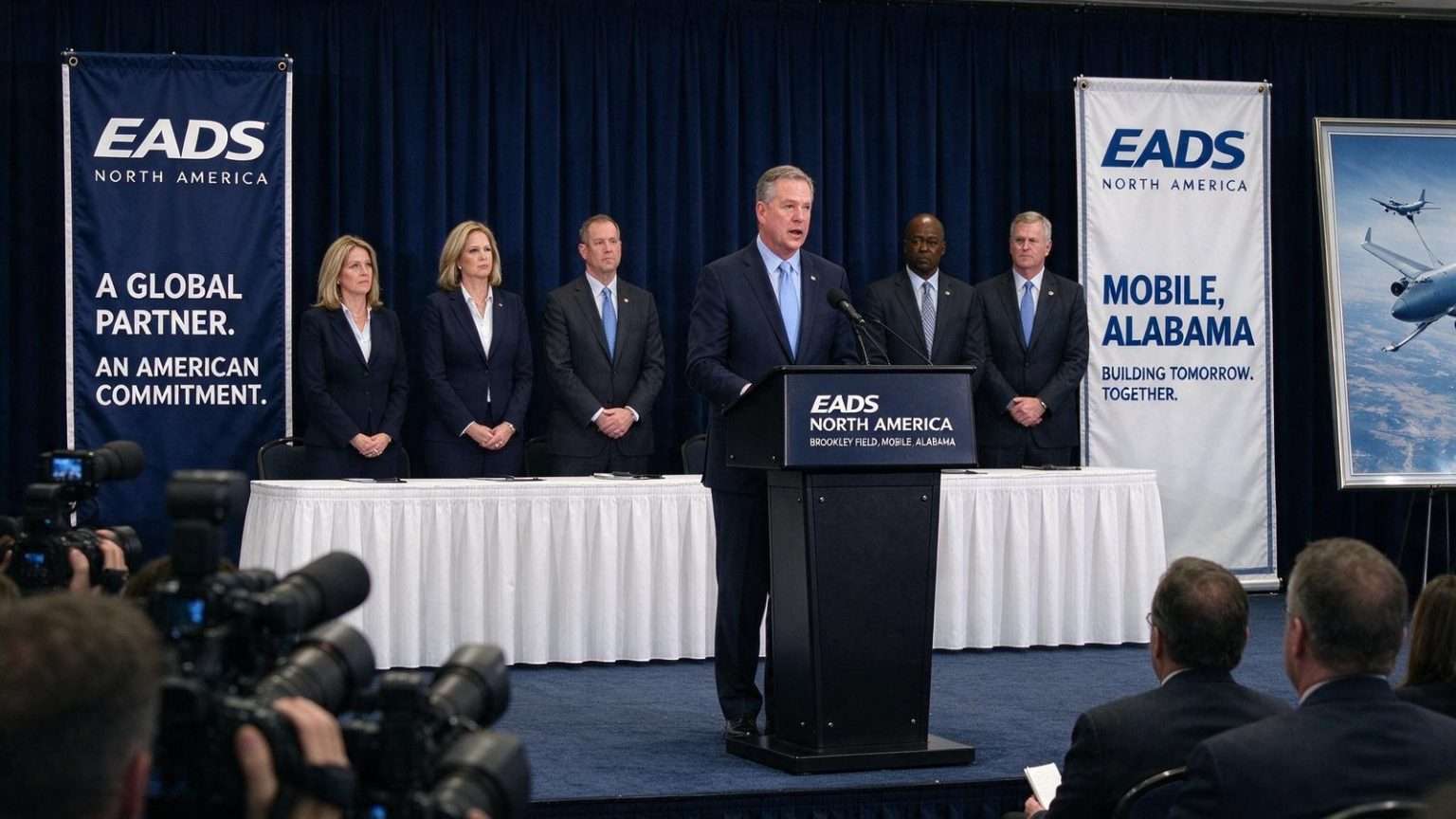
Mobile’s Brookley Field was poised to be named the winner of EADS North America’s nationwide search for a home for its aerial-refueling tanker program, a coup that local lawmakers said had been confirmed to them through the governor’s office.
The company planned to make the announcement Wednesday morning at the National Press Club in Washington, with a local celebration to follow at 5 p.m. at the Arthur R. Outlaw Convention Center in downtown Mobile.
The decision, if it unfolded as expected, would place Mobile at the center of EADS North America’s industrial ambitions for the KC-330, the advanced tanker the company was offering the U.S. Air Force as a replacement for its aging KC-135 refueling fleet.
The prize at stake was one of the largest military procurement programs in the country. The Air Force’s KC-135s, workhorses of aerial refueling since the 1950s, were aging toward the end of their service lives, and every American combat air operation — from fighter patrols to cargo lifts — depends on tankers to keep aircraft aloft. The contract to build their replacement promised decades of production work, and the city that hosted the assembly line would anchor an industrial program measured in billions of dollars and generations of employment.
Beating out three states
Brookley emerged from a field that had been narrowed to finalists in four states. The other contenders were Melbourne International Airport in Florida, Stennis International Airport in Kiln, Mississippi, and Charleston International Airport in North Charleston, South Carolina.
EADS had launched the search in January 2005 with a request for information sent to all 50 states; more than 70 candidate locations from 32 states responded, and the process was managed on the company’s behalf by the Dallas real estate firm The Staubach Company.
The sheer breadth of the competition underscored how seriously states court aerospace investment. Site consultants running such searches weigh a familiar stack of factors — a large airfield with runway capacity for widebody aircraft, deep-water or barge access for moving oversized assemblies, available land adjacent to the field, a trained or trainable labor pool, and the incentive packages state and local governments assemble. That Mobile advanced from more than seventy candidates to the final four, alongside established competitors on the Gulf and Atlantic coasts, marked the judgment of the company’s site team on what the Brookley complex could offer against every one of those criteria.
Brookley’s own strengths told the story. The field’s long runways, its waterfront position on Mobile Bay with channel access to the Gulf, its thousands of acres of developable land and its existing aerospace tenant base — a legacy of the Air Force logistics operation that had closed there in the 1960s — gave the site the combination of capability and capacity the search demanded. What the base closure had taken away, the industrial park built in its place had spent decades waiting to restore.
Engineers first, an assembly line to follow
Under the plan, the Brookley operation would begin in 2006 with an aircraft engineering center employing roughly 200 aerospace engineers. The far larger prize, a plant employing about 1,000 workers assembling the tankers, hinged on a contest still to be decided: EADS would have to beat Boeing for the Air Force contract itself.
The company had already pledged to establish assembly and support facilities in the United States and to team with American industrial partners.
The two-stage structure shaped how the announcement should be read. The engineering center was committed — a facility where design work on the KC-330 would be performed by American engineers on American soil — while the assembly line remained contingent on the military program it existed to serve. For Mobile, the sequence still represented an immediate gain: two hundred engineering positions arriving within a year, in a city where aerospace employment had been more a memory than an industry for four decades.
A fight in Washington
Even a favorable Wednesday announcement would not settle matters. EADS would have to navigate Congress, where protectionist sentiment had been building to Boeing’s potential benefit and where the argument over building an American military aircraft with a European-based partner was only beginning.
The political terrain was as demanding as the technical one. The tanker contract touched every congressional district with an aerospace plant, a military installation or a defense supplier, and the prospect of an Air Force tanker built by the parent of Airbus — Boeing’s chief rival in the commercial market — guaranteed a fight on Capitol Hill regardless of what the acquisition officials concluded on the merits. Lawmakers from Washington State and Kansas, where Boeing’s commercial work was concentrated, had already framed the program as a question of American jobs; the counterargument, that EADS would build the aircraft in America with American workers and partners, was the case Mobile’s win was designed to make visible.
The company said it had accelerated its site-selection timetable specifically to line up its industrial plans with the Air Force’s own acquisition schedule. The distinction mattered for a region weighing how much to celebrate. Winning the site competition guaranteed the engineering center; winning the tanker contract itself, and with it the assembly line and the thousand jobs, was a separate battle to be waged in Washington over the months and years ahead.
Local leaders were careful to frame the announcement as a beginning rather than a finish line.
That discipline reflected experience. Mobile had chased large industrial prospects before and watched them land elsewhere, and civic leaders had learned to distinguish between an announcement and a ribbon-cutting. The celebration planned for the Outlaw Convention Center was genuine, but the language accompanying it — a first step, a foundation, a beginning — was the vocabulary of a community that understood the tanker contract still had to be won on its merits.
What it meant for Mobile
EADS North America described itself as the North American arm of EADS, then among the largest aerospace and defense companies in the world, with operating companies scattered across more than a dozen states and, by its own accounting, a multibillion-dollar annual contribution to the U.S. economy.
For a city that had watched Brookley evolve from a shuttered Air Force base into an industrial complex hunting for anchor tenants, the decision promised something rare: a marquee aerospace name, a pipeline of skilled engineering jobs and the prospect, however contingent, of a full assembly line on the bay.
The anchor-tenant logic is what made the announcement more than a jobs headline. Aerospace suppliers site their operations near their customers, and a manufacturer committed to Mobile would draw a constellation of parts plants, tooling shops and service firms into the region around it. The engineering center alone would arrive within a year. The bigger promise would depend on a tanker competition, and a political battle, that lay ahead.
From base closure to aerospace ambition
The story of Brookley Field is inseparable from the story of Mobile’s economic identity. For decades the field had been home to a major Air Force logistics operation, an installation that employed thousands and made aviation part of the city’s daily fabric. When the Pentagon ordered the base closed, the community absorbed one of the region’s sharpest economic losses — and then spent the following decades converting the installation into the industrial airport complex that bore its old name.
That conversion is what made the EADS search win possible at all. A site with runways, waterfront access, industrial buildings and an airport operator experienced in hosting aviation businesses does not appear quickly; Brookley had spent years marketing itself to aerospace tenants large and small, building the case that south Alabama could support flight-line industry at scale. Winning a national competition run on behalf of one of the world’s largest aerospace companies was the strongest external validation that strategy had received.
The human arithmetic of the announcement
The numbers attached to the plan — two hundred engineers within a year, a thousand assembly workers if the contract followed — carried different meanings for different audiences. For the region’s engineers, many of whom had left for Huntsville, Atlanta or the coasts to find aerospace work, the announcement imagined a career path that kept them on Mobile Bay. For the region’s technical workers and tradespeople, the assembly-line prospect represented the kind of steady, well-paid industrial employment that the Gulf Coast had historically associated with shipbuilding rather than aviation.
The educational institutions of the region would feel the pull as well. Engineering faculties, community college technical programs and the area’s growing network of aerospace training providers would all be asked to feed a pipeline toward Brookley — a demand signal that, over time, reshapes what local schools teach and what local students believe is possible in their own hometown.
The contest ahead
Nothing in the announcement changed the fundamentals of the decision that mattered most. The Air Force still had to choose its tanker; Congress still had to fund it; Boeing, with decades of tanker heritage and a formidable lobbying operation, still had to be beaten. Mobile’s site victory positioned the city to capture the work if the program survived Washington — and gave the company’s American-partnership argument a concrete place where the aircraft would actually be built.
That is how the day belonged to both celebration and caution. At the National Press Club in the morning, the company was expected to make Mobile’s name part of the national aerospace conversation; at the Outlaw Convention Center that evening, the city would celebrate the same fact in its own voice. Between the two stood the tanker competition itself — the engineering center already won, the assembly line still to be earned, and a community that had learned, across the years since Brookley’s flag came down, exactly how to wait for the next one.