Calcedeaver Elementary Hosts 18th Annual Culture Fest Honoring MOWA Choctaw Heritage
Calcedeaver Elementary in Mount Vernon hosted its 18th annual Culture Fest, where students showcased MOWA Choctaw drumming, dance and heritage.
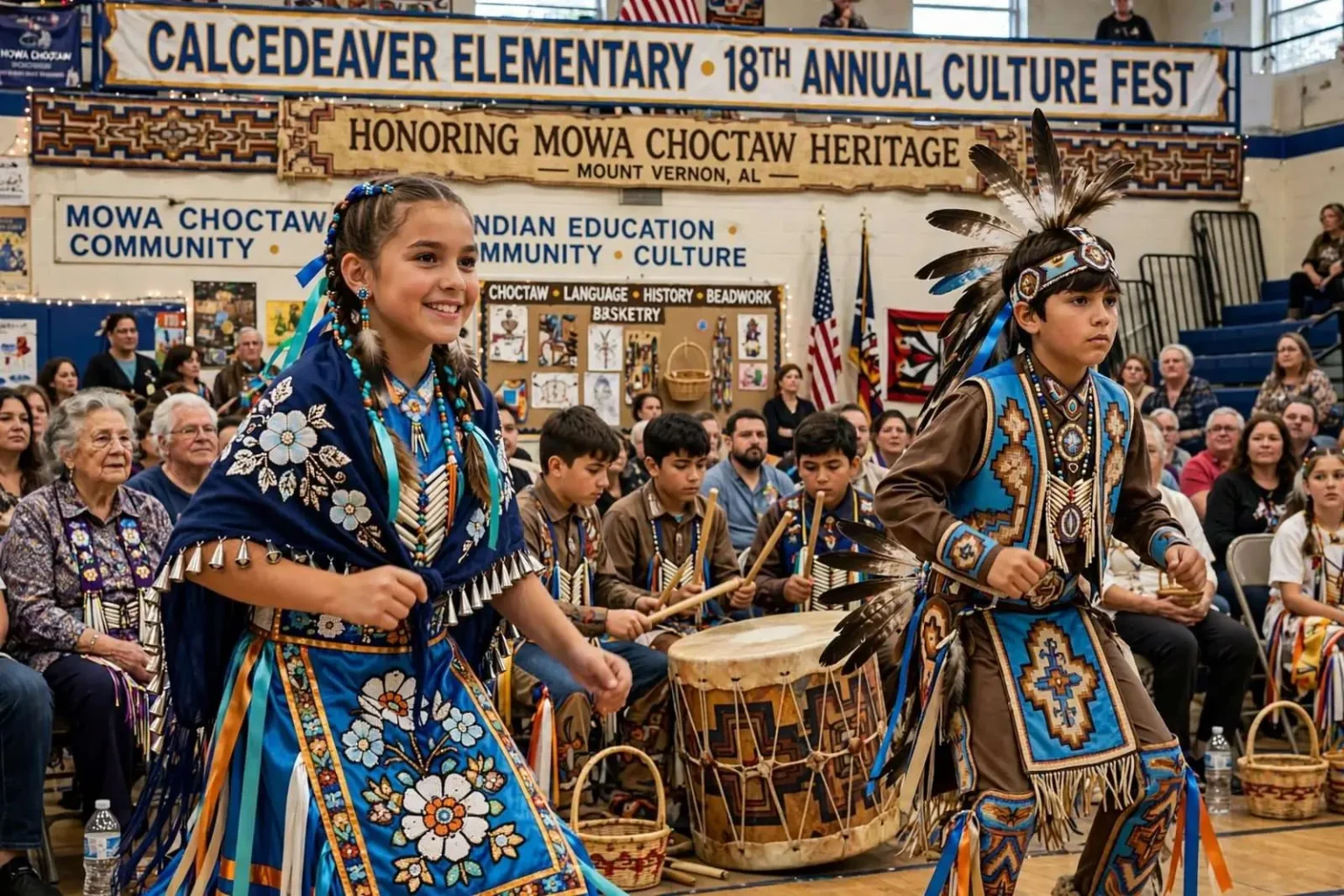
Drums and traditional dance filled Calcedeaver Elementary School on Friday as the Mount Vernon school hosted its 18th annual Culture Fest, celebrating the heritage of the MOWA Choctaw Indians. The festival transformed the campus into a gathering ground for families, students and community members from across north Mobile County, all drawn to one of the region’s most distinctive school celebrations.
More than half of Calcedeaver’s students are MOWA Choctaw, a heritage that shapes the school’s identity as deeply as any subject on its curriculum. Every student at the school studies Indian Education, and Culture Fest — known as the “Calcedeaver Pow Wow” — gives them a chance to show their parents and the wider community what they’ve learned throughout the year. The festival is the culmination of months of study and practice, the day when the classroom work becomes performance.
The boys learn traditional drumming, while boys and girls alike study traditional dancing. That structure means no student at Calcedeaver is a spectator to the school’s cultural life: every child has a role in the festival, whether at the drum, on the dance floor, or in the supporting work of hosting a celebration that draws the wider community through the school’s doors each year.
Lead dancers take the floor
This year’s celebration featured Annslee Snow as head lady — the lead female dancer — and Delsyn Weaver as head man, the lead male dancer. In pow wow tradition, the head dancers set the style and the standard for the rest of the floor, opening the dance and leading the grand entries that formally open the event. For students, being named head lady or head man is an honor earned through the year’s practice, and their selection places them at the center of a tradition their school has staged for nearly two decades.
Mobile County Public Schools shared photos from the event, calling it a fun day honoring the traditions of the MOWA Choctaw people. The images from the festival showed the color and motion of the dance floor, the drum at the center of the gathering, and a gymnasium and grounds full of families watching children perform what they have spent the year learning.
The MOWA Choctaw and north Mobile County
The MOWA Choctaw take their name from the Mobile and Washington counties where their community has endured for generations — descendants of Choctaw people who remained in the region after the removal era of the 1830s, when most of the Choctaw Nation was relocated west. The community maintained its identity through the decades that followed, and it is today a state-recognized tribe whose center of gravity sits in and around Mount Vernon, Citronelle and the rural stretches of north Mobile County and southwest Washington County.
Calcedeaver Elementary sits at the heart of that community. Serving students in the Mount Vernon area, the school draws heavily from MOWA Choctaw families, and its Indian Education program exists precisely because the school system recognized that the heritage of its students was worth teaching as systematically as any other subject. Over the years the program has made Calcedeaver a model among Mobile County schools for cultural education rooted in the community it serves.
What the students learn
The Indian Education curriculum at Calcedeaver reaches beyond the dance floor. Students study the history of the Choctaw people and their endurance in this corner of Alabama, the language elements and stories that carry the culture, and the craft traditions — beadwork, basketry, regalia — that connect a modern classroom to generations of ancestors. The drumming and dancing featured at Culture Fest are the visible center of that study, but they rest on a year’s worth of broader learning about identity, history and community.
Traditional drumming, taught to the school’s boys, and the traditional dancing learned by both boys and girls carry specific meanings within pow wow practice. The drum is regarded as the heartbeat of the gathering, and dancers move in styles whose footwork, regalia and songs have been passed down through generations. When Calcedeaver’s students perform, they are not putting on a show in the loose sense — they are taking their places in a living tradition, under the eyes of elders and family members for whom that tradition is home.
Eighteen years of the Calcedeaver Pow Wow
The festival has become one of north Mobile County’s most treasured annual school traditions since its founding nearly two decades ago. Eighteen annual festivals mean a generation of Calcedeaver students has now grown up with the event as a fixture of the school year — students who performed as head dancers at fourteen or fifteen now watching younger siblings and cousins take the floor, and parents remembering their own years in the celebration.
That continuity is what distinguishes Culture Fest from a one-time assembly. It is a scheduled, anticipated part of life in Mount Vernon, a day when the school’s doors open to grandparents, neighbors and visitors from across the county, and when the MOWA Choctaw heritage that fills the school’s classrooms is displayed with pride for everyone who comes.
What the day means for the community
For the MOWA Choctaw community, the school’s festival is more than a celebration — it is evidence of a heritage sustained and passed on. Communities survive displacement and hardship by teaching their children, and a public school where more than half the students are MOWA Choctaw, where every child studies Indian Education, and where the whole county is invited each spring to watch those children dance is a rare and concrete expression of that continuity.
Mobile County Public Schools’ sharing of photos from the day carried that message beyond Mount Vernon, showing the rest of the district — the state’s largest school system — a tradition most of its schools have no equivalent of. The 18th annual Culture Fest ended as its predecessors did: with drums and dance filling the school, with Annslee Snow and Delsyn Weaver leading the floor as head lady and head man, and with a community’s heritage on display in the hands of its youngest generation — a tradition, the school and the community intend, that will fill Calcedeaver’s campus for decades to come.
A school day built around heritage
The Friday festival requires weeks of preparation that visitors never see. Teachers fold the cultural curriculum into the spring term as the date approaches; students rehearse the dances and drum pieces they will perform; and the school’s staff and volunteers arrange the floor, the seating and the flow of a gathering that fills the campus with an audience far larger than an ordinary school day. The logistics fall on the same community that will fill the seats, which is part of what makes the event feel less like a school function and more like a family reunion staged in a gymnasium.
The morning of the festival, students arrive in regalia and festival dress, and the school’s usual schedule gives way to the performances. For the youngest grades, it is often their first time on the floor; for the fifth and sixth graders, it is the year they take the most prominent roles. The progression through the grades is part of the design — a student who enters Calcedeaver at five years old will have performed at many Culture Fests before leaving for middle school, with the tradition layered on year after year like the beadwork on a dancer’s regalia.
The wider role of Indian Education
Calcedeaver’s Indian Education program also serves a purpose beyond cultural pride. Educators have long observed that students perform better when the school visibly values who they are, and at a school where the majority of students share a heritage, a program that teaches that heritage is an investment in attendance, engagement and achievement. The district’s photos from the festival — shared widely — reflect that institutional recognition: the MOWA Choctaw heritage is presented not as an aside but as a core strength of the school.
The program’s reach extends into the community as well. Elders and culture-keepers from the MOWA Choctaw community participate in the school’s teaching, passing on songs, stories and skills that a textbook alone cannot carry. That partnership between the school and the community’s own teachers is what gives the festival its authenticity — the students are learning from people who live the tradition, not merely studying it.
Looking toward the 19th festival
As the 18th annual Culture Fest closed, the school’s calendar already pointed toward the next one. The festival’s momentum has carried it through nearly two decades without interruption, and each year’s head dancers — like this year’s Annslee Snow and Delsyn Weaver — become part of the event’s growing history, names added to a list the school and community remember.
For Mount Vernon and the MOWA Choctaw families of north Mobile County, the day was what it has been every year since the festival’s founding: drums and traditional dance filling Calcedeaver Elementary School, a school showing its community what it teaches, and a heritage handed forward — one festival, one drum, one dance at a time.