Callaghan’s Presses On With Slimmed-Down St. Patrick’s Street Party Amid Virus Concerns
Mobile's Callaghan's Irish Social Club held its 74th St. Patrick's Day party with a much smaller street footprint after the city capped gatherings at 500.
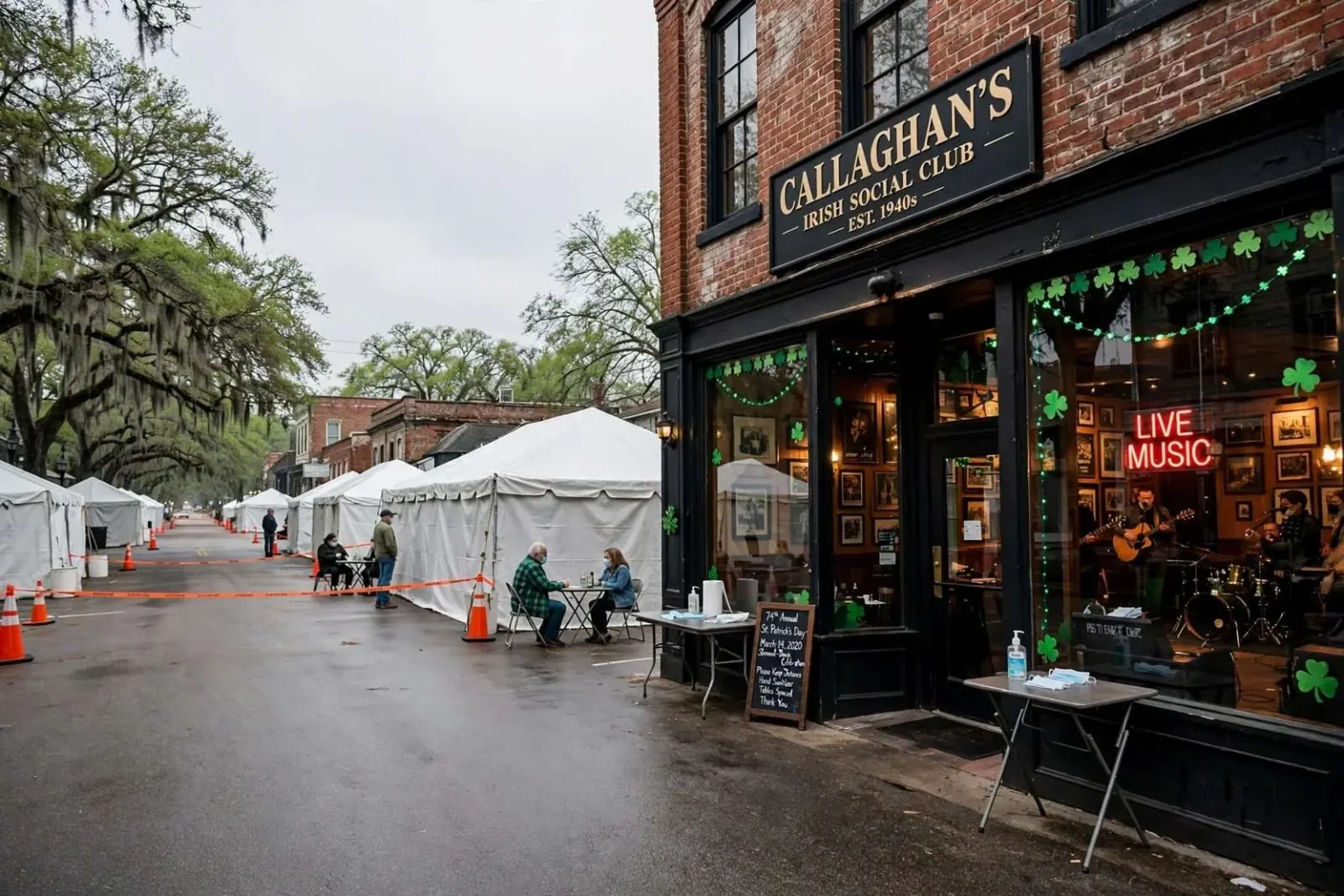
Mobile’s famed Callaghan’s Irish Social Club held its 74th annual St. Patrick’s Day party on Saturday — but the coronavirus state of emergency forced a celebration that looked nothing like the block parties of years past. Instead of the usual sea of green filling Old Shell Road from curb to curb, the 2020 edition unfolded on a narrow strip of asphalt with bands relocated indoors and crowds kept to a fraction of their normal size.
The changes came in direct response to the unfolding public health crisis. With Alabama operating under a coronavirus emergency declaration, the City of Mobile barred gatherings of more than 500 people, a threshold that would have been obliterated within minutes at a typical Callaghan’s street party, which historically has drawn thousands of revelers to the block outside the beloved neighborhood bar and restaurant.
Owner John Thompson’s answer was to reconfigure the event rather than scrap it. He moved the musical acts inside the building, where bands normally play to a packed room during the annual celebration, and set tables on only a small slice of the street instead of taking over the whole block. Large empty tents lined the unused portion of the street, a striking visual reminder of the scale of the event that could not take place this year.
For longtime Mobile residents, the sight was jarring. Callaghan’s Irish Social Club has been a fixture of the Oakleigh Garden District for decades, and its St. Patrick’s Day party is one of the city’s most enduring neighborhood traditions, drawing families, regulars and visitors who plan their March calendars around it. The club has weathered wars, recessions and hurricanes over its long history, but the spring of 2020 presented a challenge unlike any before it.
The party also carried extra weight this year because of what had already been lost on Mobile’s events calendar. The coronavirus pandemic had upended the city’s signature celebration — Mardi Gras — with the remainder of the 2020 Carnival season curtailed just before its climax, and residents were still processing the shock of seeing months of tradition canceled in a matter of days. Thompson’s decision to press forward with a slimmed-down St. Patrick’s party, whatever the risks, stood out as a rare moment of normalcy in a season defined by cancellations.
“We Need to Pay the Vendors”
Thompson said the event takes six months of planning, and that canceling outright was not something he could do in good conscience to vendors, bands or staff. The weeks of preparation involve booking musical acts, arranging food and drink suppliers, coordinating with the city on street closures and staffing the venue for one of its busiest days of the year — commitments that carry real costs whether the party happens or not.
“We need to pay the vendors, we need to pay the bands, we need to pay the staff,” Thompson said. “If people can’t understand that, I’m sorry. I understand the health concerns — if they feel like they’re at risk, then I ask them not to come down.”
His comments captured the impossible position in which small business owners across Mobile and the Gulf Coast found themselves in March 2020. The emerging guidance from public health officials urged people to stay away from crowds, and many residents were doing exactly that. At the same time, restaurants, bars and music venues operate on thin margins, and the hourly workers, musicians and suppliers who depend on them had rent and grocery bills of their own.
The emergency declaration that triggered the gathering limits had cascaded through every sector of Mobile life. Schools and universities were announcing extended closures, churches were suspending in-person services, and major events across the region were being postponed or called off outright. Against that backdrop, even a reduced street party represented a gamble — both financial and, in the view of some critics, a public health one.
The scaled-back celebration captured the moment for Mobile businesses in March 2020. Thompson said he worried about his staff and neighboring establishments if the virus lockdown worsened in the days ahead, reflecting a concern that extended well beyond his own doors. Callaghan’s anchors a stretch of Old Shell Road that includes other locally owned restaurants, shops and businesses, many of which rely on the foot traffic that a major event brings to the neighborhood.
In the days surrounding the party, uncertainty deepened across Alabama. State and local officials were weighing further restrictions, and business owners everywhere were left to guess what the coming weeks would bring. For Thompson and his staff, each announcement carried the potential to shutter the club entirely, turning a one-day party question into an existential one for a business that had operated continuously since the mid-1940s.
The economics of a bar and restaurant in a pandemic were stark. Music venues in particular depend on packed rooms, and Callaghan’s is as much a listening room as a restaurant, hosting local and touring acts throughout the week. With bands moved indoors to a room that could no longer be filled, and tables spaced across a fraction of the usual footprint, the revenue math of even a successful night looked nothing like a normal St. Patrick’s Day.
A Tradition Nearly Eight Decades in the Making
Callaghan’s Irish Social Club opened in the years following World War II and has grown from a neighborhood social club into one of Mobile’s most recognized gathering places, known equally for its burgers, its live music calendar and its role as a civic living room for the Oakleigh Garden District. Its St. Patrick’s Day party, now in its 74th year, predates many of the city’s other spring traditions and has become a multigenerational event — attendees who first came as children now bring their own families.
The 2020 party will almost certainly be remembered less for its music or its corned beef than for the moment it documented. Photographs of empty tents standing over an unused street told the story of a city — and a country — caught between the pull of tradition and the urgency of a gathering storm.
For the vendors, bands and staff Thompson was determined to pay, the day delivered at least a measure of relief. Local musicians, whose spring booking calendars were evaporating as festivals and venues canceled en masse, collected paychecks they might otherwise have lost. Food and supply vendors fulfilled contracts they had spent months preparing for. And the club’s staff worked a busy shift on a day when so many of their peers across the hospitality industry were being sent home indefinitely.
Thompson’s message to anyone who felt unsafe was simple: stay home. To everyone else, the party went on — smaller, quieter and stranger than any of its 73 predecessors, but a lifeline for the people who make it happen every March.
As the weekend closed, the question hanging over Old Shell Road was the same one hanging over every business in Mobile: not how to hold this year’s party, but how to survive the months ahead. For one Saturday at least, Callaghan’s answered the way it has for 74 years — with the bands playing, the staff working and the doors open to the neighborhood it has served since the 1940s.
Health officials had spent the week urging communities nationwide to limit large gatherings, and Mobile’s 500-person cap reflected an effort to slow the spread of a virus that was still poorly understood at the time. Testing capacity in Alabama remained extremely limited, meaning the true scope of community transmission was unknown. That uncertainty shaped every decision made by event organizers, mayors and business owners across the state in the second week of March 2020.
The emergency declaration itself carried practical consequences beyond the gathering limit. It activated emergency response mechanisms across state government, freed up resources for public health agencies and signaled to residents that the situation was serious enough to alter daily routines. Grocery stores across Mobile and Baldwin counties reported empty shelves of staples as residents began preparing for extended disruptions, and hand sanitizer and cleaning supplies were in short supply throughout the region.
Hospitality workers felt the ground shift first. Bartenders, servers, musicians and kitchen staff across the Port City watched event after event vanish from the calendar, and with it, the shifts and gig income those events generated. In a tourism- and events-driven economy like Mobile’s — where Mardi Gras alone supports thousands of seasonal jobs each winter and spring — the loss of a single weekend can ripple through paychecks for weeks. The St. Patrick’s party, coming on the heels of a curtailed Carnival season, was for many workers the last reliable payday before an indefinite drought.
Against that backdrop, Thompson’s insistence on paying vendors, bands and staff read to many in the local hospitality community as an act of solidarity. The decision was not without controversy — some residents questioned holding any public gathering during a declared emergency — but Thompson acknowledged those concerns directly, telling anyone who felt at risk not to attend. Those who did come found a party stripped to its essentials: music inside the club, a few tables on the street, and the familiar faces of a neighborhood institution refusing to let a 74-year tradition lapse without a fight.
The days that followed would bring the lockdown Thompson feared. Bars and dining rooms across Alabama would soon be ordered closed to in-person service, and events of every size would disappear from the calendar for months. But on that Saturday in March 2020, Callaghan’s Irish Social Club gave Mobile one last block party — a slimmed-down, socially distanced echo of the celebration it has hosted every St. Patrick’s Day since the 1940s, and a fitting snapshot of a city standing at the edge of an unprecedented year.