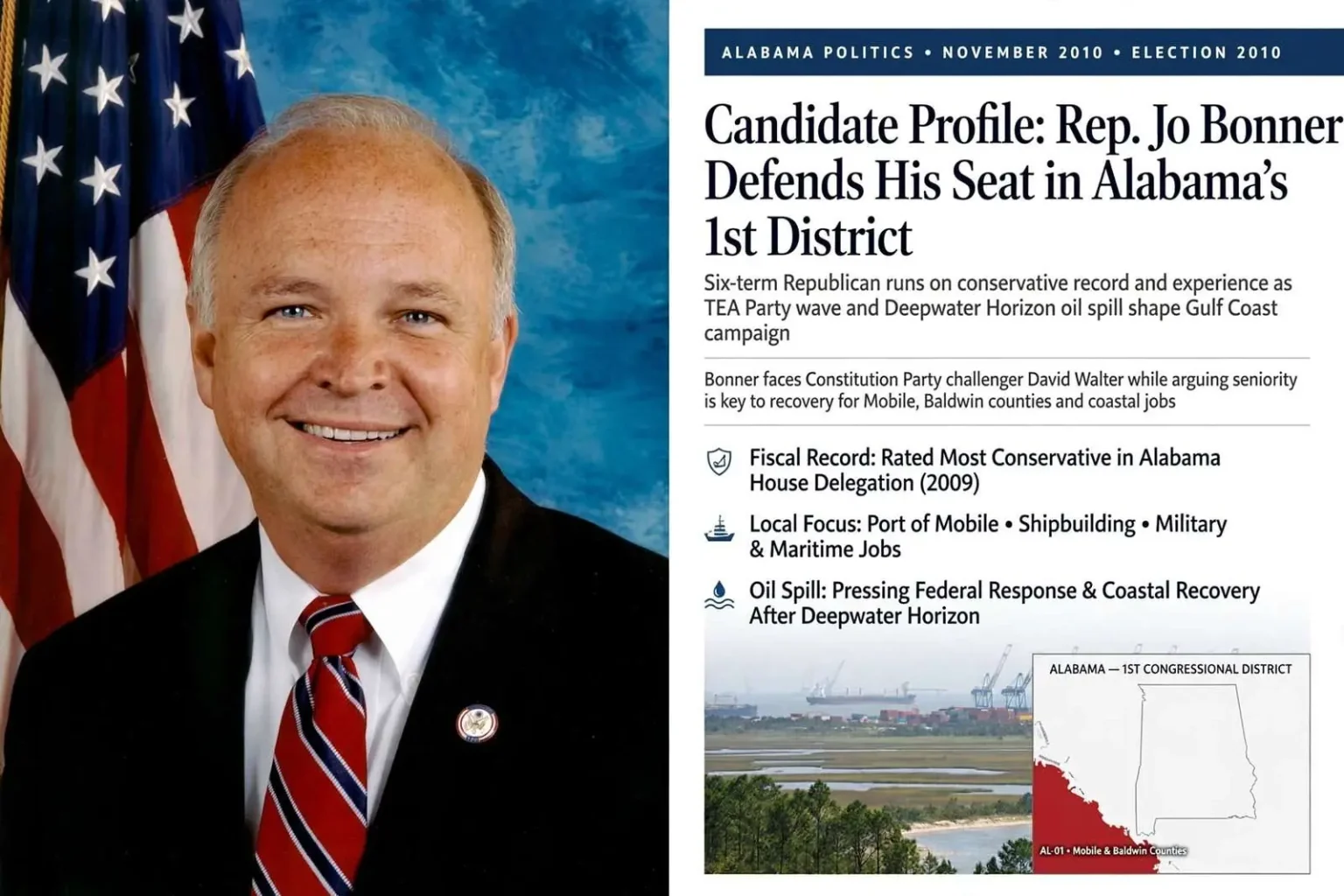
Heading into the November 2010 elections, six-term Republican Rep. Jo Bonner faced voters in Alabama’s 1st Congressional District with a closing argument built on his conservative record, and a warning that the country stood at a turning point.
The campaign’s case
In his campaign message, Bonner’s team framed the election as a response to Washington’s direction: rising federal debt, what they described as runaway spending and taxes, and the newly passed healthcare law. The campaign argued that a rejuvenated Republican Party, joined by energy from the TEA Party movement, was positioned to reverse that course at the ballot box, calling it a second American revolution “without bullets or blood.”
The message aligned Bonner with the national mood of 2010, a year when frustration over the economy, the federal deficit and the Affordable Care Act animated voters across the South. In southwest Alabama, that frustration landed in a district where military installations, shipbuilding, agriculture and timber made federal spending a daily concern, and where the Republican primary had already served as the outlet for much of the year’s grassroots energy. Bonner emerged from that primary fight with his party’s nomination secured, and the general election campaign became an argument for experience and consistency rather than change.
Bonner’s own record was presented as proof of his credentials. His campaign noted he was rated the most conservative House member from Alabama for his 2009 votes, cited top marks from groups including the U.S. Chamber of Commerce, the NFIB and the National Taxpayers Union for leadership on fiscal matters, and pointed to his support for a federal balanced budget amendment. The campaign also highlighted a 100 percent rating from anti-abortion organizations and strong backing from gun-rights groups for his second amendment positions.
Each of those ratings pointed at a specific argument. The Chamber and small-business endorsements reflected a pro-business, anti-regulation voting pattern that played to the district’s shipyard workers, farmers and port interests. The balanced budget amendment position let him attack deficit spending with a concrete proposal, and the social-conservative ratings closed off any attempt to paint the incumbent as a Washington moderate.
The race
Bonner argued that south Alabama already had an engaged representative respected on both sides of the aisle for his stands on smaller government, fewer regulations and lower taxes, and that economic and military strength remained essential in confronting terrorism.
That closing argument leaned on seniority as much as ideology. A sixth term would place Bonner deeper into the House’s committee structure at a moment when Alabama’s Gulf Coast had pressing federal business: the recovery from the Deepwater Horizon oil spill, which had damaged the coast’s tourism and fishing seasons that summer; the future of shipbuilding and the Navy’s presence at the region’s yards; and the federal response to the recession, which had pushed unemployment across the district to levels residents had not seen in decades. An incumbent who had served since 2003 argued, in effect, that seniority would let him defend those interests better than a newcomer could.
He faced Constitution Party nominee David Walter, a Baldwin County businessman and Vietnam-era Marine making his first run for office, in the general election.
Walter’s candidacy gave conservative voters a choice further to Bonner’s right, running under the banner of a party built on constitutional limits and a smaller federal footprint. A first-time candidate with no campaign apparatus to match an incumbent’s, he represented the same anti-establishment current that had energized the primaries, though his path to victory against a six-term congressman with the Republican nomination was a steep one in a district where the GOP nomination was effectively the prize.
The district and the year
Alabama’s 1st District stretches across the state’s Gulf Coast and its southwestern corner, taking in Mobile and Baldwin counties along with a band of largely rural counties to the north. Its economy runs on the port of Mobile, the tourism and fishing industries of the barrier islands, shipbuilding, chemical and paper manufacturing, and the pine timber belt, all of which give the district’s politics a practical, business-minded conservative flavor.
November 2010 delivered a Republican wave nationally, with the party retaking the House on a wave of voter frustration with the economy and the new healthcare law. Alabama matched the pattern: the state’s congressional delegation emerged entirely Republican, and incumbents like Bonner were returned with comfortable margins. The TEA Party energy that the campaign’s message invoked was rewarded across the state’s ballot, and the election marked a generational shift in Alabama’s Washington representation.
Who Jo Bonner was when the votes came in
Bonner had entered Congress in 2003 after more than a decade in Alabama politics and government service, and he built his tenure around the issues his campaign emphasized: fiscal restraint, support for the district’s military and maritime industries, and constituent service that kept him visible from Mobile to the Florida line. Colleagues in both parties knew him as a workhorse on appropriations matters affecting the Gulf Coast, a reputation that mattered in a district where federal projects, from harbor dredging to military construction, are economic mainstays.
The 2010 campaign’s “second American revolution” language captured the rhetorical temper of the year, but the profile’s substance was continuity. Bonner asked the district for another term on the strength of the record he had already built, betting that voters in a changing political climate would reward the incumbent whose votes already matched their values. The election that November would test exactly that proposition, in a year when incumbents everywhere were running against the mood of their own capital.
For south Alabama voters, the choice on the ballot came down to that record against a first-time challenger’s argument for something different, in a district that had sent the same party’s nominee to Washington for decades. The campaign’s final argument, that the country stood at a turning point and the district already had a representative positioned for it, was the message Bonner carried into Election Day.
The oil spill summer that shadowed the campaign
No issue hung over the 2010 race in the district more heavily than the Deepwater Horizon disaster. The April explosion off Louisiana sent oil drifting toward Alabama’s beaches through the spring and early summer, closing fishing grounds, emptying hotels during the height of tourist season and putting thousands of coastal residents out of work just as the election year heated up. Bonner spent the summer pressing federal agencies on response operations, claims processing and the long-term restoration of the coast, and the episode became part of his closing argument that experience in Washington translated into leverage for the district.
The spill also reshaped the district’s political conversation. Residents watched claims offices open across Mobile and Baldwin counties, debated the moratorium on deepwater drilling and argued over how the compensation fund would treat the businesses whose losses were hardest to document. For a coastal congressman, the crisis offered both a test and a platform, and both campaigns had to address how the recovery would be managed in the years ahead.
The TEA Party current
The TEA Party movement that Bonner’s campaign invoked had grown out of town halls and tax-day rallies across the district in 2009 and 2010, and it had already left its mark on the Republican primary, where challengers argued that the incumbent had spent too long in Washington. The movement’s concerns, the deficit, the healthcare law and what activists described as executive overreach, mapped closely onto the closing message Bonner’s team settled on, which was no accident: in a district that leaned heavily Republican, the general election campaign was really an argument about which candidate best represented the year’s insurgent energy.
Bonner’s answer was the ratings and the record. The most-conservative ranking among Alabama’s House delegation for 2009, the perfect score from anti-abortion groups and the strong marks from fiscal watchdog organizations were designed to show that the incumbent had voted the movement’s values all along, even before the movement had a name. The “without bullets or blood” line, borrowed from the campaign’s revolutionary framing, cast the election itself as the remedy, with ballots replacing confrontation.
What a sixth term would mean
Seniority is the currency of a House career, and the argument for a sixth term rested on the committee posts and relationships that accumulate with time. Alabama’s delegation, though small, has historically punched above its weight on defense and infrastructure matters, and the district’s economy, from the port to the shipyards to the military installations along the Gulf, depends on federal decisions made in exactly the rooms Bonner had spent eight years working.
The campaign’s closing case, in short, asked voters to weigh continuity against the national appetite for turnover. The record was conservative, the district was conservative, and the year rewarded the party whose brand Bonner carried. The question that remained was whether the anti-establishment current that had surfaced in the primary would carry into November, where his opponent stood to its right, or whether the incumbent’s experience would carry the day.